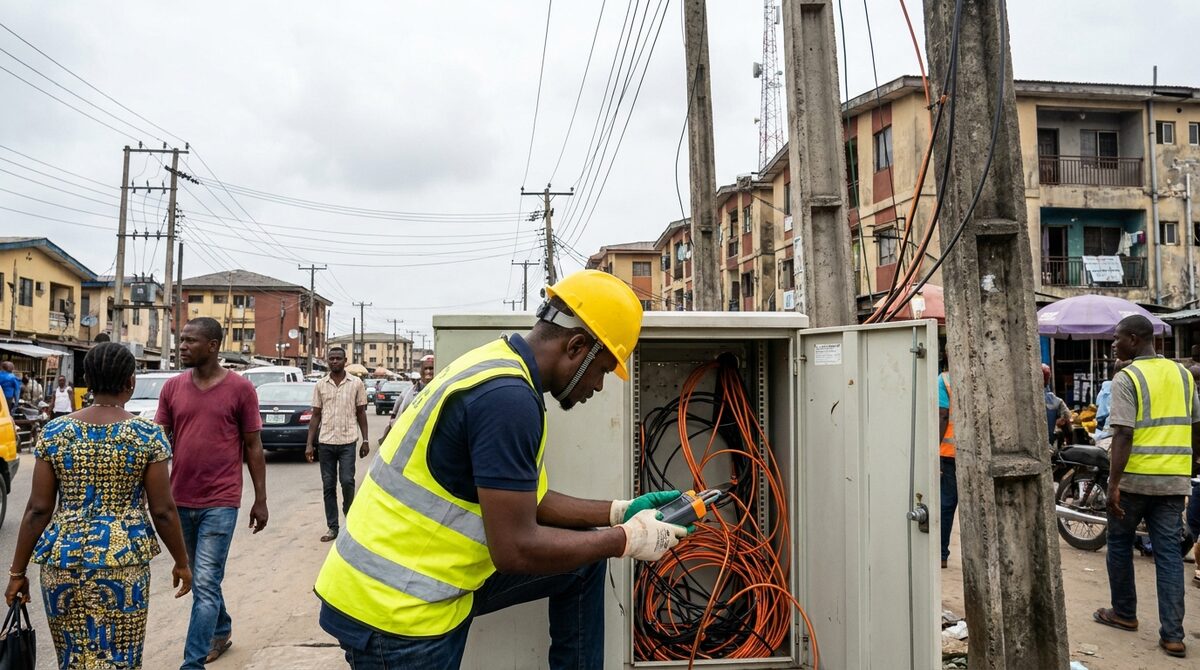
A Lagos connectivity firm just did something unusual: it funded fibre rollout through a domestic corporate bond
In a market where most investors sprint toward short-dated, high-yield instruments to outrun inflation, a Nigerian connectivity provider has convinced the capital markets to take the longer view. Dimension Data Limited closed the first tranche of a N20 billion (approximately US$14.7 million) bond programme in late July 2026, raising N4.05 billion — roughly US$2.9 million — to finance fibre network expansion across Nigeria.
The significance lies less in the headline figures, which are modest against the country's infrastructure deficit, and more in the mechanism itself: patient, domestically sourced debt capital being directed at physical telecommunications infrastructure, without a foreign development finance institution in sight.
Why the Instrument Matters as Much as the Money
Fibre rollouts are notoriously difficult to finance. The economics demand heavy capital expenditure upfront, years of incremental revenue build, and a tolerance for slow payback periods that most commercial lenders and equity investors find unattractive. Bank loans come with short tenors and pricing that rarely aligns with the long gestation of infrastructure projects.
Corporate bonds, structured correctly, can thread that needle. The Dimension Data raise was routed through a special purpose vehicle — Dimension Data SPV Limited — with Pathway Advisors Limited serving as lead issuing house and book runner. The SPV structure ring-fences the infrastructure assets and cash flows, a standard project finance technique that gives debt investors cleaner recourse and lenders a degree of insulation from broader corporate risk.
Pathway Advisors founder and chief executive Adekunle Alade acknowledged the fundraising environment was far from accommodating. High-net-worth investors who participated did so, he noted, despite a prevailing market bias toward shorter maturities — a preference driven by Nigeria's elevated inflation and persistently high domestic yields, which make long-dated commitments a harder sell in any pitch room.
The Demand Side: Fintechs, Banks and the Enterprise Appetite for Connectivity
Dimension Data's expansion target is the enterprise and financial services corridor — financial institutions, fintechs and large corporate customers whose operational reliance on cloud infrastructure, real-time payments and data-intensive applications has grown sharply in recent years.
This is not a consumer broadband story. The company is positioning itself within the business connectivity market, where uptime requirements are stringent, service level agreements are contractual rather than aspirational, and the customer willing to pay a premium for reliability exists in numbers large enough to generate bankable revenue projections.
Nigeria's fintech sector — one of Africa's largest by transaction volume and venture investment — is a particularly important demand driver. As digital payment platforms, neobanks and embedded finance providers scale, their infrastructure dependency deepens. Fibre reaching data centres, colocation facilities and enterprise campuses is not a peripheral concern for these businesses; it is load-bearing.
What Nigeria's Enterprise Connectivity Gap Actually Looks Like
- Uneven last-mile reach: Terrestrial fibre in Nigeria remains concentrated in Lagos and select urban corridors, leaving significant enterprise demand in secondary cities underserved or dependent on more expensive wireless alternatives.
- Data centre growth outpacing fibre density: A wave of hyperscaler and regional data centre investment in Lagos has intensified demand for fibre connectivity to and between facilities, tightening an already constrained market.
- Redundancy deficits: Many enterprise customers operate on single-provider fibre routes, exposing them to outage risk that more developed markets would consider unacceptable.
A Two-Year Road to Closing
The signing ceremony on July 27, 2026 marked the end of what Shatse Kakwagh, managing partner of Mbavaa Partners and a director of the SPV, described as a two-year process. That timeline — from structuring through investor engagement to close — illustrates the friction involved in originating infrastructure debt in markets where the asset class remains relatively nascent.
Kakwagh was careful to frame the N4.05 billion not as an arrival but as a starting point. The programme architecture allows Dimension Data to draw down further tranches as construction milestones are met, meaning the N4.05 billion first close is the opening chapter of what could become a substantially larger capital deployment if subsequent tranches are successfully raised.
Whether they are will depend partly on how the first tranche of capital is deployed and whether the network expansion it finances produces the revenue visibility needed to underwrite the next round of investor conversations.
The Broader Pattern: Local Capital Filling an Infrastructure Finance Gap
Africa's telecommunications infrastructure has historically been funded through a combination of multilateral development bank lending, development finance institution equity, and the balance sheets of large pan-African operators. That model has delivered meaningful progress — undersea cable systems, tower rollouts, early fibre backbone — but it has left last-mile and enterprise-grade fibre build-out chronically underfunded.
The Dimension Data transaction, small as it is in absolute terms, represents a different model: a local operator going to the local capital market with a structured instrument and making the case to domestic investors. The investors who participated are Nigerian high-net-worth individuals choosing infrastructure debt over the government bills and treasury instruments that dominate most of their portfolios.
That choice, repeated at scale and across multiple issuers, would represent a meaningful shift in how African telecommunications infrastructure gets financed. It would reduce dependence on foreign capital flows, which are subject to global risk sentiment and currency volatility, and build a domestic institutional market for infrastructure paper.
The N20 billion programme is, in that context, an experiment worth watching — not because the numbers are large enough to matter on their own, but because the template it is testing could matter considerably if it proves replicable.
Managing Director's Framing: National Digital Infrastructure, Not Just Corporate Growth
Olugbenga Olabiyi, managing director of Dimension Data Limited, positioned the raise in explicitly national terms, describing the company's work as strengthening Nigeria's digital economy and building infrastructure that enables business activity, innovation and what he called national digital transformation.
That framing is partly rhetorical — companies financing their own growth routinely reach for public-benefit language — but it also reflects a real alignment of interests. Nigeria's ambitions around digital public infrastructure, financial inclusion and technology-sector job creation all run on physical connectivity. A fibre network that serves enterprise customers today creates the backbone capacity that wider digital services depend on tomorrow.
What to Watch Next
The first test will be deployment: how quickly Dimension Data translates the N4.05 billion into installed fibre, and whether the customers who have been identified as the target market convert into contracted revenue at the pace the bond's repayment schedule requires.
The second, more consequential test will be whether subsequent tranches of the N20 billion programme close. A successful second draw would validate the structure, demonstrate investor appetite for the asset class and begin establishing a track record that could support future issuances — by Dimension Data or by other operators watching this transaction.
Regulators and capital market participants will also be observing how the SPV structure performs under Nigerian securities law, and whether the model offers a replicable blueprint for other infrastructure categories facing the same financing constraints: rural broadband, power distribution, water and sanitation.
The fibre underneath Nigeria's technology economy has always been the unglamorous prerequisite for the applications and platforms that attract headlines and venture capital. Getting the financing architecture right for that layer — and proving that domestic capital markets can provide it — may be a more durable contribution than any individual network build.