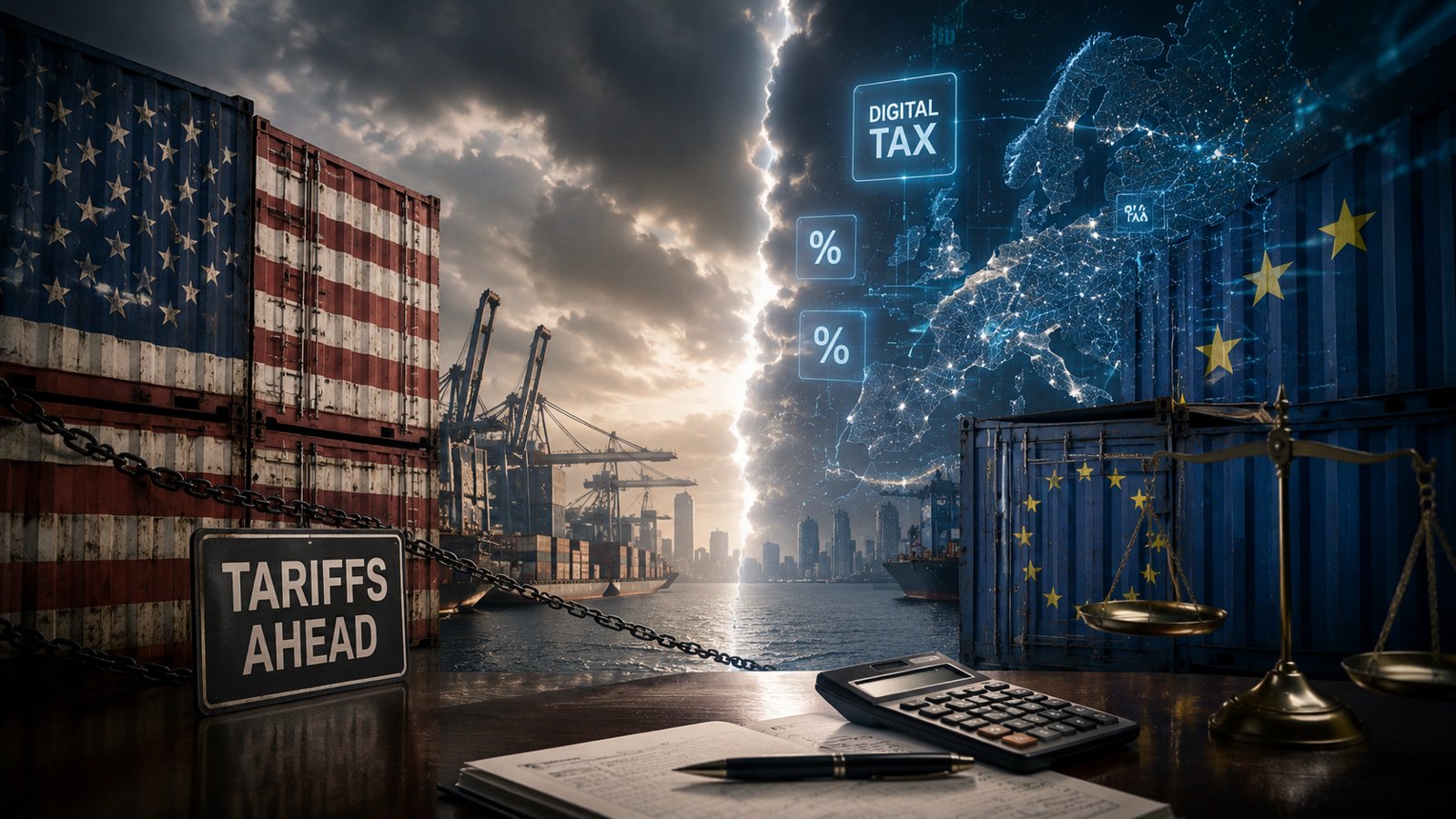
A 100% tariff. That is the number Donald Trump put on the table this week for any European country that dares tax American tech companies.
The US president made the threat on his Truth Social platform on June 27, 2026, warning that "numerous European countries" had been discussing — and some were close to actually introducing — digital services taxes targeting US technology giants.
"Please let this statement serve to represent that any Country that imposes such a Tax will immediately be met with a 100% TARIFF on any and all Goods sent to the United States of America," Trump wrote on Truth Social.
Trump added that these penalties would kick in immediately and would completely "supersede" any existing bilateral trade agreements — a pointed escalation given the US and EU had only just finalised a new trade deal days earlier.
The UK's £800 Million Problem
Britain's position in all of this is particularly complicated. The UK has had a 2% Digital Services Tax (DST) in place since 2020, targeting major search engines, social media platforms, and online marketplaces with global revenues from their digital businesses exceeding £500 million, and total UK revenues above £25 million.
That tax directly hits some of the biggest names in US tech — Apple, Google, Meta, and Amazon. According to the UK Treasury, it raised more than £800 million in 2024–25, up from £678 million in 2023–24. Trump's post explicitly targets nations planning the "imminent implementation" of new levies, leaving the precise implications for the UK unclear.
This is not Trump's first shot across London's bow. Back in April, he said the UK faced "a big tariff" for purportedly targeting major US companies. "They think they are going to make an easy buck, that is why they have all taken advantage of our country," he said at the time. The UK's Department for Business and Trade and the Treasury had both been contacted for comment at the time of publication.
France, Italy, Spain Also in the Crosshairs
France, Italy, and Spain each impose a 3% digital services tax on large companies operating within their borders, according to Tax Foundation, a nonprofit organisation focused on tax policy. Several other EU nations have either implemented or proposed similar levies.
The timing of Trump's threat is notable. Michael Damianos, Cyprus's Minister of Energy, Commerce and Industry, had said during the US-EU trade deal announcement that "the EU can respond swiftly and proportionately when the deal is not respected or its interests are at stake." That statement now reads as something of a warning.
Amazon Already Passing Costs On
The commercial fallout from these taxes is not theoretical. Amazon earlier this year raised its fees on third-party sellers, explicitly citing digital services taxes as a reason. That kind of cost pass-through affects not just European merchants but sellers globally — including across Africa — who rely on the platform to reach international buyers.
Trump's broader tariff push has been aggressive since he returned to the presidency in 2025. The US Supreme Court struck down his earlier attempt to impose a blanket global tariff of 10% in February. That has not slowed him down — the US has since announced new tariffs of 10–12.5% on dozens of countries, citing concerns over forced labour practices.
Whether Europe blinks or retaliates will shape the future of how governments everywhere — including in Africa — can tax the world's most powerful tech companies without triggering an economic firestorm from Washington. The stakes, it turns out, are a lot bigger than a 2% levy.