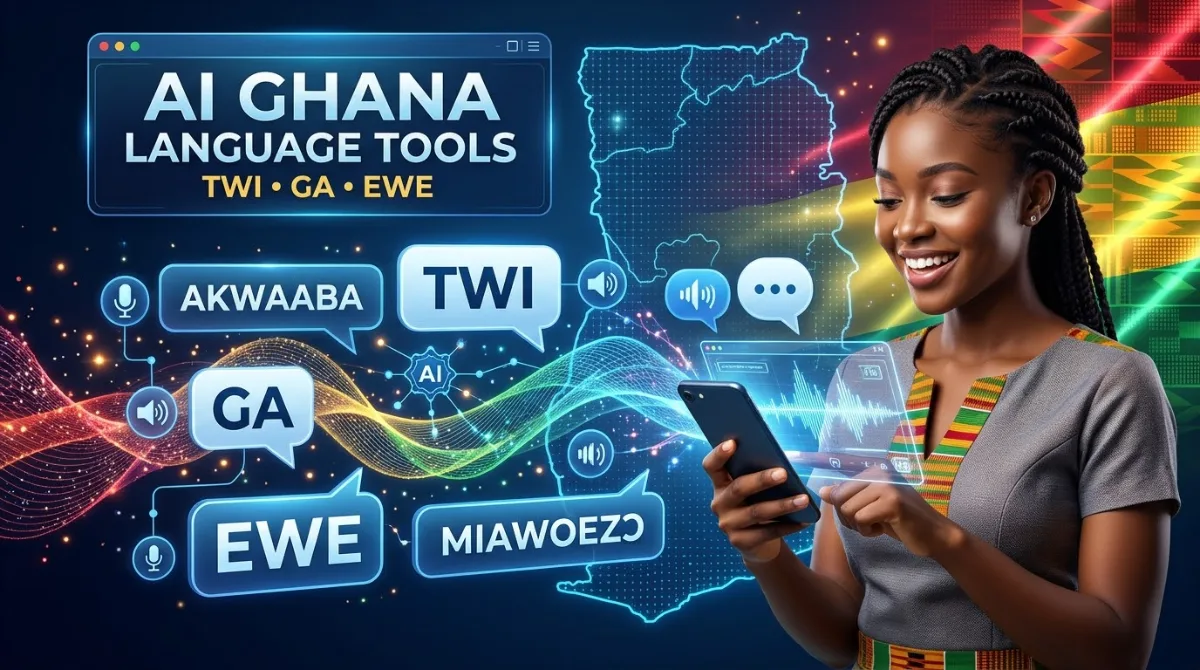
Ask ChatGPT to greet someone in Twi and it'll give you a decent shot. Ask it to translate a Ghanaian proverb — something with cultural weight — and it'll probably miss the point entirely. That gap between what looks like it works and what actually works is what this guide is about.
Twi, Ga, and Ewe are spoken by millions of people in Ghana and beyond. But for AI systems built on the kind of massive text datasets that make tools like ChatGPT fluent in English or French, these languages are what researchers call low-resource. That's not an insult — it just means there isn't much labelled data for the models to learn from. And that matters enormously to the quality you get.
So let's go through what's actually available, language by language and tool by tool.
Google Translate: The Starting Point for Most People
Google Translate is free and it's on everyone's phone. That's why it's the default. But you need to know what you're getting.
Twi was added to Google Translate in 2022 as part of a batch of 24 new languages, using a technique called Zero-Shot Machine Translation. In 2022, Google added 24 new languages using Zero-Shot Machine Translation, where a model learns to translate without ever seeing an example — and that addition included Twi and nine other African languages.
Ga was added later, in a bigger rollout. The Ga language is among 110 languages added to Google Translate in one of the platform's largest expansions ever, with about a quarter of the new languages coming from Africa — including Fon, Kikongo, Luo, Ga, Swati, Venda, and Wolof.
Ewe has been in Google Translate for a while too. So in theory, you've got all three. In practice, the quality varies a lot.
For simple, everyday phrases in Twi, it handles things reasonably. Google's model treats Asante Twi and Akuapem Twi as one language, which creates spelling inconsistencies. That matters because a native speaker will immediately notice when the dialect is off. The Akan Orthography Committee (under the Bureau of Ghana Languages) updated Twi spelling rules in 2020, but Google Translate still uses the older 1978 orthography for some words.
Ga fares worse. For Ga and Ewe, the numbers drop further: Ga hovers around 55–62% accuracy, while Ewe manages 48–60%. Those are rough benchmarks, not official figures, but the direction is clear: the further you get from Twi, the shakier things get.
One useful thing: Google Translate works offline if you download the language pack in advance (Settings → Offline translation → Download Twi/Ga/Ewe). If you're in an area with patchy MTN or Telecel data, that's worth doing ahead of time.
ChatGPT and Claude: Powerful but Patchy on Ghanaian Languages
These two are the biggest general-purpose AI tools most people are using in 2026. Both have free tiers and paid plans (around $20/month for Plus or Pro, as of November 2026 — confirm current pricing before you subscribe).
For Twi, they can do some things well. ChatGPT and Claude can translate basic Twi sentences but fail on idioms, proverbs, and tone-dependent words. That's the honest summary. Short, simple text? Passable. Anything culturally layered? Don't rely on it.
Asking ChatGPT or Claude to write original text in Twi produces grammatically shaky output that native speakers will flag immediately. So if you're trying to draft a Twi social media post or a message to your grandmother and you want it to actually sound right — get a native speaker to review it. Use these tools to get a first draft, not a final product.
For Ga and Ewe, the gaps get bigger. These are languages with significant tonal complexity. Recognising spoken Twi or Ga is a harder problem than translating written text because of tone, dialect variation, and the absence of large labelled audio datasets. General AI models like ChatGPT weren't trained with enough Ga or Ewe data to handle nuance. What you get is a rough approximation at best.
Voice Mode? Not for These Languages
This one trips a lot of people up. ChatGPT has a voice mode. It doesn't mean it understands Twi when you speak it. OpenAI Whisper (the model behind ChatGPT's voice mode) does not officially support Twi, and ChatGPT voice does not support Twi as of April 2026.
Google Assistant in Ghana, similarly, does not understand Twi if you speak slowly — it only processes English.
Siri is the same situation. No commercial Twi voice assistant exists in Ghana as of April 2026; Google Assistant and Siri remain English-only.
Khaya AI: The Most Serious Tool Built for This
This is where it gets more interesting. Khaya AI was built by Ghana NLP and Algorine specifically to serve Ghanaian and other African languages. It's not a Western company that bolted on Twi as an afterthought.
Khaya was the first translation app for Ghanaian languages relying on Artificial Intelligence, and it has since expanded to other African languages such as Nigerian Yoruba, as well as Kenyan Kikuyu, Kimeru and Luo.
What it actually does: it includes Automatic Speech Recognition (ASR) capabilities for Twi, Ewe, Yoruba, Ga, and Dagbani — you can speak directly to your phone and the app will transcribe your speech into text — and it can do text-to-speech (TTS) pronunciations for Twi, Ewe and Kikuyu.
Ghana NLP's Khaya model is described as the most accurate open-source Twi translator available today. That's a meaningful claim — but keep in mind the bar for Ghanaian language AI is still being raised. It's the best available, not perfect.
You can also submit improved translation corrections and recommendations directly from the app, so the technology gets better over time from community feedback. That's actually a smart approach for a low-resource language — users help train the model.
Khaya is available on Android and iOS. If you're a developer building something in a Ghanaian language, this is your starting point. Check khaya.ai for current API documentation and pricing.
Abena AI: Text-to-Speech for Twi and Ewe
If what you need is voice output — say, you want text read aloud in Twi — Abena AI (at abena.mobobi.com) is worth knowing about. Abena AI generates natural-sounding audio in Twi, Ghana Pidgin, Yoruba, Swahili, Hausa, Ewe and more, with speech options available in Twi, Yoruba, Hausa, Ewe, Swahili, Ghanaian and Nigerian Pidgin, and English accents.
It also handles accurate special characters like ɛ, Ɛ, ɔ, Ɔ for Twi and dotted letters for Yoruba — which matters a lot for Ghanaian languages where those characters change the meaning of a word entirely.
There's a free playground on the site. It's worth trying before you decide if you need anything more. No Ga TTS support there at the time of writing — check the site directly to see what's current.
Kasahorow: A Ghana-Based Language Tech Option
Kasahorow is a Ghana-based language tech startup offering Twi, Ga, Ewe, and Hausa translation tools. It's been around for a while and has focused specifically on Ghanaian and broader African languages. If you want to support homegrown tech and get a tool that understands the local context, it's worth checking out at kasahorow.com. Confirm what's free and what's paid directly on their site.
What's Coming: Google + University of Ghana Partnership
The situation is improving. There's a real pipeline of work happening that should make Ghanaian language AI significantly better in the next few years.
The University of Ghana is partnering with Google and the Global Disability Innovation Hub to develop speech recognition and AI tools in Ghanaian local languages, with Google working closely with the University of Ghana and GDI Hub to advance tools for Twi, Ewe, and Dagbani, with a strong focus on non-standard speech to improve accessibility.
The initiative forms part of Google's $37 million investment in Africa and includes the development of speech recognition systems and AI tools in Ghanaian languages — tools also being designed to recognise non-standard speech to make digital learning more accessible.
Google has also assured Ghana's Ministry of Education that the tools will be deployed on a zero-rated basis, allowing learners to access the platforms without data charges. If that holds, it's genuinely significant for access — especially outside Accra.
Ga didn't make the initial announcement for this partnership. The Minister for Education also pushed for the inclusion of Hausa, one of the most widely spoken languages in Ghana and across West Africa, in the AI tools being developed. So there's advocacy happening for broader language inclusion.
Why These Languages Are Hard for AI
It's worth understanding the root issue, because it explains why some tools will always struggle with tone-based languages.
Artificial intelligence learns by studying large collections of text and sound — what experts call a language corpus. Without it, AI cannot translate or process Twi, Ewe, or Ga effectively.
Ewe is a particularly tough case. Ewe is a tonal language where three words can differ only by tone — something that written text often doesn't fully capture, and something that current AI models handle poorly compared to how they handle, say, French or Spanish.
Twi has the most data available of the three, which is why it consistently performs better across all tools. Recognising spoken Twi or Ga is a harder problem than translating written text because of tone, dialect variation, and the absence of large labelled audio datasets — and while Ghana NLP and Google's African Languages Initiative have made progress, accuracy is still below what most production applications need.
Quick Guide: Which Tool for What
- Getting the gist of a Twi text message: Google Translate (free, works offline)
- Translating written Twi, Ga or Ewe more accurately: Khaya AI (free tier available, khaya.ai)
- Text-to-speech in Twi or Ewe: Abena AI (abena.mobobi.com) or Khaya
- Writing a first draft in Twi (to be reviewed by a native speaker): ChatGPT or Claude — cautiously
- Building an app that needs a Ghanaian language API: Khaya AI's API or Ghana NLP's open-source models
- Voice commands or voice assistants in Twi/Ga/Ewe: Nothing commercially available works reliably yet
- Professional or sensitive communication (health, legal, financial): Use a qualified human translator. No AI tool is reliable enough for this in 2026.
The honest takeaway: Twi has the best AI support of the three languages, Ga is the weakest, and Ewe sits somewhere in between. All three are vastly underserved compared to what speakers of major European languages get from the same tools.
That's not a permanent state. The University of Ghana partnership with Google, the ongoing work at Ghana NLP, and tools like Khaya and Abena AI all point in the right direction. But right now, in November 2026, check what a tool actually does before you trust it with something that matters.
Sources
- TRT Afrika — Ghana to develop AI tools in Twi, Ewe, Dagbani languages
- Asaase Radio — Ghana to roll out AI education tools in Twi, Ewe and Dagbani
- AllAfrica / Google — Google Translate Adds 110 New Languages Including Ga From Ghana
- Khaya AI — Official site (khaya.ai)
- Khaya AI — Pricing page
- ATIGSI — More African languages added to Khaya AI (July 2026)
- The Savanna Online — Khaya Language AI achieves new feat with more updates
- Abena AI — Text-to-Speech playground
- Modern Ghana — AI Translation: The Bridge Between Ghana's Languages and the Future
- JBKlutse — AI in Ghanaian Languages: Twi, Ga, Ewe (2026)