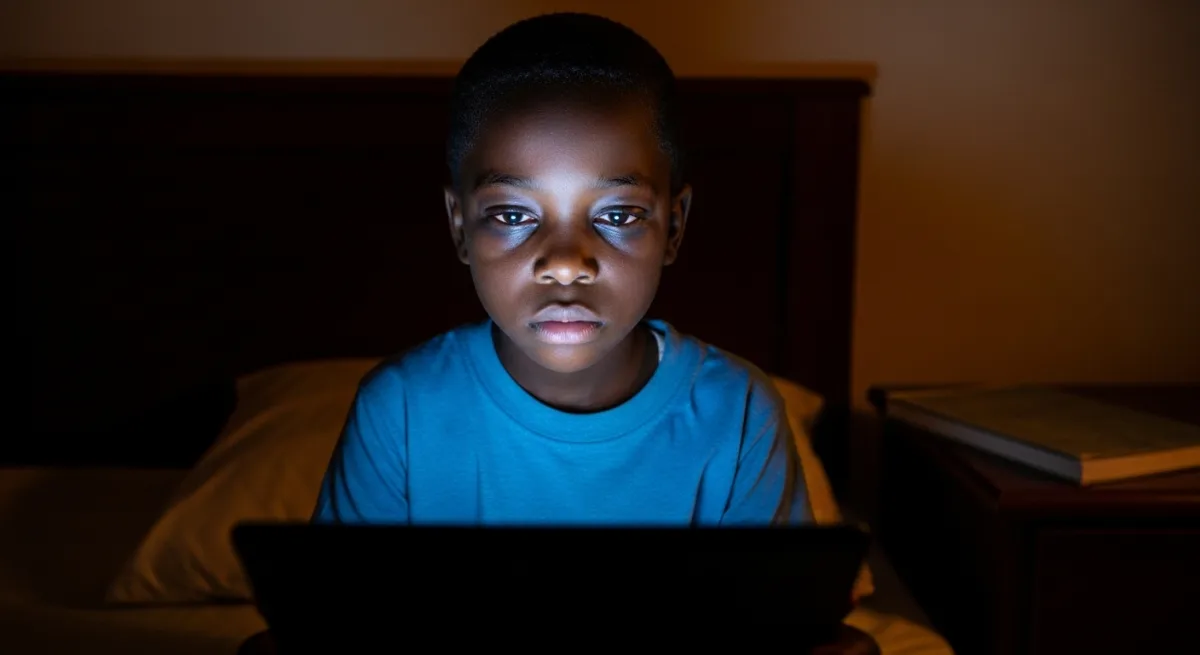
My neighbour's daughter is nine years old. She is sharp, funny, and can navigate YouTube faster than most adults. But last year, her teacher sent a note home. Not about behaviour. Not about grades. About reading. The girl could not finish a single page of a printed book without losing focus. She would re-read the same sentence three or four times, fidget, then give up.
Her mother thought it was a concentration problem. Took her to a doctor. The doctor asked one question: how many hours a day is she on a screen?
The answer was six. Sometimes seven on weekends.
Sound familiar? It should. Because what happened to that child in Accra is happening to millions of children right now — in Lagos, in Nairobi, in London, in Stockholm. And the science behind it has become impossible to ignore.
Sweden Tried It First. Sweden Is Now Undoing It.
In 2013, Sweden was the envy of the world's education ministers. Every classroom was paperless. Every child had a tablet. The government had spent years and billions building what it called the most digitally advanced school system on the planet. Education delegations flew in from across Europe — and from Africa — to copy the model.
Twelve years later, Sweden is doing something extraordinary. It is tearing the whole thing down.
By 2023, Swedish students were recording some of the steepest declines in reading comprehension ever measured in a developed nation. Teachers reported children who could not read a paragraph without scrolling instinctively. Concentration spans had collapsed. The PISA results — the global standard for measuring what 15-year-olds actually know — told a brutal story.
The Swedish government responded with action, not studies. It allocated $83 million to purchase physical textbooks for every student in every subject. It banned phones from classrooms. And starting in 2026, a full nationwide school phone ban takes effect for the entire school day.
"We went too fast and too far. The children paid the price for our optimism." — Swedish Education Minister Lotta Edholm, 2023
Norway and Denmark are studying how much screen time is appropriate in early schooling. The Netherlands moved to ban all mobile phones from schools. New Zealand is in the same conversation. These are not technophobic countries. These are the most digitally literate nations on earth — and they are collectively saying: we got this wrong.
The question is whether Ghana, Nigeria, Kenya and the rest of Africa will wait for our own crisis before we listen.
The Eyes Do Not Lie: A Global Myopia Epidemic
Before we get to brains and behaviour, let us start with something you can see — literally. The eyes of an entire generation are deteriorating at a rate that eye doctors describe, without exaggeration, as an epidemic.
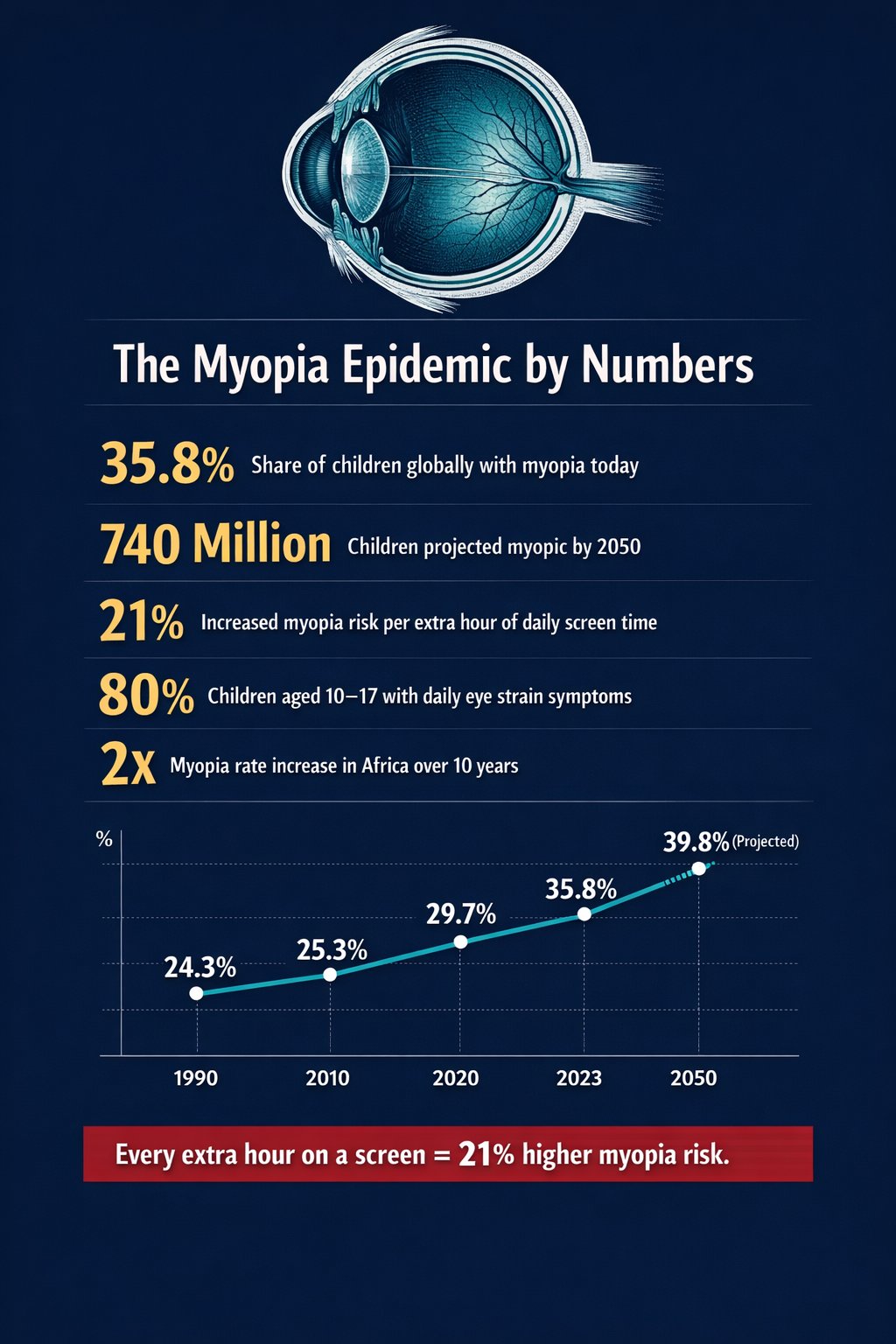
- 35.8% of children globally now have myopia — up from 24.3% just 30 years ago
- 740 million children projected to be myopic worldwide by 2050
- Every extra hour of daily screen time increases a child's odds of developing myopia by 21%
- 80% of children aged 10 to 17 already experience burning, blurry, or tired eyes from screen use
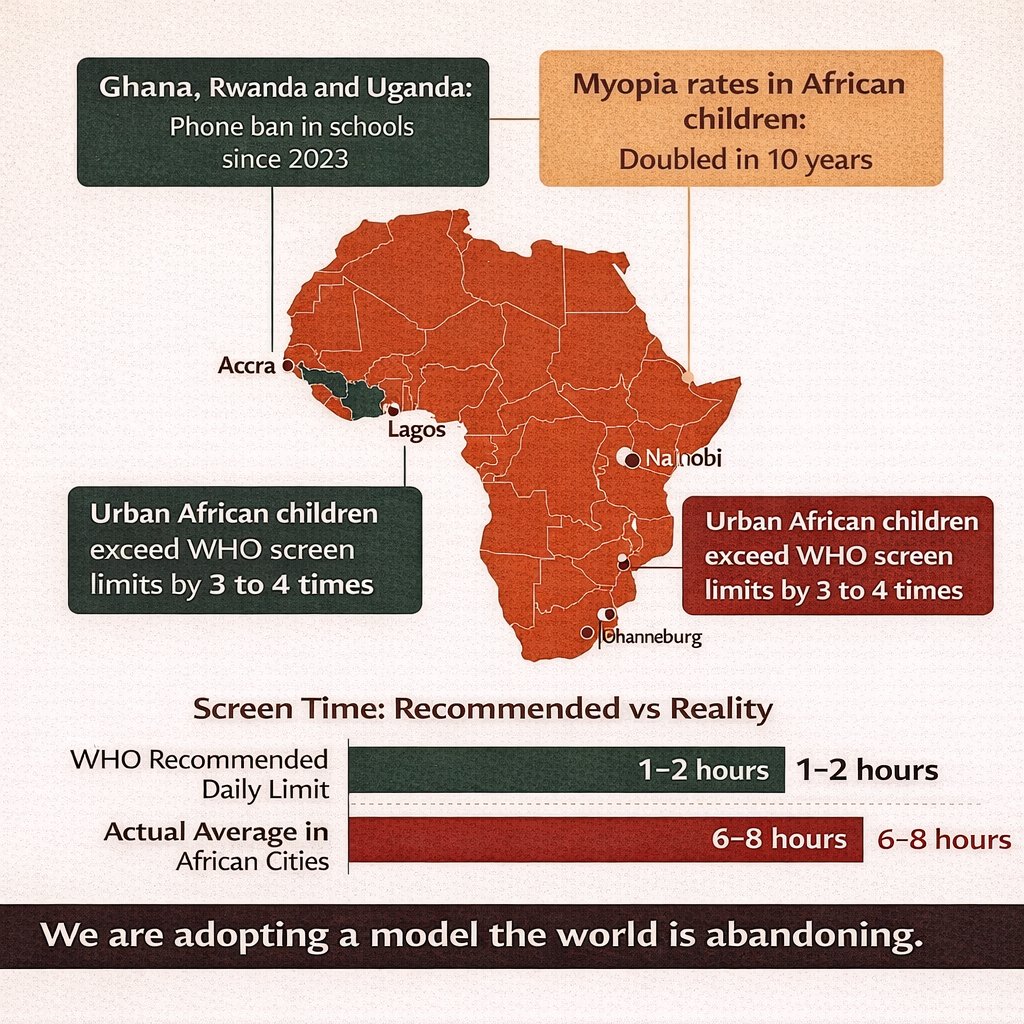
- Myopia rates in Africa have doubled in the past decade — driven by urbanisation and increased near-work
Myopia — short-sightedness — is not just an inconvenience. In its severe form, it is a leading cause of permanent vision loss. Children whose myopia develops young and progresses fast are at significantly higher risk of retinal detachment, glaucoma, and macular degeneration in adulthood.
The connection to screens is now backed by a meta-analysis of 45 studies covering over 335,000 participants, published in JAMA Network Open. Each additional hour of daily screen time was associated with 21% higher odds of developing myopia.
Why Near Work Destroys Distance Vision
When a child stares at a screen for hours, the eye muscles responsible for focusing on distant objects become undertrained. The eyeball itself — which in children is still growing — begins to elongate in response to constant close-range focus. Once elongated, it cannot return to its original shape. The damage is permanent.
Children's eyes are especially vulnerable because they are still developing. The lens, the retina, the muscles — all of it is in active formation during childhood. What we are doing with screens is essentially shaping that development in the wrong direction, and only discovering it when a child squints at a blackboard or fails a vision test.
What Is Happening Inside the Brain
The eye damage is visible. The brain damage is invisible — and in many ways, far more serious.
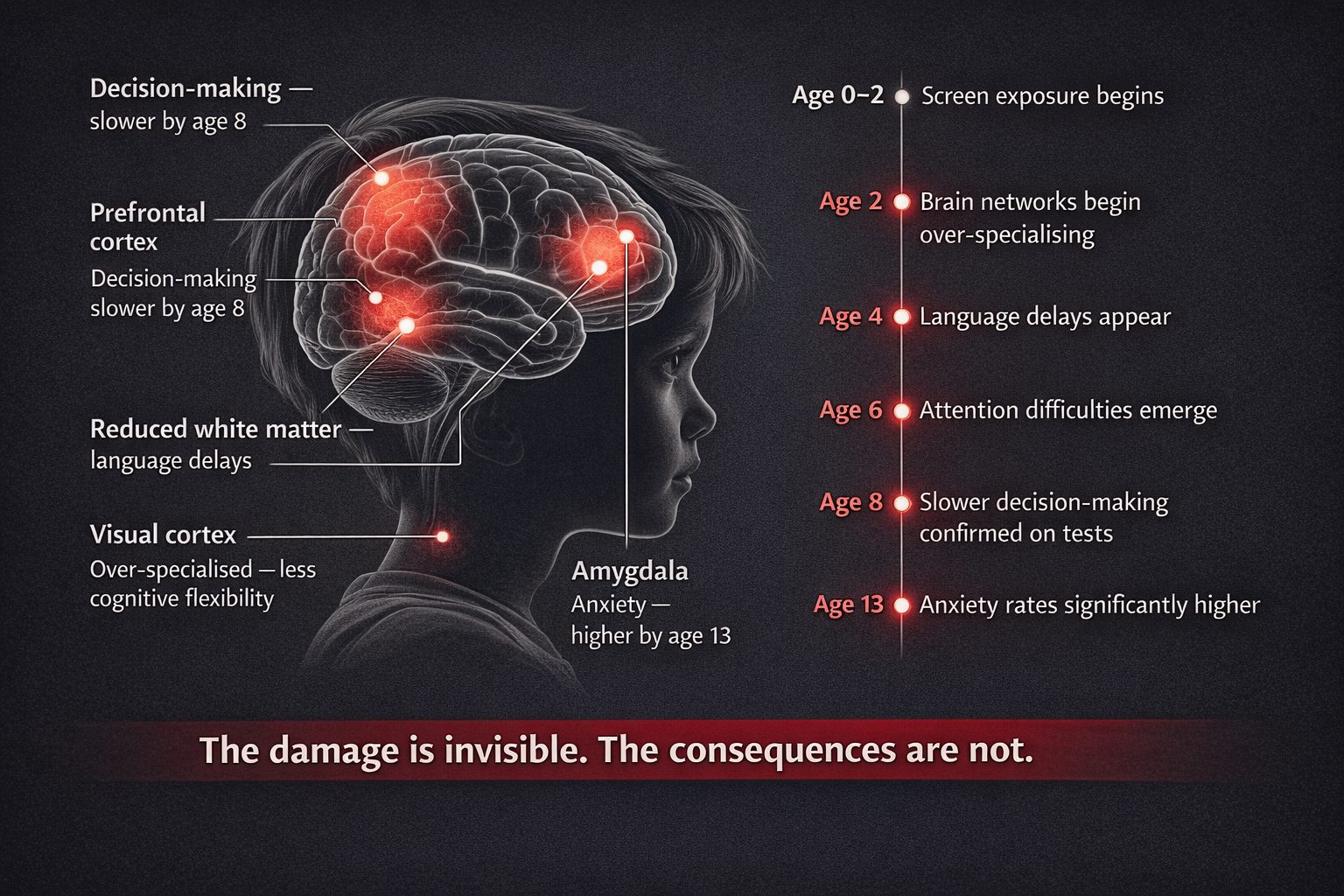
A landmark study tracking children for more than a decade found that high screen exposure before the age of two led to measurable, lasting changes in brain architecture:
- Premature specialisation in brain networks responsible for visual processing — the brain learned to process screens at the cost of broader cognitive flexibility
- Slower reaction times and decision-making by age eight
- Significantly higher rates of anxiety by age thirteen
- Reduced white matter integrity in the brain regions that support language acquisition and literacy
A child given a tablet at 18 months is not just being entertained. Their brain is being physically restructured — in ways that show up years later as anxiety, slower thinking, and difficulty with language.
The Attention Span Is Not Broken — It Is Trained
Here is what most parents misunderstand: your child's short attention span is not a disorder. It is a learned behaviour. When a child spends years consuming content that changes every 8 seconds — the average cut rate of YouTube Kids content — the brain literally learns to expect stimulation at that frequency.
A printed page does not refresh. A storybook does not autoplay the next chapter. So the brain, trained to expect constant new input, experiences the stillness of a page as boredom — and gives up.
"We are not raising a generation with attention problems. We are raising a generation whose attention has been systematically captured and monetised since infancy." — Dr. Jenny Radesky, University of Michigan, Developmental-Behavioural Paediatrician
The ABCD Study — the largest long-term study of brain development ever conducted, tracking over 10,000 children — found that children with more than two hours of screen time daily scored measurably lower on cognitive tests. Children with more than seven hours showed visible differences in brain structure on MRI scans.
Seven hours. Many Ghanaian children — and children across urban Africa — are at or above that number before factoring in school devices.
- Screen exposure before age 2 leads to slower decision-making at age 8 and higher anxiety at age 13
- Children with 7+ hours of daily screen time show visible differences in brain structure on MRI
- High screen use reduces white matter in language and literacy brain regions
- Fast-paced media trains the brain to expect constant stimulation — making stillness feel unbearable
- WHO recommendation: zero screen time under age 2. Maximum 1 hour per day for ages 2 to 4.
Paper Beats Screen. Science Is Now Certain.
For years, the debate over screens versus textbooks was treated as a matter of preference. The 2024 and 2025 research has largely closed that debate.
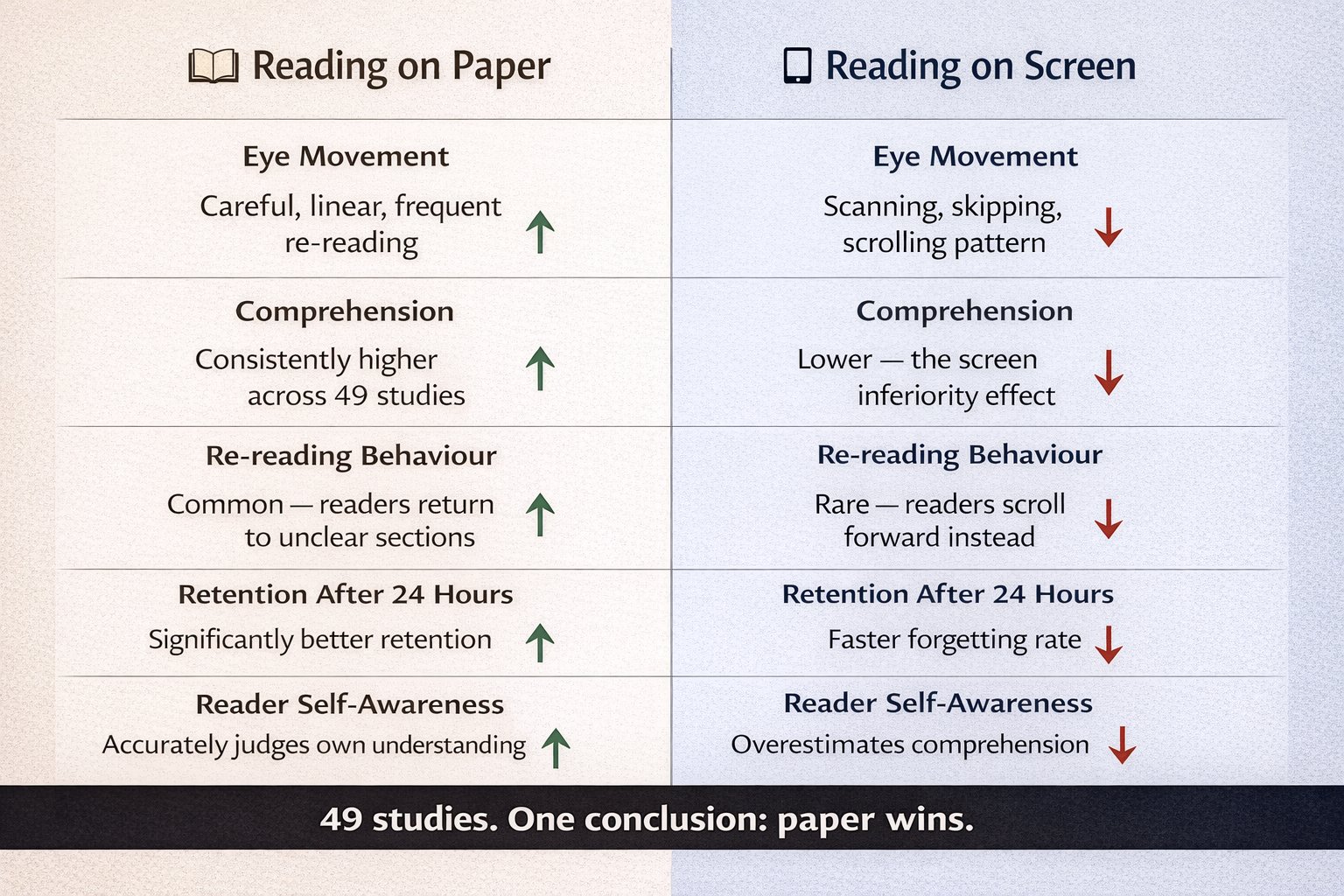
A meta-analysis of 49 studies found that students who read on paper consistently scored higher on comprehension tests than those reading identical material on screens. Researchers now call it the "screen inferiority effect."
Eye-tracking studies show why. When children read on paper, they slow down, re-read confusing sentences, and absorb. When children read on screens, they skim. They scroll. They pick up fragments. The brain processes screen text the same way it processes a social media feed — rapidly, superficially, without retention.
Perhaps most disturbing: the children did not know their behaviour had changed. They believed they had understood the screen text just as well. They had not.
This is why Sweden did not just ban phones from schools. It bought physical textbooks — millions of them — and put them back in classrooms. Not as nostalgia. As evidence-based education policy.
Africa Is Walking Into a Problem the West Is Walking Out Of
Here is the part of this story that should concern every Ghanaian parent, teacher, and policymaker reading this.
While Sweden is spending $83 million to return to paper, while Norway and Denmark are retreating from digital classrooms, while the Netherlands is banning phones from schools — African governments and schools are in the middle of a digital rush. Tablets in classrooms. Smart boards. E-learning platforms. The assumption is that digital equals modern equals better.
We are adopting, at scale and at speed, a model that the countries who invented it are now publicly abandoning.
Ghana, Rwanda, and Uganda have already banned phones in schools — a significant and correct step. But the broader conversation about screen time, brain development, and childhood vision health has barely started in our region.
Africa's Myopia Problem Is Already Here
Myopia rates among African children have doubled in the past decade. As urbanisation expands across the continent — more time indoors, more near-work, more screens — African children are developing myopia at accelerating rates. Previous global models underestimated myopia in sub-Saharan Africa. The real numbers are higher than projected. The trajectory is upward.
In a region where access to eye care is already limited — where a child in rural Ghana may wait years for a proper vision test — a preventable myopia epidemic is a public health crisis unfolding quietly, child by child, classroom by classroom.
The Urban African Child in 2026
Walk through any middle-class neighbourhood in Accra, Lagos, or Nairobi on a Saturday morning. The children are inside. They are on phones and tablets. The same children who a generation ago would have been outside — running, playing, building things — are now in their rooms, bathed in blue light, their eyes fixed at 30 centimetres for hours at a time.
Their parents hand them the devices out of love. To keep them safe. To reward good behaviour. To buy twenty minutes of quiet. Every parent reading this knows the feeling.
But those twenty minutes are adding up. And the bill is being delivered not to us, but to our children.
- Myopia rates among African children have doubled in 10 years
- Ghana, Rwanda and Uganda have banned phones in schools — but home screen time is largely unaddressed
- Rapid urbanisation means less outdoor time and more myopia risk for African children
- UNICEF 2025 found children across Sub-Saharan Africa spending more time on screens with little to no parental guidance
- In many African cities, children now exceed WHO-recommended screen limits by 3 to 4 times
The Sleep Problem Nobody Is Talking About
Blue light — the specific wavelength emitted by phone, tablet, and laptop screens — directly suppresses melatonin, the hormone that signals the body it is time to sleep. In children, whose melatonin systems are still developing, the suppression is even stronger than in adults.
A child using a screen in the hour before bed is not just staying up late. Their brain is receiving a hormonal signal that it is still midday. Their body does not begin preparing for sleep. When they eventually put the device down, they cannot fall asleep easily. When they do sleep, the quality is lower. They wake up unrefreshed. They go to school already behind.
Studies link poor sleep in children to impaired memory consolidation, reduced emotional regulation, weakened immune response, and lower academic performance. The biggest driver of poor sleep in children under 14, globally, is screen use in the hour before bed.
In many Ghanaian and African households, the phone sits on the bedside table, charging. Notifications light it up at 2am. The child stirs, checks it, and loses another 40 minutes of deep sleep they will never recover.
What You Can Do — Starting Tonight
I am not going to tell you to throw away every screen in your home. That is neither realistic nor necessary. What follows is a specific, research-backed set of changes that are achievable and make a measurable difference.
For Children Under 5
- Zero screens before age 2 — WHO guidance, backed by the brain development research above
- Ages 2 to 4: maximum one hour per day of high-quality, supervised content — not YouTube autoplay
- No screens during meals. No screens in the hour before bed. No screens in the bedroom.
- Replace screen time with outdoor time — at least 2 hours of outdoor exposure daily is the single most effective protection against myopia
For School-Age Children (5 to 12)
- Set a hard daily limit of 2 hours of recreational screen time
- Enforce the 20-20-20 rule: every 20 minutes of screen time, look at something 20 feet away for 20 seconds. Set a timer. Make it a habit.
- Buy one physical book per month. Read it together. Consistency matters more than length.
- Charge all devices in a common area at night — never in the child's bedroom
- Watch for early myopia signs: squinting, sitting closer to screens, frequent headaches, complaints of blurry distant objects
For Teenagers
- Commands do not work with teenagers. Share this research with them. Show them the Sweden story. Treat them as intelligent people who deserve to understand what is happening to their own biology.
- No-phone zones at dinner and in the bedroom after 9pm — frame it as a household rule, not a punishment
- Encourage one physical hobby away from screens: sport, music, drawing, cooking, anything
For Adults
- The screen inferiority effect applies to you too. If you are reading something you need to actually retain — print it out.
- Your own phone-before-bed habit is doing the same thing to your sleep that your child's is doing to theirs
- Your child is watching you. The most powerful screen time intervention is not an app or a parental control — it is a parent who puts their own phone down at dinner
The Real Question
Sweden built the future. Then it looked at what the future had done to its children's eyes, attention spans, reading ability, and sleep — and decided the future needed to be revised.
We do not have to make the same mistakes before we reach the same conclusions. The research is available. The evidence is substantial. The countries leading the digital reversal are not backwards — they are the ones honest enough to admit they moved too fast.
The child who cannot finish a page in Accra is not broken. The teenager who cannot sleep in Lagos is not lazy. The six-year-old in Nairobi who squints at the blackboard is not struggling academically. They are all responding, perfectly rationally, to an environment that was not designed for human development.
We designed that environment. We handed it to them. We can also choose to change it.
One Challenge. One Week. Start Tonight.
Pick one of these and do it without negotiation this week:
- No screens in the bedroom — for every person in the household, including you.
- Read one physical page with your child before bed instead of a screen.
- Two hours outside every day this week. No phones on the walk.
- Teach the 20-20-20 rule to your child today and set a recurring alarm to practise it.
You do not have to overhaul everything tonight. But you do have to start somewhere. Your child's eyes, brain, and sleep are not waiting for the perfect moment.
Share this article with one parent who needs to read it. The conversation starts with us.