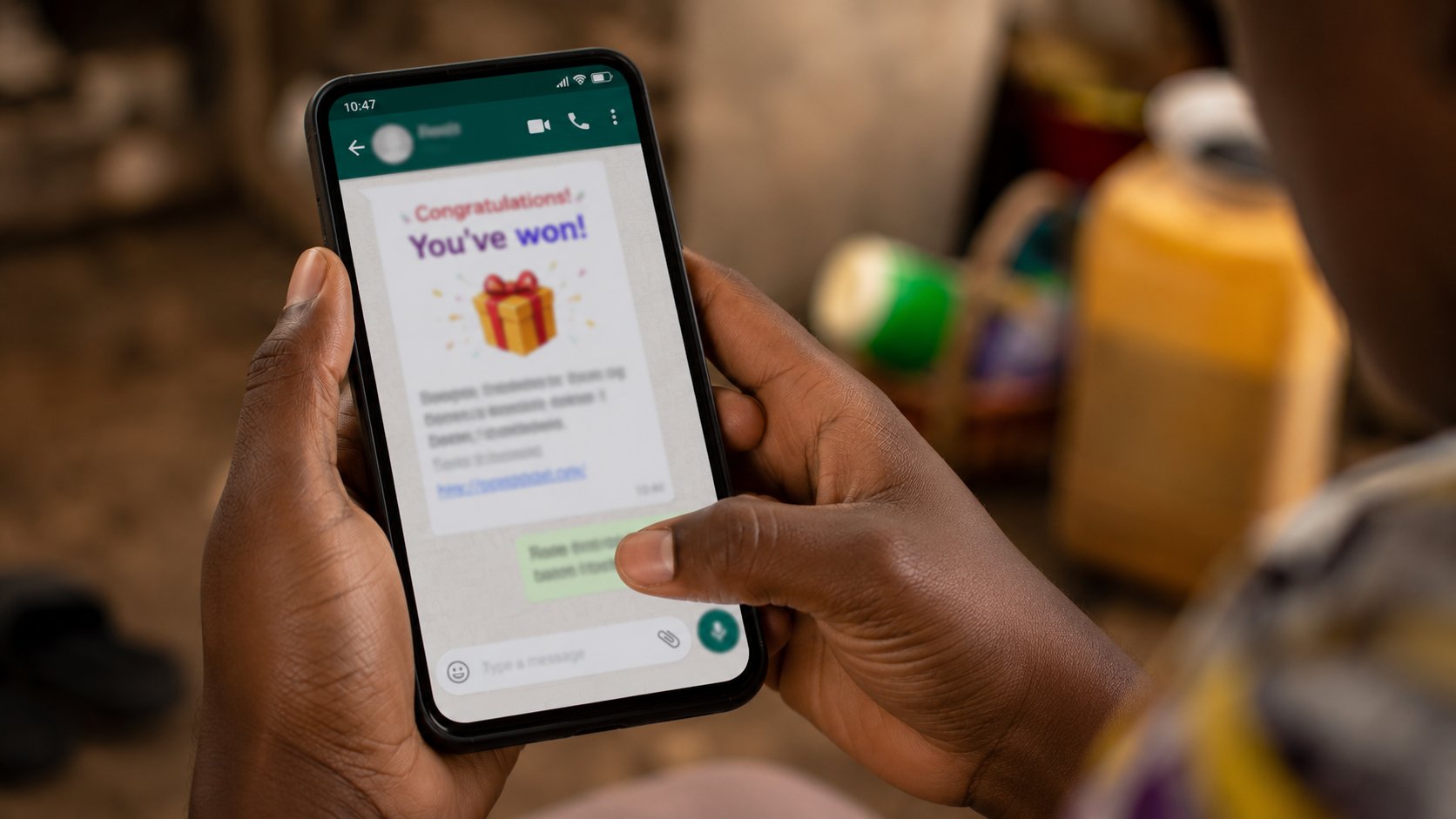
You're scrolling WhatsApp and a message lands: "Melcom is giving away an iPhone 17 Pro Max for its 37th anniversary — click to win!" Or: "President Mahama, with MTN, Telecel, AT and Glo, is giving everyone 10GB free data and GHS 20 airtime for his birthday." A friend forwarded it, so it must be real, right?
It's not. Both of these are circulating in Ghana right now, and both are scams. The good news: once you know the pattern, you'll spot every single one of them — instantly, forever.
How the fake-promo scam works
The recipe is always the same. Take a name people trust — a big shop like Melcom, the President, or all four networks at once. Promise something everyone wants: a free iPhone, free data, free airtime. Add a link and a deadline. Then sit back while people click, hand over their details, and forward it to everyone they know.
That last part is the clever bit. You become the one who spreads it, because it came from someone you trust. That's how a scam reaches thousands of phones in a day without the scammer lifting a finger.
The dead giveaways — every fake promo has these
You don't need to know the company. You just need to check the message against this list. If two or more of these are true, it's a scam:
- The web address is wrong. Real Melcom is melcom.com. The scam used a strange address like a .pages.dev page or a shortened tinyurl link. Real networks use mtn.com.gh, telecel.com.gh, and so on — never a random name like gbamz.com. The lookalike address is the single biggest red flag.
- A prize you never entered for. You can't "win" a competition you never joined. Free iPhones and free data don't get handed out to strangers on WhatsApp.
- It asks for your number or details. A genuine network already has your number. Anything that says "enter your mobile number to claim" is harvesting data.
- It tells you to forward it. "Share with 10 friends to qualify" is never how real promos work. That instruction exists only to spread the scam.
- Big names, all at once. MTN, Telecel, AT and Glo are competitors — they do not run joint giveaways together. A "collaboration" between rivals (and the President) is a fantasy designed to sound official.
- Urgency. "Today only," "limited slots," "expires soon" — pressure is there to stop you thinking.
What to do when one lands in your chats
And if a friend or group sent it in good faith, do them a kindness: reply and let them know it's a scam, so they stop spreading it. That one message from you can protect a whole group.
The one rule that protects you: a real company you already deal with never needs you to "claim" a prize on a strange website by typing in your number. If you have to chase free money through a link a stranger sent, the only thing being given away is your data.
Already clicked or shared one?
These fake "anniversary" and "birthday" giveaways will keep coming back with new names — a different shop, a different holiday, a different "free" thing. But the pattern never changes, and now you know it. Spot the wrong web address, the prize you never entered for, and the "forward to claim," and you'll never fall for one.
This guide is part of TechTrendi's Online Safety series for Ghana, drawn from real scam messages in circulation and from Ghana's Cyber Security Authority (CSA). Written by Edmund A. and reviewed by the TechTrendi editorial team. Last reviewed: June 2026.
Spotted a scam we should cover? Email [email protected]. To report a crime, contact the CSA on 292.