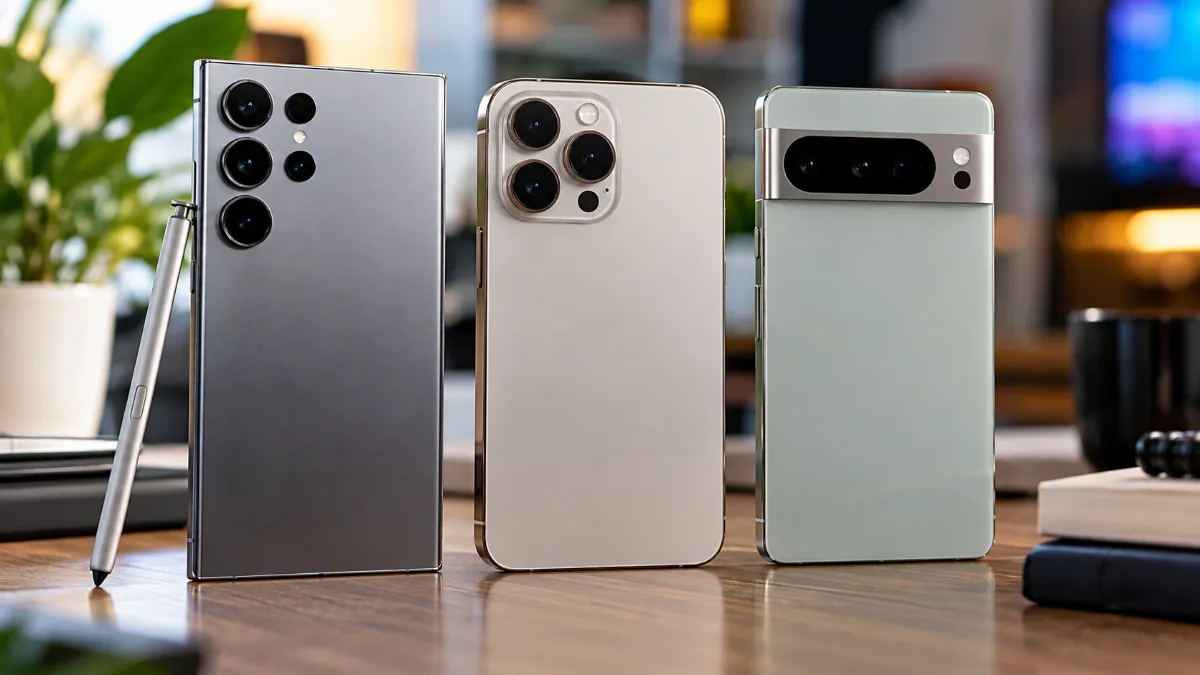
Three weeks ago I had four flagship phones sitting on my desk at the same time. My partner thought I'd lost it. Maybe I had. But here's what I found after actually using all of them as my daily driver — not just running benchmarks and reading spec sheets.
The short version: none of them are bad. They're all genuinely impressive phones. But "best" is doing a lot of heavy lifting in that sentence, and which one wins depends almost entirely on what matters to you.
Let me break it down properly.
The Contenders and What They Cost
I'm focusing on four phones here: the Samsung Galaxy S25 Ultra, the Apple iPhone 16 Pro Max, the Google Pixel 9 Pro, and the OnePlus 13. That last one might surprise you, but stick with me — it's the wildcard that might actually make the most sense for a lot of people.
- Samsung Galaxy S25 Ultra — starts at $1,299 (256GB)
- Apple iPhone 16 Pro Max — starts at $1,199 (256GB)
- Google Pixel 9 Pro — starts at $999 (128GB)
- OnePlus 13 — starts at $899 (256GB)
Right away you can see the price gap is real. The S25 Ultra is $400 more than the OnePlus 13, and that's a number you need to justify.
Performance: They're All Fast, But Not Equally
The Galaxy S25 Ultra and iPhone 16 Pro Max are both running silicon that was genuinely groundbreaking when they launched. Samsung put the Snapdragon 8 Elite in the S25 Ultra (for global markets — no more Exynos split, thankfully), while Apple runs their own A18 Pro chip on a 3nm process.
In real-world use? Both feel instant. Apps open before you've finished tapping. I genuinely couldn't feel a difference during normal use. The gap shows up in video editing and sustained workloads, where the iPhone's thermal management is still slightly ahead in my experience.
The Pixel 9 Pro runs on Google's own Tensor G4 chip, and I'll be honest — it's the weak link in this group on raw performance. It's not slow, but it runs warmer under load and you'll feel it if you're doing anything intensive. Geekbench 6 single-core sits around 1,900 for the Tensor G4, which is a meaningful step behind the other two.
The OnePlus 13 also runs the Snapdragon 8 Elite with 12GB of RAM as standard. It's basically as fast as the S25 Ultra in day-to-day use, and that's kind of remarkable given the price difference.
Cameras: This Is Where It Gets Complicated
Samsung Galaxy S25 Ultra
The S25 Ultra has a quad-camera system with a 200MP main sensor, a 50MP 5x periscope telephoto, a 10MP 3x telephoto, and a 12MP ultrawide. On paper it sounds untouchable. In practice it's excellent, but Samsung's processing still leans toward punchy, saturated colors that don't always match what a scene actually looked like.
The 200MP mode is genuinely useful when you're shooting something you want to crop heavily. Wildlife, sports from the stands, reading text on a sign across a street. I used it more than I expected to.
iPhone 16 Pro Max
The 48MP Fusion main camera with a 5x periscope telephoto and 48MP ultrawide is a strong system. Apple's computational photography has gotten a lot better, and the new Camera Control button is actually useful once you get used to it. Video quality is still the best in class here — I don't think anyone seriously disputes that. If you're shooting any kind of content, the iPhone 16 Pro Max is hard to beat.
The colors are more natural than Samsung's by default, which I personally prefer. But that's subjective.
Google Pixel 9 Pro
"The Pixel camera is the best you can get" — I've seen this written so many times and I think it's genuinely overstated at this point. The Pixel 9 Pro takes great photos, but it's not the gap-closer it used to be.
Honestly? I think the Pixel 9 Pro camera is overrated in 2025. Two or three years ago, Google's computational photography was ahead of everyone. Now Samsung and Apple have caught up significantly, and the Tensor G4's processing limitations actually hold back some of what the hardware could do.
That said — Best Take, Magic Eraser, and Photo Unblur are legitimately useful AI features that the others don't have in the same way. If you take a lot of candid shots of people and kids who won't sit still, the Pixel is still your friend.
OnePlus 13
The OnePlus 13 has a 50MP Hasselblad-tuned main camera, 50MP periscope telephoto, and 50MP ultrawide. The Hasselblad partnership adds some nice natural color calibration. It's not going to beat the iPhone or S25 Ultra in low light, but it's solidly in the second tier — and for a phone $400 cheaper, that's impressive.
Battery and Charging: A Clear Winner Here
This one's not even close and I spent way too long being surprised by it.
The OnePlus 13 has a 6,000mAh battery with 100W wired charging and 50W wireless. It goes from 0 to 100% in about 37 minutes wired. That's faster than some phones can go from 0 to 50%.
- S25 Ultra — 5,000mAh, 45W wired, 15W wireless
- iPhone 16 Pro Max — 4,685mAh, 27W wired (with right cable), 25W MagSafe
- Pixel 9 Pro — 4,700mAh, 27W wired, 23W wireless
- OnePlus 13 — 6,000mAh, 100W wired, 50W wireless
The S25 Ultra and Pixel 9 Pro both gave me a full day easily. The iPhone 16 Pro Max has genuinely improved battery life compared to previous generations — I got through a heavy day without anxiety. But the OnePlus 13 laughed at all of them. I charged it every other day, and when I did need to top it up, it was done before I finished my coffee.
Software and How Long They'll Last
Apple still wins on longevity. The iPhone 16 Pro Max will get iOS updates for at least 5-6 years based on Apple's track record. Samsung has committed to 7 years of OS and security updates for the S25 Ultra, which is actually impressive and a real shift for Android.
Google promises 7 years of updates for the Pixel 9 Pro too. OnePlus? 4 years of OS updates and 5 years of security patches for the 13. Not bad, but behind the others.
Samsung's One UI 7 has gotten noticeably cleaner. I still think it has too many features most people never use, but the core experience is good. The AI stuff — Samsung calls it Galaxy AI — is genuinely useful in spots, particularly Live Translate and Transcript Assist.
iOS 18 is stable and polished. If you're already in the Apple ecosystem, it's seamless. If you're switching from Android, there's still an adjustment period for things like file management.
Pixel's software is the cleanest Android experience by a significant margin. No bloat, no UI weirdness, and the Google Assistant / Gemini integration feels more natural than Samsung's implementation. For people who want Android at its most straightforward, Pixel is still the answer.
Display Quality
All four have LTPO AMOLED displays that drop to 1Hz when static and go up to 120Hz during scrolling. They all look great. The S25 Ultra's 6.9-inch QHD+ panel is the biggest and sharpest here. The iPhone 16 Pro Max's 6.9-inch Super Retina XDR is genuinely stunning with ProMotion.
The OnePlus 13's 6.82-inch BOE X1 panel is brighter than I expected — rated at 4,500 nits peak — and honestly competitive with phones $400 more expensive. The Pixel 9 Pro's 6.3-inch screen is the smallest of the group, which some people will prefer. Smaller doesn't mean worse.
The Value Breakdown
Here's where I give you my actual take, not a wishy-washy "it depends on your needs" non-answer.
If you're in the Apple ecosystem or shoot a lot of video — get the iPhone 16 Pro Max. The camera system, video quality, and software longevity justify the $1,199. It's not the cheapest, but it's not overpriced for what it delivers.
If you want the most powerful Android phone with S Pen functionality — the S25 Ultra is the one. But only if you actually use the S Pen or need the 200MP zoom system. If you're just using it as a regular phone, you're paying for features you won't touch.
If you want clean Android software and genuinely useful AI photo features — Pixel 9 Pro at $999 makes sense. I'd wait for a sale though, because Google regularly drops the price within a few months of launch and you can often find it for $799 or less.
If you want the best value straight up, no asterisks — the OnePlus 13 at $899 is the phone I'd tell a friend to buy. Same Snapdragon 8 Elite as the S25 Ultra, better battery than everyone, fast charging that embarrasses the competition, and a camera system that's genuinely good. You give up some software support longevity and some camera polish in low light. That's a real trade-off. But $400 is real money too.
As we move into 2026 and these phones age, the update commitments matter more. That's one reason the S25 Ultra and Pixel 9 Pro's 7-year promises look better the longer you plan to hold the phone.
Look — flagship phones all passed the "good enough" threshold years ago. The honest question now is which trade-offs you can live with and how much you're willing to spend to avoid them.
For most people who asked me which to get? I said OnePlus 13. For my video creator friends? iPhone, no hesitation. For the person who wants to geek out on Android and has the budget? S25 Ultra. There's no wrong answer here, just the wrong answer for you.