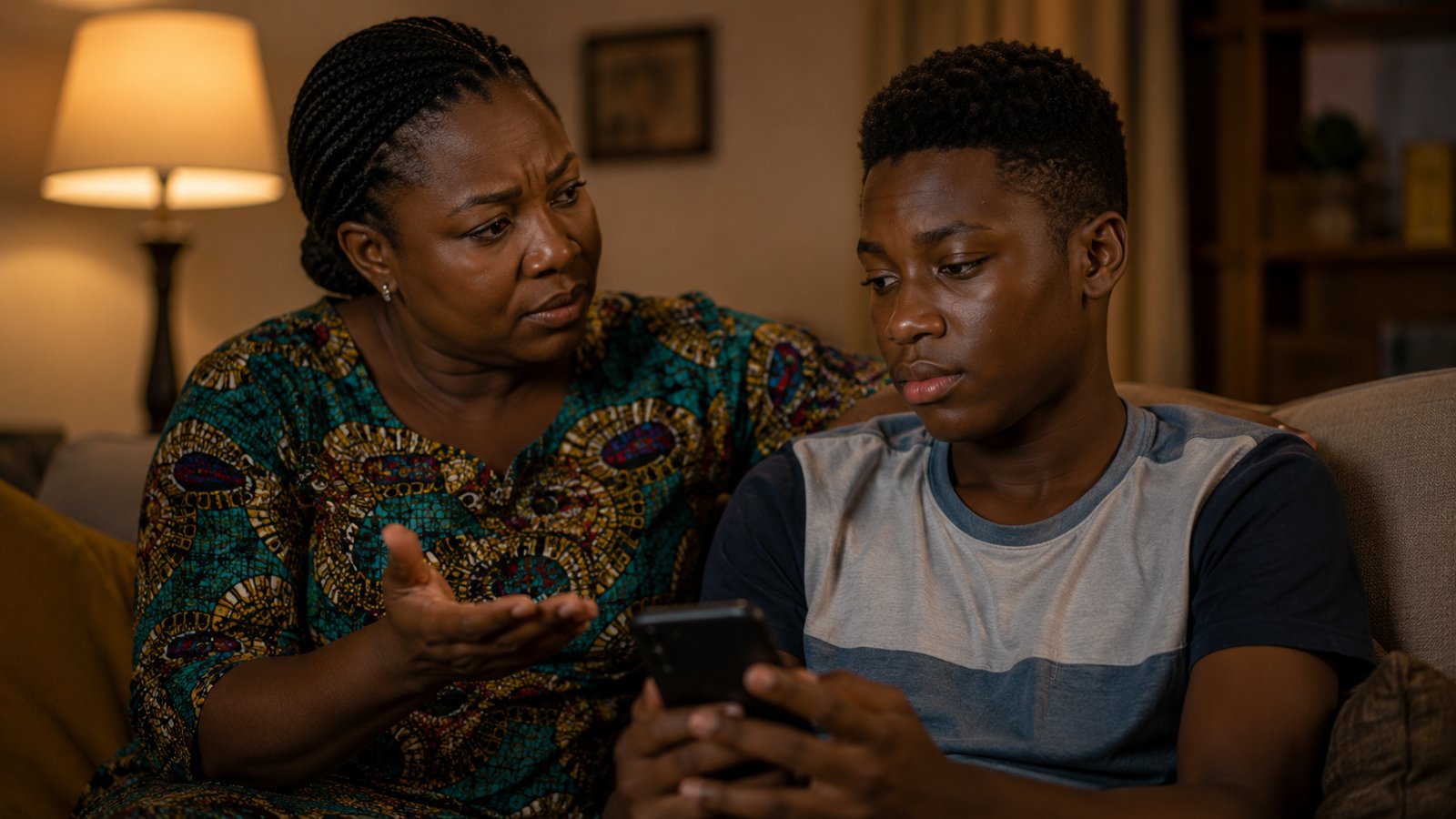
Think about what a child has in their hand today.
A smartphone the size of a small notebook holds more knowledge than every library in Ghana combined. Every book ever written. Every university lecture. Every skill — coding, design, music, business, farming, medicine — taught for free by some of the best teachers alive. A child in Tamale or Tema can today learn things a professor in 1990 could only dream of reaching.
By every right, this should be the smartest, most capable generation Ghana has ever raised. Our parents and grandparents — the Gen X and millennial generations — sat in classrooms with one shared textbook and a library that closed at 4pm. Today's child has the entire internet, awake at 3am, ready to teach them anything.
So here is the question that should keep every parent and teacher awake at night: if our children have everything, why do so many of them seem to be losing themselves?
This is not a comfortable article. It is a long one — and it is meant to be. If you are a parent, a teacher, a pastor, an imam, a chief, or anyone who loves a Ghanaian child, please read it to the end. Then share it. Because what we do in the next few years will decide what kind of adults this generation becomes.
The promise we were sold — and the reality we got
The internet arrived with a beautiful promise: it would level the playing field. The village child and the city child would have the same access to knowledge. Information would set everyone free.
And for some, it has. We will come back to those children — the ones quietly building remarkable futures online — because their story is real and it matters.
But for far too many, the same tool that was supposed to make them smarter is instead consuming them. The attention that should be going to a learning video on YouTube is going to an endless scroll of TikTok dances. The curiosity that could be exploring how the world works is being pulled, again and again, toward pornography, gossip, scams, and content designed to do one thing only: keep them watching.
It is worth sitting with how strange this is. The knowledge is right there. The same phone that can teach a child to code can also waste six hours of their day. The same app that can connect a student to a tutor in Accra can connect a predator to that same student. The tool is neutral. What our children do with it — and what we allow — is not.
The numbers Ghana doesn't want to look at
It is easy to dismiss all this as an older generation complaining about "these children today." Every generation does it. So let us not rely on feelings. Let us look at what the data actually says about Ghanaian children right now.
A study of children aged 8 to 17 in the Tema Metropolitan Area found that 87.5% of them have used social media — and the number one reason was simply entertainment. Not learning. Not research. Entertainment. These are primary and junior-high-aged children.
Now look at the darker side. According to figures cited around child online protection in Ghana, reports of child sexual abuse material linked to this country jumped from about 750 in 2016 to over 23,000 in 2024. Read that again. In eight years, the reports multiplied roughly thirty times over.
A survey of senior high school girls in Accra found that one in three had been blackmailed on social media — for money, or for sex. One in three. Look at any classroom of SHS girls and imagine that a third of them have already faced an online predator trying to extort them.
Ghana's own Cyber Security Authority (CSA) recorded 155 reported sextortion cases between January and April 2024, with losses of about GH¢103,663. For the same period the following year, the financial losses had exploded to nearly GH¢499,044 — almost five times higher in a single year. And those are only the cases people were brave enough to report. Most are never reported at all, because shame keeps families silent.
This is not an older generation grumbling. This is a measurable, accelerating crisis, and the children at the centre of it are ours.
First, the truth: this is not simply "bad children"
Before we point fingers at our kids, we owe them one piece of honesty.
Your child is not weak-willed for getting hooked on their phone. They are up against some of the most powerful psychological engineering ever built. The apps on that phone were designed by teams of brilliant, well-paid engineers in California whose literal job is to make the product impossible to put down. The infinite scroll, the notifications, the little hit of pleasure when a video starts — none of it is an accident. It is engineered to trigger dopamine, the brain's reward chemical, over and over.
And here is the cruel part: the teenage brain is the perfect target. The part of the brain responsible for self-control and weighing consequences — the prefrontal cortex — is the last to fully develop, often not until the mid-twenties. So we have placed the most addictive technology ever created into the hands of the humans least equipped to resist it, and then we act surprised when they can't.
This does not excuse harmful behaviour. But it should change who we are angry at. The fight is not really "parents versus wicked children." It is "one struggling Ghanaian family versus a trillion-dollar attention industry that does not care about your child at all." When you understand that, you stop shouting at the child and start protecting them.

The leaked videos: let us be honest about what is really happening
We have to talk about the videos. Almost every Ghanaian with a phone has seen one — a clip of secondary school children, or a teacher and a student, doing something that should never have been recorded, spreading across WhatsApp and X (Twitter) within hours.
The reaction is always the same. Outrage, mockery, and then, almost always, the shaming of the girl. We need to be much more honest than that, because the reality is in two parts, and both must be told.
Part one: the adults preying on our children
Many of the most viral "SHS leaked videos" in Ghana are not children misbehaving among themselves. They are adults — teachers and school staff — sexually exploiting students in their care.
In just nine months, between September 2025 and June 2026, the Ghana Education Service was forced to interdict, suspend, or dismiss staff at no fewer than four senior high schools over allegations of sexual misconduct with students — including incidents reported at Bole SHS, Okadjakrom SHS, and others involving assistant headmasters and teachers. Four schools. Nine months. And those are only the ones that became public.
When the video leaks, who does society punish? Too often, the child. We laugh at her, we share her face, we ruin her name — while the grown man who groomed her, who abused his authority, who often filmed it, slips into the background. A 15-year-old cannot legally or morally consent to a relationship with the adult responsible for her education. That is not romance. That is abuse. And when the country spends its energy shaming the victim instead of jailing the predator, we are failing that child twice.
Part two: children and the choices they are making
And here we must be just as honest, because this is in many ways the bigger and quieter problem. For every video involving a predatory adult that reaches the news, there are far more that never make headlines at all — student to student. Two classmates. A boyfriend and girlfriend. Friends daring each other. Children recording sexual acts, filming each other in changing rooms and dormitories, sending nude images ("nudes") back and forth, sexting, going on late-night video calls they should never be on.
These are the videos quietly multiplying on every campus, passed phone to phone, long before any of them "leak." And the painful question every parent asks is: why would a child record themselves, or a classmate, doing this?
The answers are uncomfortable but real:
- Pressure and proof. A boyfriend demands a video "to prove you love me." A friend group treats it as normal. The child who refuses is mocked.
- Grooming. An older person — sometimes a stranger online, sometimes someone close — slowly normalises it, step by step, until the child believes it is their own idea.
- Imitation. They are drowning in sexual content. Pornography, suggestive music videos, "content creators" performing sexuality for clout. To a teenager, recording themselves can feel like simply copying what the whole internet seems to celebrate.
- Betrayal by a "friend." A huge share of these clips are filmed or shared without the other person's knowledge — a partner who secretly records, a friend who films through a window, a breakup where one person takes revenge by leaking private images. The child trusted the wrong person, and that trust became a weapon.
- It has become normal among them. When sharing nudes and sex clips circulates freely in a friend group or a dormitory, it stops feeling like a crime and starts feeling like just what everyone does. A child swimming in that water often cannot see how dangerous it is.
- No one ever told them the danger. Many of these children genuinely do not understand that a video sent to one trusted person can be on a thousand phones by morning — and online forever.
That last point is the heart of it. These children are not evil. They are unguided, over-exposed, and under-protected — by all of us.
The internet never forgets — and that is the real tragedy
Here is what almost no Ghanaian teenager truly understands, and what every parent must drill into them: the internet does not forgive, and it does not forget.
Delete the post. Block the person. Beg them to take it down. It does not matter. Someone already screenshotted it. Someone already downloaded it. It has been re-uploaded to ten other places. Search engines have indexed it. The internet is a filing cabinet that never loses paperwork.
Now imagine that child in ten years. Picture the futures that one careless or coerced video can quietly poison:
- Marriage. She meets a good man, they fall in love, the families are happy — and then someone "remembers" an old video and sends it to his family the week before the wedding. A union destroyed by something she did, or was forced to do, as a frightened sixteen-year-old.
- Employment. Studies show that around 96% of recruiters now check a candidate's social media before hiring, and more than half have rejected someone because of what they found. A dream job, gone — not because of his skills, but because of a digital ghost from his school days.
- Public life and leadership. Picture this young person, twenty years from now, running for Parliament, applying to lead a church group, or standing for a top position — and an old rival simply digs up the video. In Ghana, where reputation is everything, one resurfaced clip can end a career before it begins.
- Scholarships and travel. Embassies, universities and scholarship boards increasingly look people up. A tainted online trail can quietly close doors the child never even knew were closing.
- Mental health. Long before any of that, there is the immediate damage: the depression, the anxiety, the suicidal thoughts that come when a teenager's most private moment becomes public entertainment. Some children, in Ghana and around the world, have taken their own lives over exactly this.
A moment that lasts thirty seconds can follow a child for thirty years. This is the conversation we are not having with them.
How "easy communication" quietly eroded our morals
Let us be honest about something our generation finds awkward to admit.
Thirty years ago, a young person who wanted to misbehave had to work hard at it. There were no video calls. No instant nudes. No private chat that vanishes. If you wanted to send something to someone, you wrote a letter or found a phone booth. The friction itself protected people. Many vices simply were not convenient.
Today, every bad impulse has a frictionless tool waiting for it. WhatsApp, video calls, disappearing messages and the like did not invent lust, infidelity, or peer pressure — those are as old as humanity. But they have removed every speed bump. Sexting, late-night video calls, "situationships" managed entirely through a screen, the casual sharing of intimate images — these are not new desires. They are old desires given a superhighway.
We must be careful here, because this is also where naïve thinking creeps in. The answer is not to pretend the internet is evil and ban it — that ship has sailed, and these same tools also deliver education, opportunity, and connection. The honest point is simpler: we handed our children the most powerful communication tools in human history and gave them almost no training in how to use them with wisdom or restraint. We would never hand a teenager a car with no driving lessons. Yet we hand them a smartphone — arguably more dangerous to their future — and say nothing.

So who is failing our children? All of us. Here is how.
It is tempting to find one villain. The schools. The government. "These useless children." But the truth is that the protection of a child is a chain, and right now, in Ghana, every single link is weak. Let us look honestly at each one — what they are doing wrong, what they are failing to do, and what they must start doing.
1. Parents
What is going wrong: Many Ghanaian parents have handed their child a smartphone as a babysitter, a status symbol, or simply to keep up with other families — and then walked away. They do not know what apps their child uses, who they talk to, or what they watch. Some are too busy surviving. Some are embarrassed to discuss sex and the internet, so they say nothing at all. And many parents are quietly addicted to their own phones, modelling the very behaviour they condemn.
What they must do: Stop outsourcing parenting to a screen. Know the apps on your child's phone. Keep charging stations in the living room, not the bedroom, especially at night — most harm happens after midnight, alone, in the dark. Above all, talk. The research is overwhelmingly clear that open, ongoing conversation protects children far more than any rule or app. Talk about pornography before the internet does. Talk about why a "trusted" boyfriend asking for nudes is a red flag, not love. Make your home the place a child runs to when something goes wrong online — not the place they hide it for fear of being beaten.
2. The schools and teachers
What is going wrong: Most Ghanaian schools have no real digital-safety curriculum. ICT class teaches Microsoft Word, not how to spot a groomer or what sextortion is. Worse, as the data shows, some of the very people entrusted to protect children — teachers and staff — are among the predators. And when a scandal erupts, schools too often move to protect the institution's reputation rather than the wounded child.
What they must do: Teach online safety as seriously as we teach maths — what grooming looks like, what to do if an image is shared, where to report. Build a culture where a student can report a predatory teacher without fear, and where that report is acted on, not buried. Enforce a zero-tolerance, swiftly-prosecuted standard for staff misconduct. A school that shields a predator has betrayed every child in its care.
3. The community
What is going wrong: The old Ghanaian idea that "it takes a village to raise a child" has quietly died in the digital age. Neighbours look away. Worse, the community has become the distribution network for harm — it is ordinary aunties, uncles, and classmates who gleefully forward the leaked video, who screenshot, who comment cruelly. We have become a society that consumes a child's destruction as entertainment.
What it must do: Reclaim the village — but for the digital age. The single most powerful thing you can do when a leaked video reaches your phone is delete it and refuse to share it. Every forward is another nail in a child's coffin, and under Ghanaian law, sharing intimate images of a minor is itself a crime. Defend the victim. Name the predator. Stop laughing.
4. The churches and mosques
What is going wrong: Religious bodies command enormous influence over Ghanaian family life, yet many treat the internet either as a taboo not to be discussed, or address it only with vague condemnations of "immorality" that no teenager actually hears. Few mosques or churches offer practical guidance to parents or safe spaces for struggling youth.
What they must do: Move from condemnation to equipping. Run real sessions for parents on digital safety. Create youth programmes that speak honestly about online temptation, pornography, and pressure — not with shame, but with understanding. A child who has been exploited online needs a faith community that offers compassion and a path back, not one that drives them deeper into hiding through judgement.
5. The government and authorities
What is going right (and wrong): Ghana is not doing nothing. The Cyber Security Authority runs a 24-hour helpline — call or text 292 — for anyone, including students, to report online abuse. The Cybersecurity Act, 2020 (Act 1038) makes grooming, cyberstalking, sextortion, and the non-consensual sharing of intimate images serious crimes, carrying penalties of up to 25 years in prison. The CSA has visited schools, reaching tens of thousands of students with safety education. There is also a National Child Online Protection Framework. These are real, good steps.
What must improve: The law is strong on paper but weakly enforced — predators rarely face those 25-year sentences, which teaches the next predator that the risk is low. Most parents, teachers and children have never heard of the 292 line or the COP Framework. The government must massively publicise these protections, properly resource enforcement, and ensure that reporting actually leads to justice. A law nobody fears is just words.
6. The tech companies
What is going wrong: Let us not forget the elephant. The platforms profit from every hour our children lose and have historically done the bare minimum to protect African children, who are an afterthought in their safety planning.
What they must do: They will not act out of kindness — only pressure. African governments and unions must demand real age verification, faster removal of abuse content, and local safety teams that understand the Ghanaian context. Until then, the responsibility falls back on us.
7. The youth themselves
The honest part: Our children are not only victims; they are also, increasingly, participants — in the sharing, the bullying, the pressure. A generation that forwards a classmate's leaked video is helping to destroy one of its own.
What they must understand: Your reputation is the one thing you cannot buy back. The friend pressuring you, the boyfriend "proving love," the trend everyone is copying — none of them will be there in ten years when the consequences arrive. You will face those alone. The most rebellious, powerful thing a young Ghanaian can do today is to be the one who refuses to send it, refuses to share it, and protects their own future fiercely.
But let us be fair: the internet is also raising some of our brightest children
If we only tell the dark story, we lie by omission — and we miss the entire point. The same internet that is harming some children is, right now, building extraordinary futures for others.
There are Ghanaian teenagers who taught themselves to code from free YouTube tutorials and are now building apps. Students who learned graphic design, video editing, or digital marketing online and are earning real money before they finish school. Young people running small businesses entirely through WhatsApp and Instagram. Children who use the internet exactly as it was meant to be used — as the greatest library and the greatest opportunity in human history.
This is the proof that the tool is not the enemy. The difference between the child it destroys and the child it elevates is almost always the same single factor: guidance. A caring adult who showed them what the internet is for. That is the whole game. And it is within every parent's and teacher's power to provide.
What to actually do — starting today
Enough diagnosis. Here is the practical, doable action plan.
For parents
- Have the conversation — and keep having it. Not one awkward lecture. A hundred small, calm chats. Talk about pornography, pressure, scams, and the permanence of the internet before your child meets them alone.
- Move phones out of the bedroom at night. A simple charging station in the sitting room removes the time and privacy where most harm happens.
- Use parental controls — but never instead of conversation. Built-in tools on Android and iPhone, plus apps like Google Family Link, can filter content and set screen-time limits. They are a seatbelt, not a substitute for teaching the child to drive.
- Teach them, don't just restrict them. A child who understands why something is dangerous protects themselves even when you are not watching — which is most of the time. For younger children, make the lessons fun: CyberAbɔfra, a free Ghanaian online-safety platform built for kids, teaches digital safety through games and characters they actually enjoy ("Learn. Play. Protect your family online"). It is exactly the kind of tool that turns a scary lecture into a habit a child keeps.
- Be the safe place. Promise your child — and mean it — that if something goes wrong online, they can come to you without being beaten or shamed. A child who fears you will hide the very danger you could have stopped.
- Model it. Put your own phone down at the dinner table. Children copy what we do, not what we say.
For teachers and schools
- Teach real digital-safety lessons: grooming, sextortion, digital footprint, how to report.
- Create a safe, trusted channel for students to report misconduct — and act on it.
- Bring in the CSA or trained NGOs to speak to students and staff.
For everyone
- If a leaked video of a child reaches you, delete it. Do not share it. Report it. You may be holding criminal content, and you are certainly holding a child's future.
- Save the number: 292. Call or text the Cyber Security Authority to report online abuse, blackmail, or grooming — for yourself or any child. It is free and available 24 hours a day.
- Talk to one child this week. Not all of them. Just one. That is how this changes.
A final word
To the parents reading this: your child is not lost, and your job is not impossible. But it is no longer enough to feed, clothe, and pay school fees. In this generation, protecting your child means protecting them online — and that requires you to be present, informed, and brave enough to have hard conversations.
And to any young person reading this: you are not in trouble. You are in danger — a different thing entirely. The internet has handed you the whole world. It can make you the most capable generation Ghana has ever produced, or it can quietly take everything from you. The difference is the choices you make when no one is watching, and the courage to protect a future you cannot yet see.
We were given children with the world in their pockets. Whether that becomes the greatest gift or the greatest tragedy of their lives is not up to the internet.
It is up to us.
If this article moved you, please share it with one parent, one teacher, or one young person. The internet never forgets — so let us make sure that, this time, it remembers something that helped.
📲 Share on WhatsApp
Need help now? To report online blackmail, grooming, sextortion, or a leaked image — for yourself or any child — call or text Ghana's Cyber Security Authority on 292 (free, 24 hours). Sharing intimate images of a minor is a crime under the Cybersecurity Act, 2020.