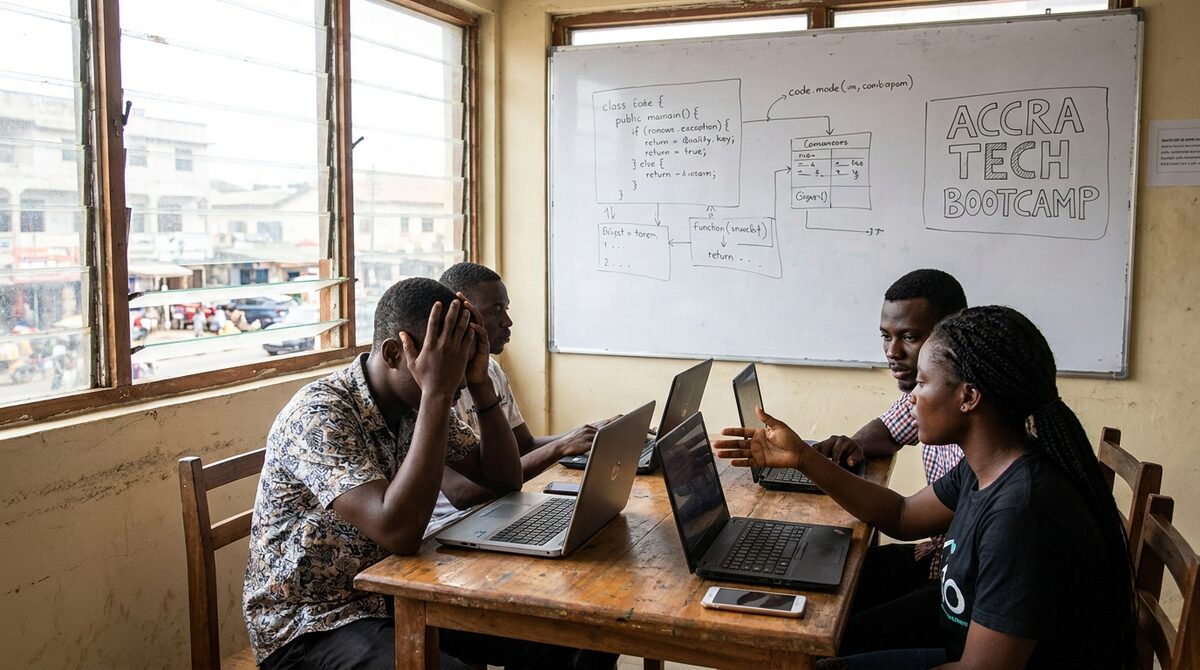
Thousands of young Ghanaians complete coding bootcamps every year, clutching certificates and portfolios, fully expecting to walk into junior developer roles within months. A significant portion of them are still waiting a year later.
The problem is not a lack of intelligence or work ethic. Ghana has produced world-class engineers who now work at Google, Microsoft, and leading fintech companies across Africa. The problem is structural — and it starts long before graduation day.
The Bootcamp Promise vs. The Market Reality
Coding bootcamps in Ghana — from Accra-based programs to online cohorts run by international providers — typically promise employment-ready skills in 12 to 24 weeks. The curriculum usually covers HTML, CSS, JavaScript, and sometimes React or Python basics.
That is a reasonable starting point. The issue is that many bootcamps stop there, treating technical syntax as the finish line rather than the starting point of a much longer professional journey.
Employers hiring junior developers in Ghana — whether local startups, NGO-backed tech initiatives, or remote-first companies — consistently report the same gap. Candidates can write code in isolation, but struggle when asked to debug an unfamiliar codebase, collaborate via Git in a team environment, or explain their technical decisions clearly to a non-technical stakeholder.
"We receive dozens of bootcamp graduate applications monthly. The ones who stand out are not necessarily the most technically advanced — they are the ones who have clearly worked on real problems with real constraints, not just tutorial projects." — CTO of a Kumasi-based fintech startup, speaking to TechTrendi in early 2026.
This observation cuts to the heart of the hiring gap. Tutorial-driven projects, however well-constructed, do not replicate the ambiguity and pressure of actual product development.
Five Reasons Bootcamp Grads Are Not Getting Hired
1. Portfolio Projects That All Look the Same
Walk through any cohort's demo day in Accra or Tema, and a pattern emerges quickly: to-do apps, weather apps, and basic e-commerce clones dominate. These projects demonstrate that a graduate completed the curriculum. They do not demonstrate problem-solving ability or market awareness.
Hiring managers have seen hundreds of these portfolios. Without a project that solves a recognizable Ghanaian or African problem — or demonstrates genuine product thinking — a portfolio blends into the background.
2. No Experience With Collaborative Development Tools
Many bootcamps teach Git in a single module and move on. But professional software development is almost entirely team-based. Pull requests, code reviews, branching strategies, and merge conflict resolution are daily realities in any real engineering team.
Graduates who have never worked inside a shared repository with multiple contributors are functionally unprepared for their first week on the job, regardless of how clean their solo code is.
3. Weak Professional Communication Skills
Technical ability alone has never been sufficient for a sustained career in software. Writing clear technical documentation, participating in code reviews constructively, communicating blockers to a project manager, and presenting a system design to stakeholders — these are skills that separate candidates who get promoted from candidates who get passed over.
Most Ghanaian bootcamps allocate minimal time to professional communication training, particularly in written English for international remote work contexts.
4. Overconfidence in One Language or Framework
A bootcamp that teaches React will produce graduates who describe themselves as React developers. But employers — especially smaller Ghanaian companies — often need generalists who can build a backend API, set up a database, configure basic cloud hosting, and maintain a frontend. Graduates locked into a single-stack identity often price themselves out of entry-level generalist roles while being underqualified for specialized ones.
5. No Network, No Referrals, No Visibility
The Ghanaian tech hiring market, like most markets globally, is heavily relationship-driven. A significant percentage of developer roles — particularly at established companies and funded startups — are filled through internal referrals before a job post ever goes public.
Many bootcamp graduates in Ghana submit applications through job boards and hear nothing back. Not because they are unqualified, but because they are invisible to the people making hiring decisions.
What Actually Works: A More Effective Path to Employment
The good news is that Ghanaian developers who are getting hired in 2026 are following identifiable patterns. These are not shortcuts — they are deliberate strategies that address exactly the gaps described above.
Build Projects That Solve Local Problems
The most compelling portfolios in the Ghanaian market are built around problems that local users actually experience. Mobile money integration issues, public transport scheduling, agricultural price tracking, health clinic appointment systems — these projects demonstrate real-world thinking and local market knowledge that a weather app never can.
Employers who are building for Ghanaian or West African users actively want developers who understand those users. A portfolio that speaks to local context is a significant differentiator.
Contribute to Open Source Projects
Open source contribution is one of the most effective ways to gain collaborative development experience without being employed. Platforms like GitHub host thousands of active projects — including African-focused ones through organizations like Open Source Community Africa (OSCA) — that welcome junior contributors.
Even small contributions — fixing documentation, resolving a minor bug, improving test coverage — create a public track record of working within real codebases under real constraints. This is precisely what hiring managers look for and rarely find in bootcamp portfolios.
Pursue Structured Apprenticeships and Internships
Several Ghanaian and pan-African programs offer structured apprenticeship tracks that place junior developers inside actual product teams. Andela, despite shifting its model in recent years, has produced developers who entered the workforce with genuine team experience. Programs like the Ghana Digital Centers initiative and various NGO-backed digital hubs also offer internship pathways worth pursuing.
An unpaid or low-paid internship for three months inside a functioning product team will often do more for long-term employability than completing a second bootcamp.
Learn the Full Stack — Including Infrastructure Basics
Developers who can demonstrate even a basic understanding of cloud hosting, environment variables, deployment pipelines, and database management stand out sharply in the junior developer pool. Free-tier offerings from AWS, Google Cloud, and Render make it entirely possible to deploy and maintain real applications at no cost.
A candidate who can say, with evidence, that they have deployed an application to a live server, managed a PostgreSQL database, and handled environment configuration is several steps ahead of a candidate whose projects exist only in a local development environment.
Build in Public and Document the Process
LinkedIn remains underused by Ghanaian tech graduates relative to its actual hiring power. Developers who write short posts documenting what they built, what broke, and what they learned — consistently, over months — build professional visibility that passive applications cannot create.
Twitter (now X), LinkedIn, and even YouTube have been used by Ghanaian developers to attract recruiter attention and direct job offers without a single cold application. The strategy requires consistency, but the return on investment is well-documented across the continent.
Join Developer Communities and Show Up Consistently
Communities like Ghana Tech Lab, Accra Javascript Community, Women in Tech Ghana, and the broader OSCA network host regular meetups, hackathons, and online events. These are not simply networking events in the traditional sense — they are places where hiring decisions are influenced and where junior developers become known quantities to senior engineers and founders.
The developer who attends every monthly meetup, contributes thoughtfully to group discussions, and helps organize community events becomes a familiar name. Familiar names get referred. Referrals get hired.
A Note on Remote Work Opportunities
Ghana's relatively stable internet infrastructure, growing co-working space ecosystem, and English-language proficiency make Ghanaian developers attractive candidates for remote positions with international companies. Platforms like Toptal, Turing, and Braintrust actively recruit African developers for remote roles that pay significantly above local market rates.
The barrier for remote work is not technical complexity — it is profile strength, communication ability, and understanding of how to position skills for an international audience. Developers who invest in a strong GitHub profile, a polished LinkedIn presence, and English written communication training can access this market effectively.
What Bootcamps Themselves Must Change
The responsibility does not rest entirely on graduates. Bootcamps operating in Ghana in 2026 need to be held to higher standards by their students, their funders, and the broader tech community.
Any bootcamp charging significant fees should be able to provide verified employment outcome data — not just testimonials. Curriculum should include dedicated modules on Git collaboration, technical communication, portfolio strategy, and professional networking. Industry partnerships that provide real project experience or internship pipelines should be considered baseline requirements, not premium add-ons.
"The best bootcamp we could offer would be three months of building a real product for a real client, with a senior developer in the room. Everything else is preparation for that moment." — Senior software engineer and bootcamp mentor, Accra, 2025.
Several newer programs in Ghana are moving in this direction — integrating real client projects, mentorship from employed developers, and career services that extend well beyond resume templates. These programs tend to produce better employment outcomes, and their graduates tend to make that fact loudly known.
The Path Forward Is Clear — If Uncomfortable
There is no version of this conversation that avoids a difficult truth: completing a coding bootcamp is the beginning of a developer's education, not the end of it. The graduates who are building careers in Ghana's tech sector in 2026 are the ones who treated their bootcamp diploma as a foundation and then kept building.
They built locally relevant projects. They contributed to open source. They joined communities and became known. They documented their learning publicly. They applied for remote roles and internships that stretched them. They did not wait for the perfect job listing — they built the profile that made employers come to them.
Ghana's tech sector is genuinely growing. The 2025 Ghana Digital Economy Policy has accelerated infrastructure investment and created real demand for local technical talent. The opportunity is present. The developers who will claim it are the ones willing to go further than the certificate on their wall.
For aspiring developers, bootcamp graduates still searching, and the programs training them: the market has made its expectations clear. The question now is whether the response matches the moment.