Last year I watched a four-hour documentary on Netflix, backed up my phone photos to Google One, and asked ChatGPT about a dozen questions before lunch. Normal Tuesday. Then I started reading about what that actually costs the planet — not in a vague hand-wavy way, but in real megawatts, real water, real emissions. Honestly, it changed how I think about my digital habits.
Here's the thing nobody really talks about: the internet doesn't feel physical. You can't see it, you can't touch it. But somewhere there's a building the size of a city block, full of servers running at full tilt, burning through electricity and water just so you can rewatch The Office for the fourth time.
Data Centers Are Basically Industrial Facilities
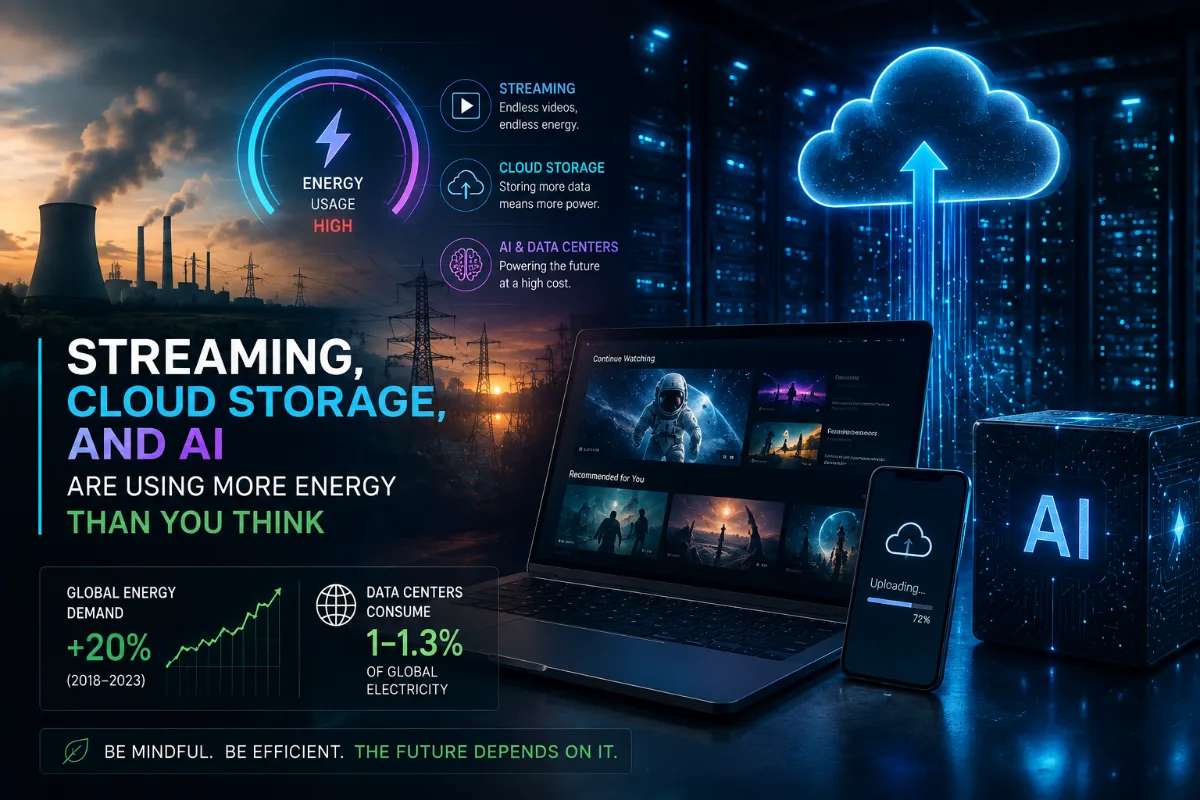
I don't think most people picture what a data center actually looks like. These aren't rooms with a few blinking computers. We're talking about massive warehouse-scale facilities — Google, Microsoft, and Amazon Web Services each operate hundreds of them globally. According to the International Energy Agency's 2024 report, data centers consumed roughly 240–340 terawatt-hours of electricity in 2022, which is around 1–1.3% of global electricity demand.
That number sounds small until you compare it to entire countries. 240 TWh is more than Argentina uses in a year.
And these facilities don't just need power to run the servers. They need power to cool the servers. Cooling often accounts for 30–40% of a data center's total energy use, according to Lawrence Berkeley National Laboratory's data center efficiency research. Some older facilities are even less efficient than that.
PUE: The Number That Tells You How Wasteful a Data Center Is
There's a metric called Power Usage Effectiveness, or PUE. A perfect score is 1.0 — meaning every watt goes directly to computing. Google's data centers averaged a PUE of 1.10 in 2023, which is genuinely impressive. The industry average sits closer to 1.58, per the Uptime Institute's 2023 Global Data Center Survey. That means for every watt doing actual work, another 0.58 watts are wasted mostly on cooling.
So when a data center in Virginia is inefficient, that's real coal or gas being burned for nothing useful.
What Streaming Actually Costs
I spent way too long trying to find a definitive answer on the carbon cost of streaming one hour of video. The numbers vary wildly depending on who you ask and what they're measuring. The Carbon Trust put out a widely-cited figure, but the Shift Project famously overcounted in 2019 and had to walk back a claim that streaming emitted as much CO2 as Spain. So let's be careful here.
A more grounded estimate from a 2021 study by researchers at the University of Bristol and other institutions suggests streaming one hour of HD video produces roughly 36 grams of CO2 when accounting for device use, network transmission, and data center load. That's about the same as driving a gas car for 150 meters. Not catastrophic for one person. Multiply it by Netflix's 270 million subscribers all watching simultaneously? Different story.
Netflix itself reported in its 2022 Environmental Social Governance (ESG) report that its total operational emissions were around 1.5 million metric tons of CO2 equivalent. For context, that's roughly the annual emissions of 320,000 average American cars.
"The carbon footprint of our devices, the internet, and the systems supporting them account for about 3.7% of global greenhouse gas emissions." — Frédéric Bordage, GreenIT.fr researcher, widely cited in European digital sustainability discussions
Video quality matters too. Streaming 4K uses roughly 4x the data of 1080p. If you're watching Netflix in 4K on your 65-inch LG OLED and you don't actually care about the resolution difference — and honestly, at normal viewing distances, most people can't tell — you're quadrupling the data load for no real benefit.
The Network You're On Changes Everything
WiFi is dramatically more energy-efficient than mobile data for streaming. A 2019 study by the International Energy Agency found that mobile networks use roughly 20x more energy per gigabyte than fixed-line broadband. So streaming on 5G while you're out is considerably heavier on emissions than the same video over your home WiFi. I didn't know this until I started digging, and it's now changed when I bother buffering vs. downloading.
Cloud Storage Is the Quiet Culprit
Streaming gets all the attention, but cloud storage is a constant, always-on energy draw. Your Google Photos library, your Dropbox folder, your iCloud backups — they're all sitting on physical drives in physical buildings that run 24/7.
Think about how much redundancy is involved. When you upload a file to Google Drive, it's typically replicated three or more times across different data centers for reliability. That's a feature, not a bug — but it means your 50GB photo backup is actually occupying 150GB or more of physical storage across multiple locations.
Google One's 2TB plan costs $9.99/month in the US. That seems cheap. And it is cheap — Google subsidizes it because the real value is keeping you inside their ecosystem. But it's cheap partly because energy costs are borne at scale, and partly because those costs are externalized onto the environment.
Does It Matter Where Your Data Lives?
Yes, actually. A lot. Data centers in Iceland run almost entirely on geothermal and hydroelectric power. Data centers in parts of Virginia or Texas might still be pulling heavily from fossil fuel grids. When you choose a cloud provider, the carbon intensity of their energy mix is a real variable — not just a PR talking point.
Microsoft has published detailed sustainability reports showing that its Azure data centers averaged around 67% carbon-free energy in 2023. Google claims to match 100% of its consumption with renewable energy purchases, though matching isn't the same as actually running on renewables in real time. Amazon Web Services has committed to 100% renewable energy by 2025, but as of 2023 they were at 90% according to their own sustainability report.
These numbers matter. They're not perfect, but they're moving in the right direction.
AI Is the New Elephant in the Room
Okay, this is the part that genuinely surprised me when I started researching it.
Training a large language model like GPT-4 is enormously energy-intensive. A 2023 paper from researchers at MIT and the University of Massachusetts Amherst estimated that training a single large AI model can emit as much CO2 as five average American cars over their entire lifetimes. That's the training run alone — not inference, not the ongoing cost of running it.
OpenAI hasn't published detailed figures for GPT-4's training cost. But based on what we know about comparable models, it likely required hundreds of millions of dollars of compute, running on thousands of Nvidia H100 GPUs simultaneously. Each H100 draws around 700 watts. Scale that across 10,000 GPUs running for weeks and you're talking about serious power consumption.
Then there's inference — every single time someone sends a message to ChatGPT, Claude, Gemini, or any other LLM, the model processes it. A Goldman Sachs research note from 2023 estimated that a ChatGPT query uses roughly 10x the electricity of a Google search. ChatGPT reportedly handles over 10 million queries per day. Do that math and you're looking at significant daily power consumption just for one AI product.
Microsoft, which has invested heavily in OpenAI, saw its carbon emissions actually increase 29% between 2020 and 2022 — largely because of AI infrastructure buildout. They acknowledged this in their own 2022 environmental report. It's a company that's publicly committed to being carbon negative by 2030, and their own AI ambitions are currently working against that goal. That tension is real.
"The energy demands of AI are so significant that they're reshaping regional power grids. In Northern Virginia — the world's largest data center hub — grid operators are warning about capacity constraints through 2026 and beyond." — reported by the Washington Post, 2024
Water Usage Is an Overlooked Part of This Story
Data centers use water for cooling. A lot of it. Google's data centers consumed approximately 5.6 billion gallons of water in 2022, per their own environmental report. Microsoft used around 1.7 billion gallons in the same year.
When you're talking about facilities located in water-stressed regions — parts of the American Southwest, for example — that's not a trivial concern. Some data centers use evaporative cooling systems that consume fresh water directly. Others use recycled water or closed-loop systems, which is much better. The problem is there's no consistent public reporting requirement, so it's hard to know which is which unless a company voluntarily discloses it.
What's Actually Being Done About It
I don't want this to be purely doom-and-gloom, because some genuinely interesting stuff is happening.
Liquid cooling is replacing air cooling in many next-generation data centers. Immersion cooling — literally submerging servers in a non-conductive liquid — can cut cooling energy use by up to 95% compared to traditional air cooling. Companies like GRC (Green Revolution Cooling) and Submer are building real products around this.
Smaller, more efficient AI models are gaining traction. Meta's LLaMA 3 and Google's Gemini Nano are examples of models designed to run efficiently on less hardware. Running a smaller model locally on a device like the Samsung Galaxy S25 (which has an on-device AI chip) uses a tiny fraction of the power compared to sending that query to a massive cloud server. I think this is one of the most underrated trends in AI right now.
Nuclear power is making a surprising comeback in the data center conversation. Microsoft signed a deal in 2023 to purchase power from the restarted Three Mile Island nuclear plant — specifically to power its AI data centers. Google has signed agreements for small modular reactor (SMR) power. These are long-term bets, but they're real commitments.
NextEra Energy, the world's largest producer of wind and solar, is actively partnering with hyperscalers to co-locate renewable generation with data center facilities. It's a model that actually makes geographic sense — build the power source next to the thing that needs the power.
What You Can Actually Do
Look, individual action has limits. I'm not going to tell you to delete your Google Photos and hand-deliver prints to relatives. That's not realistic. But there are a few things that do add up:
- Stream at 1080p instead of 4K when you genuinely won't notice the difference
- Download content for offline viewing instead of streaming it repeatedly over mobile data
- Actually audit your cloud storage — I cleared 40GB of duplicate photos last year that were being replicated across three regions for nothing
- Use AI tools deliberately rather than reflexively — every query has a cost, even if you can't see it
- If you're a developer or run any kind of service, the data center region you deploy to matters — pick providers with verified green energy commitments
None of that is going to reverse climate change by itself. The real leverage is in infrastructure policy, energy grid decarbonization, and holding big tech companies accountable to their own stated commitments. But being an informed user isn't nothing.
The digital world isn't weightless. It never was. We just built it in a way that made it easy to forget that.