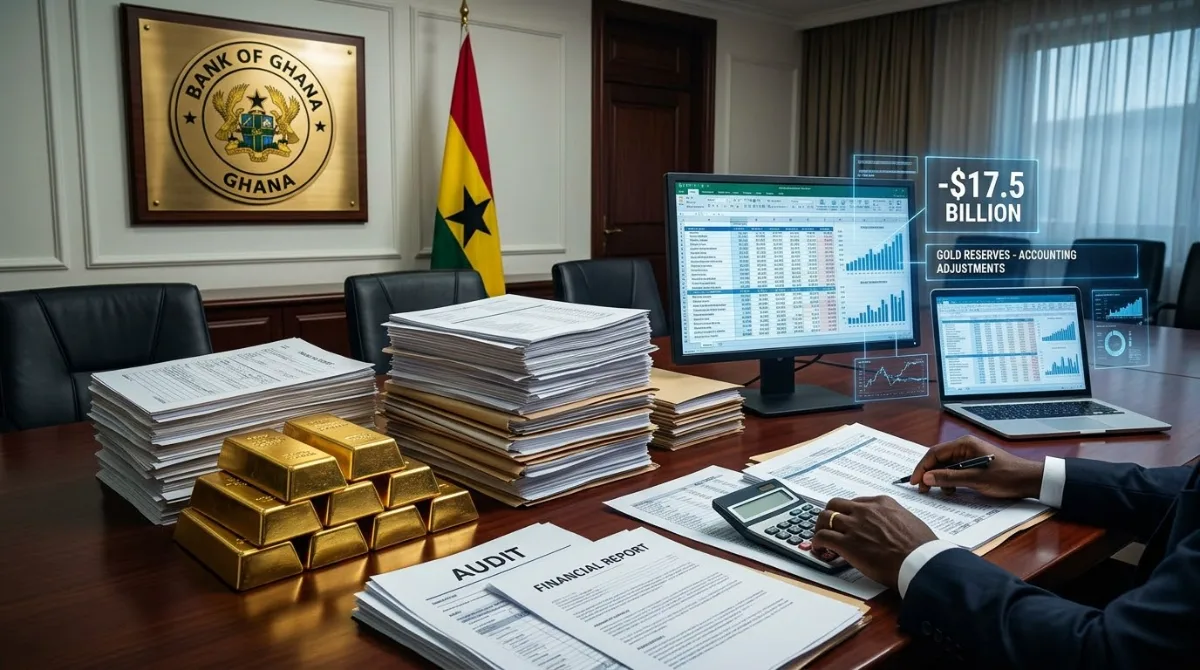
A GH¢17.5 billion figure that is been circulating around Ghana's gold programme losses is not money that walked out of the country — it is what happens when you buy gold at a weak cedi, then book the sale after the cedi has strengthened significantly. That is the Bank of Ghana's position, stated plainly before Parliament last week.
Paul Bleboo, the Bank of Ghana's Head of Gold Management, delivered that explanation on Friday, November 6, to Parliament's Committee on Economy and Development. Governor Dr Johnson Pandit Asiama led the Bank's delegation at the hearing.
How a Stronger Cedi Creates a Paper Loss
Bleboo walked the committee through the mechanics. Under the 2025 Domestic Gold Purchase Programme, the Bank bought gold at the local market rate, exported it, and booked the resulting dollars in cedis roughly ten days later. The problem: the Bank's reference rate at the time of booking was far lower than the rate used when purchasing the gold.
In his written statement, Governor Asiama confirmed that the cedi appreciated 40.7 per cent against the US dollar in 2025. That kind of move is dramatic — and it is what turns a profitable trade into an ugly accounting entry.
"So that is what is causing this, and that is for a chunk of the total cost, and it is an accounting loss and not a real loss," Bleboo told the committee.
To illustrate the point, Bleboo offered a simplified example: pay miners at roughly GH¢15 to the dollar, then convert the proceeds after the rate has moved to around GH¢12. "That is a huge accounting loss," he said — stressing that he was using the figures as an illustration, not referencing any specific transaction.
He also noted that keeping the gold sale proceeds in dollars, rather than converting them, would have avoided the loss appearing in this form on the books entirely.
The Audited Numbers Tell a Different Story
The GH¢17.5 billion is the exchange-rate portion of the programme's gross cost — not a standalone loss sitting on top of everything else. The Bank's 2025 financial statements put the net loss on gold deals at GH¢9.05 billion, broken down as GH¢8.85 billion on gold for reserves and GH¢203 million on gold for oil purchases.
Those same statements also recognise GH¢7.99 billion in realised gains on monetary gold within the reserves line — meaning the GH¢17.5 billion is not an additional figure to stack on the GH¢9.05 billion net loss.
Bleboo had flagged similar figures earlier in the year. In May, he told TV3 that the gross cost was approximately GH¢21 billion and the net burden carried by the Bank was around GH¢9.1 billion — numbers that 3News reported when the financial statements were published.
The cedi's appreciation also eroded the cedi value of foreign assets already on the Bank's books. That effect is recorded separately in the annual report as a GH¢19.32 billion loss under other comprehensive income.
What the Programme Actually Generated
Despite the accounting complications, Bleboo told the committee the programme was not without returns. It generated approximately US$10 billion in foreign exchange during 2025 and added around 11 tonnes of gold to Ghana's reserves. He also referenced a purity allowance of 0.7 to 0.8 per cent and an off-take discount that was cut to 1 per cent in 2025.
The hearing came just a day after former Vice President Dr Mahamudu Bawumia, speaking to NPP members in Tokyo on Thursday, claimed that trading gold rather than holding it had cost the central bank US$1.7 billion — a figure 3News linked to the IMF's 2025 assessment of the programme. The Bank of Ghana had not responded to that claim by Thursday evening.
Shifting the Burden to Ghana Gold Board
Governor Asiama's written statement to the committee pointed to a structural fix already in motion. Transferring the cost of domestic gold purchases to the Ghana Gold Board is expected to reduce the accounting burden on the Bank going forward — a move that could make future annual reports considerably cleaner, regardless of where the cedi trades.
For anyone following Ghana's economic recovery story, this hearing is a reminder that the numbers in central bank accounts do not always mean what they look like at first glance — especially when the currency is moving as fast as the cedi did in 2025.