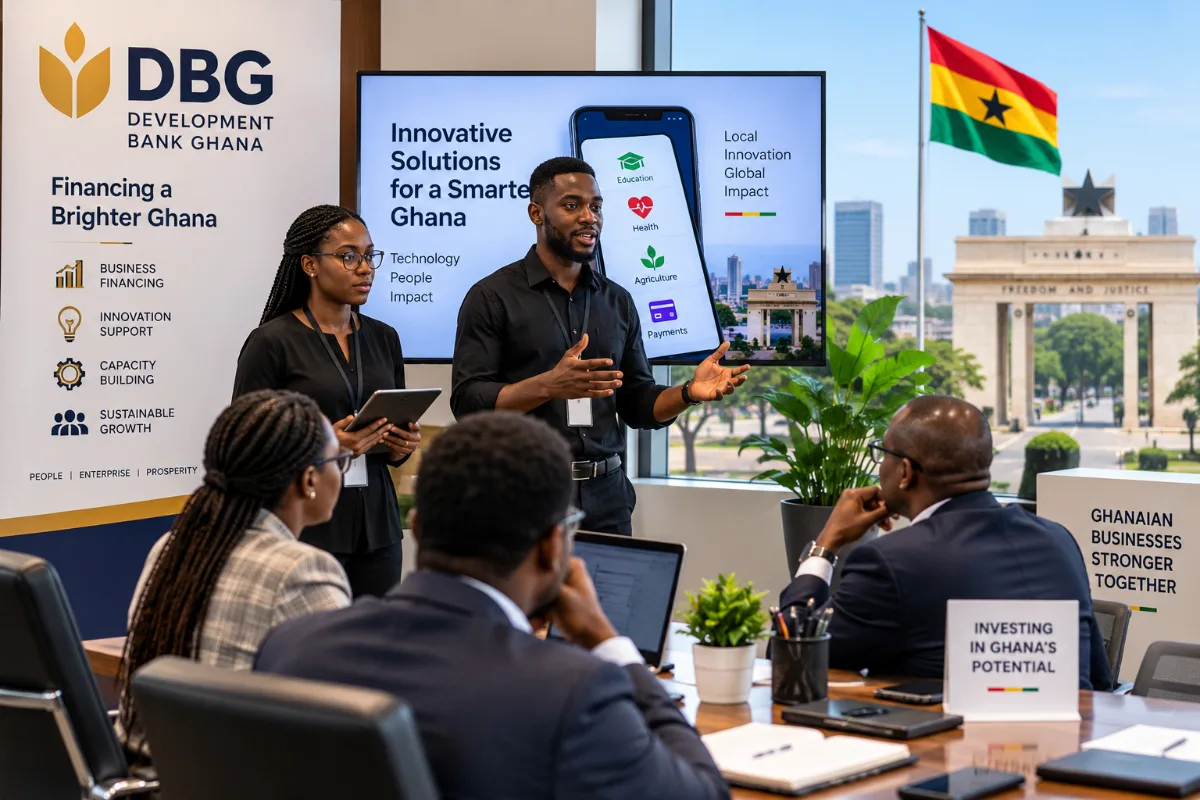
Ghana's ICT sector does not have a single problem — it has many, and Development Bank Ghana (DBG) says treating them all the same way is a mistake the country cannot afford to keep making.
The state-backed development finance institution made its position clear at an ICT roundtable discussion in Accra, where it brought together financiers, investors, engineers, innovators, and ICT businesses to hash out practical solutions to the sector's persistent challenges.
DBG Chief Executive Officer Prof. Randolph Nsor-Ambala anchored the arguments on a nationwide feasibility study the bank had conducted, which identified four major barriers holding back ICT businesses: financing, policy alignment, investor readiness, and business development support.
It is Not Just About Access to Capital
Prof. Nsor-Ambala was direct about one common misconception — that simply giving ICT companies money solves the problem. His argument is that the structure of financing matters as much as its availability.
"Our view of things is that it goes beyond just financing. When it comes to financing, it also has to do with the structure of the financing. What is the appropriate financing instrument they need?" — Prof. Randolph Nsor-Ambala, CEO, Development Bank Ghana
He explained that the ICT sector is not a single, uniform industry. It is a complex web of value chains — each with its own characteristics, risks, and capital requirements — and interventions need to reflect that reality.
"The ICT sector is not homogeneous. The value chain is complex, and the peculiarities associated with the various streams of value chains require different actions," he said.
Mapping the Value Chain, Segment by Segment
The DBG CEO said the bank's immediate next step is to break down challenges across the ICT value chain's various segments and design targeted interventions with measurable outcomes. Vague, sweeping solutions will not cut it.
"We need to essentially disabuse our mind, first of all, from the one-size-fits-all solution. The second thing is that we need to agree with everybody in the room around what would success look like." — Prof. Nsor-Ambala
He also stressed the need for continuous stakeholder engagement — not just a one-time roundtable — to track whether agreed interventions are actually delivering results on the ground.
This kind of structured, sector-specific thinking is increasingly relevant as Ghana's tech ecosystem matures and the demand for differentiated financial products grows beyond what traditional commercial banks have historically offered.
A Competitive, Not Exclusive, Private Sector
Prof. Nsor-Ambala was equally pointed about DBG's broader mandate: building a competitive private sector that spreads opportunity widely, rather than concentrating it among a handful of well-connected businesses.
"Our mandate is to create a competitive private sector. Competitive private sector essentially means that we do not believe in creating opportunities for just a few," he said.
That framing matters in an environment where access to structured finance has historically favoured larger, more established players — leaving smaller ICT startups and innovators on the outside looking in.
ICT as a Bridge Into Agribusiness, Too
The roundtable was not only about the ICT sector in isolation. Prof. Nsor-Ambala also revealed that DBG is deploying technology to address information gaps in Ghana's agribusiness sector — a space where many farmers struggle to access reliable technical guidance and, as a result, do not treat farming as a commercially viable enterprise.
"One of the challenges we found within the agribusiness space was access to quality information that is relevant to the course of business of the farmers," he said, noting that DBG is using ICT as a low-cost channel to deliver technical information and extension support directly to farmers.
It is a practical illustration of how digital tools, when applied correctly, can cut across sectors — and why getting Ghana's ICT financing architecture right has stakes far beyond the tech industry itself.