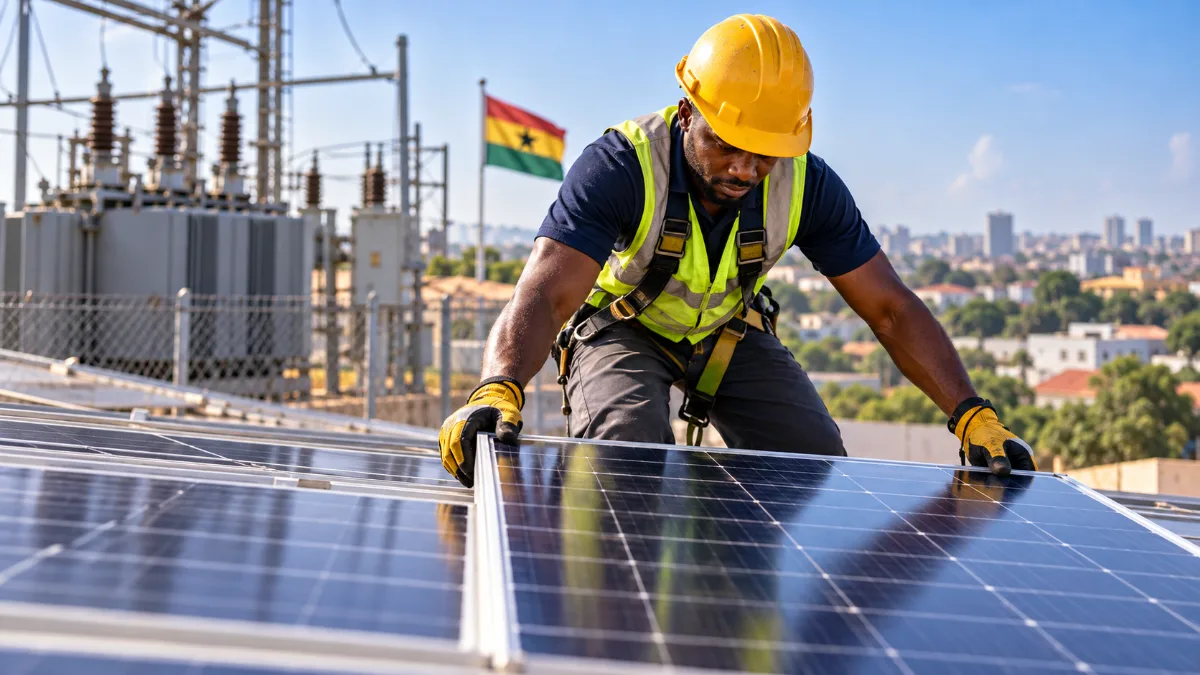
Ghana's electricity access rate has climbed to 89.13 percent, and the government has moved to back that progress with hardware — procuring more than 2,000 transformers to shore up distribution infrastructure across the country.
The announcement came from Dr John Abdulai Jinapor, Minister for Energy and Green Transition, speaking at the 2026 Energy Sector Performance Review Retreat. He framed the transformer procurement as one part of a broader push covering generation, transmission, and distribution — not a standalone fix.
Where Ghana's Power System Stands
Ghana's installed generation capacity has reached 5,854 megawatts (MW), according to Dr Jinapor. Renewable energy capacity has grown to 345MW, reflecting the country's push to diversify its energy mix beyond hydro and thermal sources.
Despite those numbers, Dr Jinapor was candid about how difficult 2026 has been. A fire at the Akosombo Switchyard in April knocked out more than 1,000MW from the national system, putting enormous strain on power supply across the country.
"I commend VRA and GRIDCo for the technical expertise, resilience and coordination they demonstrated during that difficult period, and for their efforts to minimise the impact on the national system." — Dr John Abdulai Jinapor, Minister for Energy and Green Transition
He credited the Volta River Authority (VRA) and the Ghana Grid Company Limited (GRIDCo) for their technical response in limiting the fallout from the Akosombo incident.
Transmission Projects Moving Forward
On transmission, Dr Jinapor pointed to the start of the process toward constructing the Ho–Asiekpe transmission line as a key milestone. The minister was direct about why transmission matters as much as generation capacity.
"We must have the transmission and distribution infrastructure to deliver reliable power to homes, businesses and industry." — Dr Jinapor
The proposed Accra–Kumasi 330kV transmission line is also advancing. The consultant tender has been evaluated, and both the scoping report and the Environmental and Social Impact Assessment (ESIA) have been completed — clearing the way for the next phase of that project.
Anwomaso Plant and IPP Renegotiations
On the generation side, Dr Jinapor disclosed that eight of the ten units at the Anwomaso Thermal Plant have been commissioned, with six currently in active service. The plant is expected to deliver 250MW by end of 2026.
A significant financial move also got confirmed at the retreat. The renegotiation of independent power producer (IPP) agreements has received approval from both Cabinet and Parliament, a development the minister said supports long-term financial sustainability in the sector.
This kind of structural reform matters because Ghana's power sector has long wrestled with expensive take-or-pay IPP contracts that strain state finances — a topic that intersects with broader energy policy debates across West Africa.
Challenges Still Loom
Dr Jinapor did not paint an entirely rosy picture. He acknowledged that transmission infrastructure gaps, distribution inefficiency, project financing constraints, and the implementation of key programmes remain unresolved. The 2,000-plus transformers are a step, but the work is far from done.
For a country that has spent years battling load-shedding and grid instability, reaching 89.13% electricity access alongside 5,854MW of installed capacity is a measurable milestone. Whether the infrastructure investments keep pace with demand will be the test that follows.