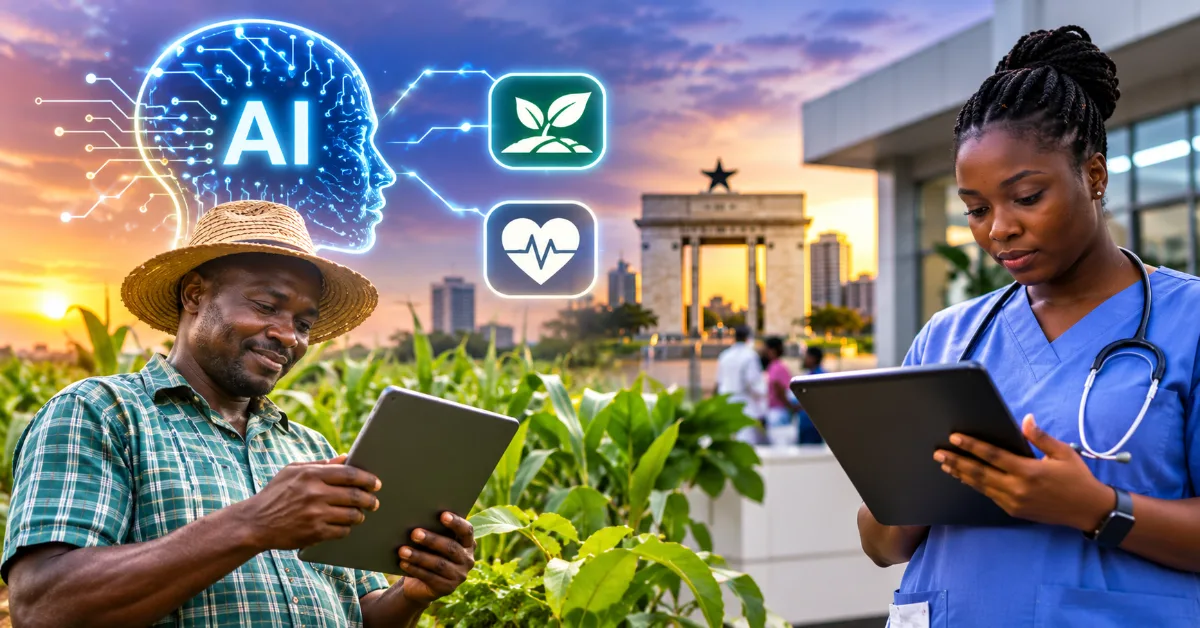
Ghana does not need its own ChatGPT. That is the blunt message from Dr Gillian Hammah, Founder and Chief Executive Officer of GradePoint AI, who is urging the government to stop chasing expensive AI ambitions and start solving real problems in healthcare and agriculture.
Speaking at the Step Up Executive Breakfast Series — held under the theme "The AI-Powered Project Leader: How to Lead, Deliver & Stay Relevant in the Age of AI" — Dr Hammah delivered a pointed warning: Ghana's limited financial resources make it impossible to compete with global AI developers, and trying to do so would only divert attention from more pressing national priorities.
"We do not need to build our own ChatGPT. For us to try and be another ChatGPT, we are wasting our time. Let us try and start solving the problems that are relevant to us today." — Dr Gillian Hammah, CEO, GradePoint AI
Small Models, Big Impact
Rather than building new large language models from scratch, Dr Hammah is advocating for what she describes as Small Language Models (SLMs) — compact, specialised AI systems trained on local datasets but built on the foundations of existing global models. The idea is to get the benefits of frontier AI without the astronomical development costs.
She pointed to Ghana's health sector as a prime example of where this approach could deliver immediate value. According to Dr Hammah, the Ministry of Health could develop an AI model trained specifically on Ghana's health data, while still benefiting from the broader capabilities of larger, established models.
"The Ministry of Health, for example, is deciding that they are going to build a model that has our health data, but it has all the benefits and the training from the bigger models. That is what we need."
It is a strategy that mirrors what several smaller economies have adopted — adapting rather than reinventing, and directing the savings into deployment that actually reaches citizens. This kind of practical AI application is increasingly where real development impact is showing up across the continent.
Agriculture and Food Security in the Frame
Beyond healthcare, Dr Hammah named agriculture and food production as sectors where AI could make a tangible difference for ordinary Ghanaians. She was emphatic that chasing prestige projects should not come at the cost of practical solutions.
"Building the biggest model is not it," she said. "Solving our problems day to day — health, food, agriculture — that is where we need to start."
The argument is not anti-innovation. It is a case for strategic prioritisation at a time when Ghana, like many African nations, faces competing demands on public funds and technical talent.
Data Is the Hidden Problem
Dr Hammah also flagged a challenge that tends to get less airtime than the AI models themselves: poor data management. She argued that without a serious national effort to digitise and harmonise government records, even the most well-designed AI application will struggle to perform reliably.
Accessible, clean data, she said, is the foundation everything else has to be built on. Without it, Ghana's AI ambitions — however scaled — remain on shaky ground. This intersects directly with broader concerns around health technology infrastructure across the country, where fragmented records have long hampered service delivery.
Dr Hammah's remarks reflect a growing conversation among African tech leaders about where the continent's AI investment should actually go. With global AI development now dominated by a handful of well-capitalised US and Chinese firms, the realistic path for most African governments runs through adaptation — not duplication.