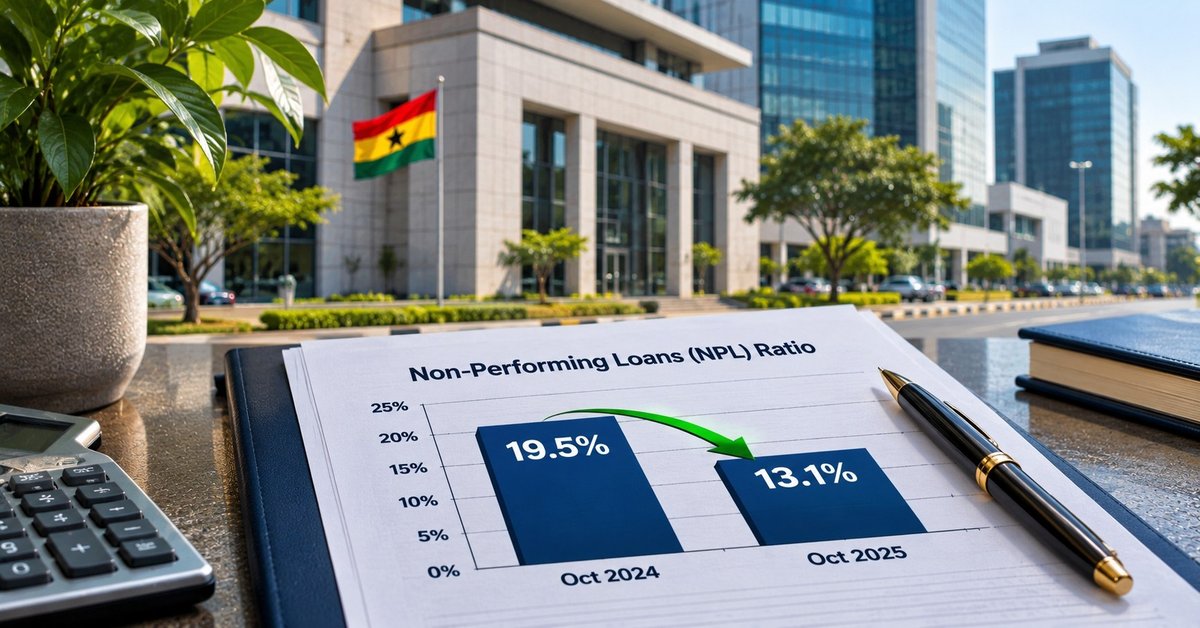
Ghana's banks are carrying significantly fewer bad loans than they were a year ago. Non-performing loans (NPLs) fell to 13.1 per cent in October, down from 19.5 per cent the same month last year, according to figures released by the Bank of Ghana — a drop of more than six percentage points in twelve months.
The NPL ratio measures what share of banks' total lending has stopped being repaid. Its fall signals cleaner balance sheets across the industry, and the central bank says the sector remains solvent, liquid and profitable.
A Year-Long Decline
The improvement has not happened overnight. The ratio sat at 14.0 per cent in September, and the Bank's monthly data show the decline has run almost unbroken through the year. The Monetary Policy Committee, in a statement released on Wednesday, said the turnaround was driven by a strong rebound in lending and a contraction in the actual stock of bad loans.
Strip out the worst category — loans in the loss category — and the picture is even sharper. That adjusted ratio fell to 3.3 per cent from 6.8 per cent a year earlier.
Lending and Deposits Accelerate
The broader health numbers back up the NPL story. Banks' total assets hit GH¢512.9 billion in October, up 21.2 per cent year-on-year, powered largely by rising deposits. Deposits closed at GH¢369.8 billion, growing 22.5 per cent, while advances jumped 36.7 per cent to GH¢140.9 billion.
To appreciate how dramatic that shift is: a year earlier, both deposits and advances were each growing at only 8.9 per cent. Private-sector credit grew 37.2 per cent in nominal terms — up from 13.9 per cent a year ago — and still clocked 30.0 per cent after adjusting for inflation.
Borrowing Is Getting Cheaper
Interest rates have come down hard. The average lending rate eased to 15.8 per cent from 22.2 per cent over the same period, and the 91-day Treasury bill yield dropped to 4.6 per cent from 10.6 per cent. The Bank linked the lending rebound directly to this lower interest rate environment, saying it has improved credit conditions and lifted demand for loans.
These figures come from the same Monetary Policy Committee meeting at which the Bank cut its policy rate from 14 to 11 per cent. Capital buffers also strengthened: the capital adequacy ratio — the cushion banks hold against losses — rose to 18.5 per cent in October from 17.9 per cent a year earlier.
Work Still to Do
The trajectory is positive, but 13.1 per cent is not a clean bill of health. As the Bank's own data make clear, roughly one cedi in every eight lent out is still not being repaid. The clean-up of old bad debts is ongoing — and the pace of credit growth means new lending standards will matter more than ever in the months ahead.