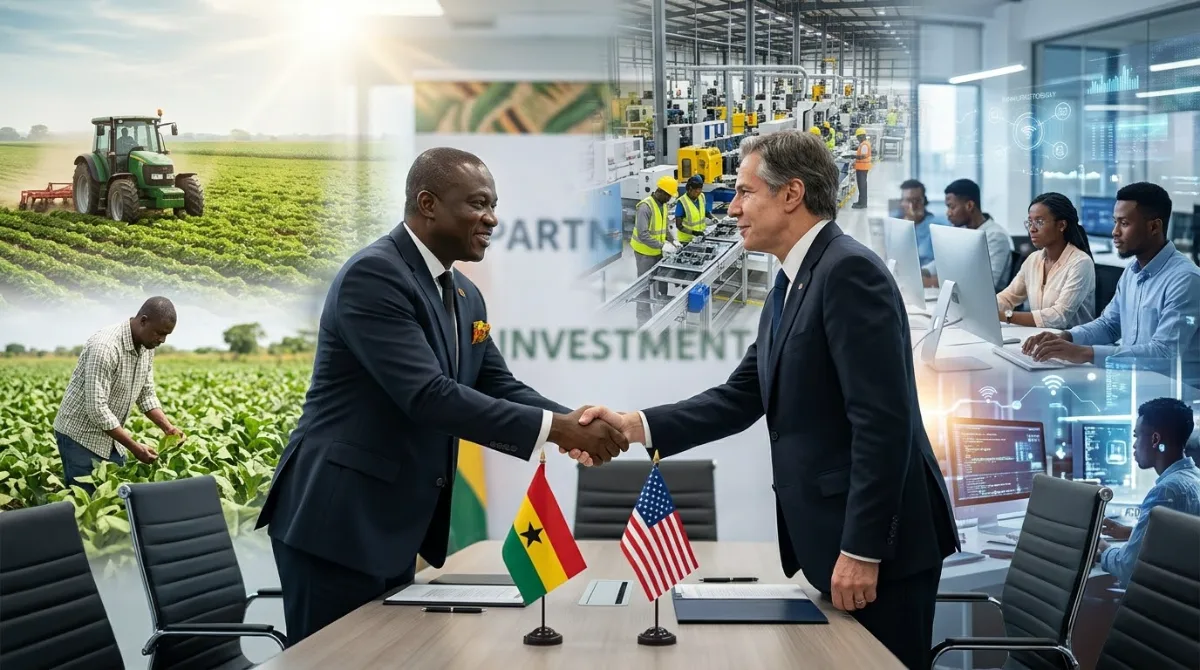
Ghana's Ambassador to the United States, Victor Emmanuel Smith, is making a direct pitch to American investors — not just for raw material exports, but for the kind of value-added manufacturing that keeps jobs and profits inside Ghana.
Ambassador Smith made the call during a meeting with Freddie O'Connell, Mayor of Metropolitan Nashville and Davidson County, at Nashville City Hall in Tennessee. The meeting was part of a four-day official visit to the state, with talks zeroing in on attracting US capital into Ghana's manufacturing, agriculture, and strategic technology sectors.
Processing Over Exporting
At the heart of Smith's message was a push to move Ghana up the value chain. Rather than continuing to ship out commodities like cocoa, shea butter, and coffee in their raw form, he argued that American investors should partner with Ghana to process these goods locally — generating better-paying jobs and keeping more economic value at home.
That argument carries extra weight right now. Ghana is grappling with a significant brain drain, as growing numbers of young Ghanaians leave the country in search of better economic opportunities abroad. Smith has been direct about linking foreign investment to that challenge.
"The true measure of successful diplomacy is not the number of high-level meetings we attend, but the investment we attract, the business we help establish and the lives we improve," Ambassador Smith has previously stated.
Ghana as Africa's Gateway
Smith positioned Ghana not just as a single market, but as an entry point into the broader African continent. He pointed to the country's stable democratic system, its rule of law, an English-speaking youthful workforce, and — critically — its hosting of the Secretariat of the African Continental Free Trade Area (AfCFTA) as key selling points for US businesses.
Beyond agriculture, the Ambassador highlighted gold and lithium mining, healthcare, infrastructure, and digital technologies as sectors with strong investment potential, backed by targeted government incentives. Lithium, in particular, has become a hot commodity globally given its central role in battery manufacturing and the energy transition — an area where emerging tech trends are intensifying demand.
Nashville's Ghanaian Ties
Mayor O'Connell's response was warm. He pointed to existing cultural and family connections between Nashville and Ghana, deepened through the city's Sister Cities programme, and flagged healthcare and technology as priority areas for future collaboration.
O'Connell also acknowledged Dr Addae, Founder and Chief Executive Officer of The Conscious Group, describing him as a living example of the Ghanaian diaspora's contribution to Nashville's community and economy.
Dr Addae, who was present at the meeting, noted that Ghanaians in Nashville have built a solid presence in academia and local government. He added that diaspora members are increasingly looking beyond remittances — exploring structured investment vehicles that could channel their financial resources back into Ghana in more impactful ways.
Mahama's Economic Vision
Dr Addae also confirmed that the Ghanaian Embassy, operating under the direction of President John Dramani Mahama, is actively working to reduce the country's dependence on raw commodity exports — a strategic shift that underpins everything Ambassador Smith is pitching to US investors on this trip.
The Nashville visit signals a broader diplomatic push to attract the kind of productive capital that creates jobs rather than just trade flows — and to do it at a moment when Ghana is competing hard for foreign direct investment across a crowded African market. Whether American investors follow through will be the real test of this diplomatic groundwork.