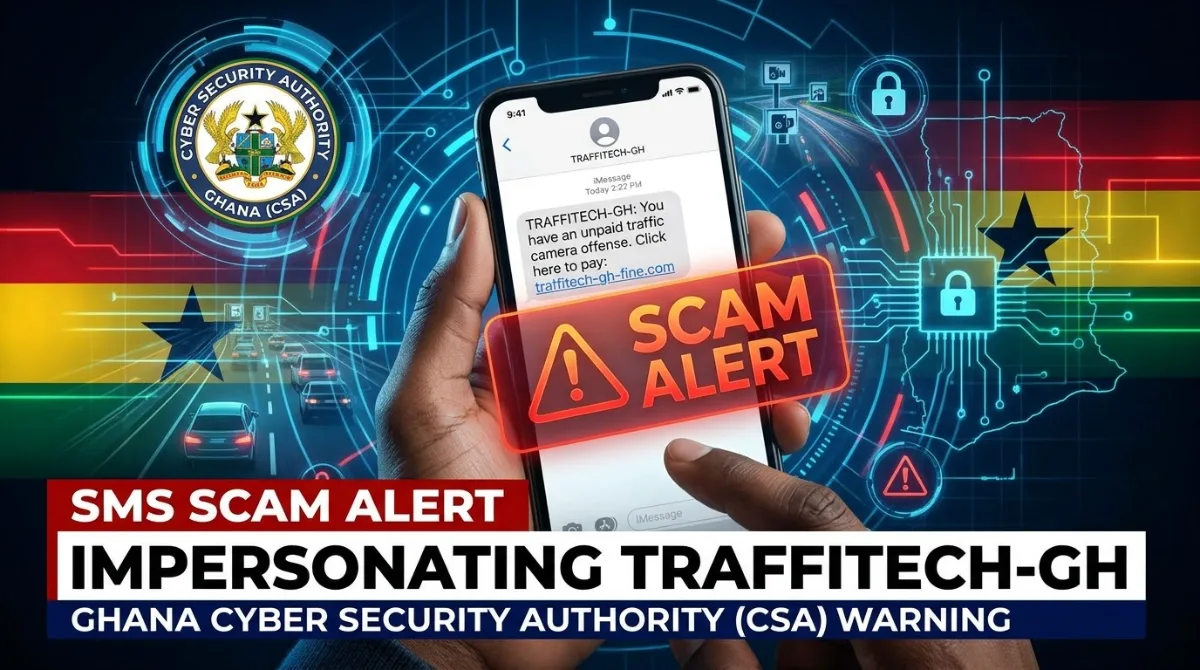
Just nine days after the Ghana Police Service launched its automated traffic enforcement system, scammers were already exploiting it.
Ghana's Cyber Security Authority (CSA) issued a public alert on November 9, 2026 — reference number CSA/CERT/MPA/2026-11/01 — warning the public about fraudulent SMS messages impersonating TraffiTech-GH, the Ghana Police Service's newly deployed automated traffic offence enforcement platform. The goal: steal motorists' payment card and banking credentials.
How the Scam Works
The fake messages accuse recipients of traffic violations — speeding, in most reported cases — and push them to click embedded links or use provided payment channels to view the alleged offence and pay a fine. To make the claims believable, the messages include fabricated ticket numbers and vehicle details.
Clicking those links sends victims to fraudulent payment portals that harvest sensitive financial data: debit or credit card numbers, expiry dates, and Card Verification Values (CVVs). The fraudsters have also included USSD codes as alternative payment options, adding a layer of authenticity designed to pressure people into acting fast.
TraffiTech-GH Is Only Days Old
TraffiTech-GH was officially rolled out by the Ghana Police Service on November 1, 2026, to automate the detection and enforcement of traffic violations. The speed at which fraudsters have moved to exploit the new system — impersonating it before most Ghanaian motorists even understand how it works — reflects a pattern increasingly common in online safety incidents across Africa, where new digital services become scam vectors almost immediately after launch.
Because TraffiTech-GH is new, many motorists do not yet know what a legitimate notification looks like. That unfamiliarity is exactly what scammers are counting on.
How to Spot a Legitimate TraffiTech-GH Message
The CSA says authentic traffic violation notifications from TraffiTech-GH arrive via the official sender ID GPS-MTTD — not from ordinary mobile phone numbers. If a message about a traffic fine is coming from a regular number, it is not legitimate.
Motorists who want to verify an alleged offence should use their Electronic Notice of Violation (ENV) or physical ticket, checking the vehicle photograph, number plate, location, date, and time recorded in the notice.
Where to Actually Pay Your Fine
According to the CSA, legitimate traffic fine payments must go through one of two official channels only: the National Investment Bank (NIB) Payment Portal, or by dialling *7100# and following the prompts using the ticket number. The authority has explicitly warned against making any payments to personal Mobile Money numbers or unofficial accounts.
The CSA advised motorists to avoid clicking links in unsolicited SMS messages alleging traffic violations or outstanding fines, and warned against sharing card details, banking credentials, Mobile Money PINs or one-time passwords (OTPs) through such messages.
The authority's alert comes as AI-assisted phishing and smishing operations across West Africa are becoming faster and more convincing, often launching within days of a new government digital service going public.
Motorists who receive suspicious messages claiming to be from TraffiTech-GH are urged to report them directly to the Cyber Security Authority and not to engage with any links, USSD codes, or payment requests embedded in those messages.