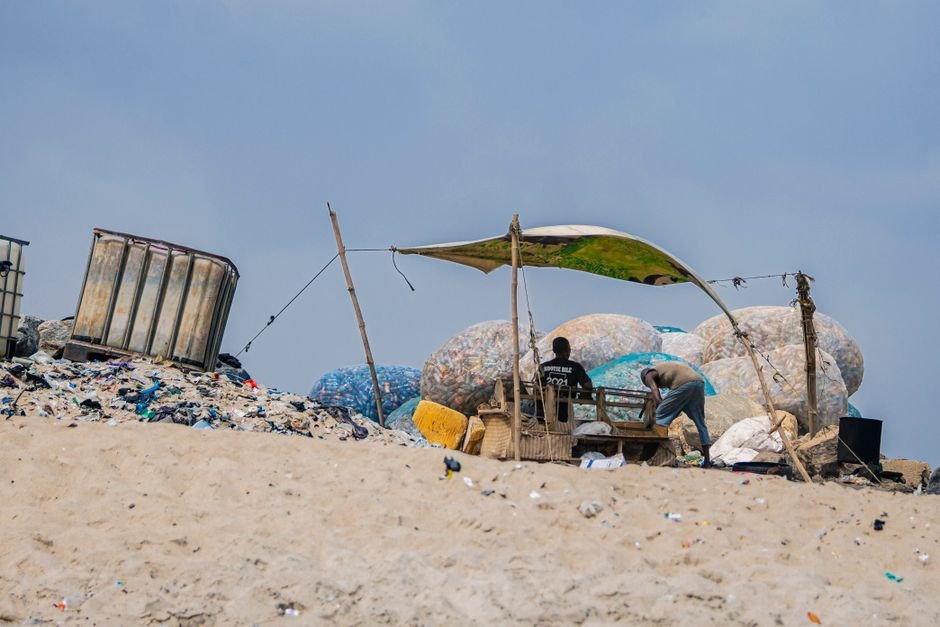
The waste mountain at Agbogbloshie is, by one minister's estimate, as tall as a 10-storey building. Before Ghana can clear it, the government first needs to know exactly how much is there — and that is where drones and artificial intelligence come in.
Local Government, Chieftaincy and Religious Affairs Minister Mahama Ayariga has confirmed that technical teams are currently using drone surveys and AI-powered analysis to map the site and calculate the logistical requirements for a large-scale evacuation. The operation, he says, has become a national priority.
A Heap That Has Grown for Decades
Agbogbloshie, located in the heart of Accra, has long been associated with informal e-waste processing and general refuse accumulation. The current waste mountain, however, has grown to a scale that the minister describes as alarming. Ayariga disclosed that he visited the site three times within his first week in office, and on his most recent visit, he physically climbed to the top of the heap.
The size of what he found clearly made an impression. He estimated the pile stands at roughly the height of a 10-storey building — a striking image for a site sitting in one of West Africa's busiest capital cities.
A Presidential Directive and a Multi-Agency Response
President John Dramani Mahama has directed four ministries — Local Government, Finance, Roads and Highways, and Defence — to jointly develop a clearance plan. That level of cross-ministerial coordination signals how seriously the administration is treating the problem.
On the ground, the operation will pull in a wide range of institutions. The Ghana Armed Forces, the Jospong Group, private contractors, and dump trucks from Metropolitan, Municipal and District Assemblies are all being mobilised. Meanwhile, the drone and AI-powered mapping exercise is running in parallel to determine exactly how many trucks and how much heavy-duty equipment the job will actually require.
Waste removed from the site will be transported to an engineered landfill off the Nsawam Road. Authorities are also considering a 24-hour continuous operation, though that is subject to final arrangements and approval from President Mahama.
Traffic Disruption Expected — And Accepted
Moving hundreds of trucks through Accra will not be quiet or painless. Ayariga acknowledged the operation would temporarily disrupt traffic in and around the area, but he was unapologetic about asking Ghanaians to bear it.
"Let all of us be inconvenienced by the problem, and if we are all sufficiently inconvenienced by the problem, the danger of reverting to the problem will be minimised." — Minister Mahama Ayariga
It is a candid framing. The minister is essentially arguing that making the clearance painful enough for the public to feel it is part of what will prevent the site from returning to its current state.
Technology as the First Step
Using drones and AI for the assessment phase is not just a logistical convenience — it is a sign of how complex the problem has become. Manual surveys of a heap this size would be both slow and potentially hazardous for workers.
The technology enables planners to get precise volumetric data, model removal sequences, and calculate fuel, truck, and personnel requirements before a single loader arrives on site. It is an approach that reflects a broader shift in how African governments are beginning to apply AI tools to urban infrastructure problems that have resisted conventional solutions for years.
What happens after the clearance — and whether Agbogbloshie can be kept clear — will depend on longer-term waste management systems that the government has not yet detailed publicly. But for now, the immediate goal is clear: measure first, then move.