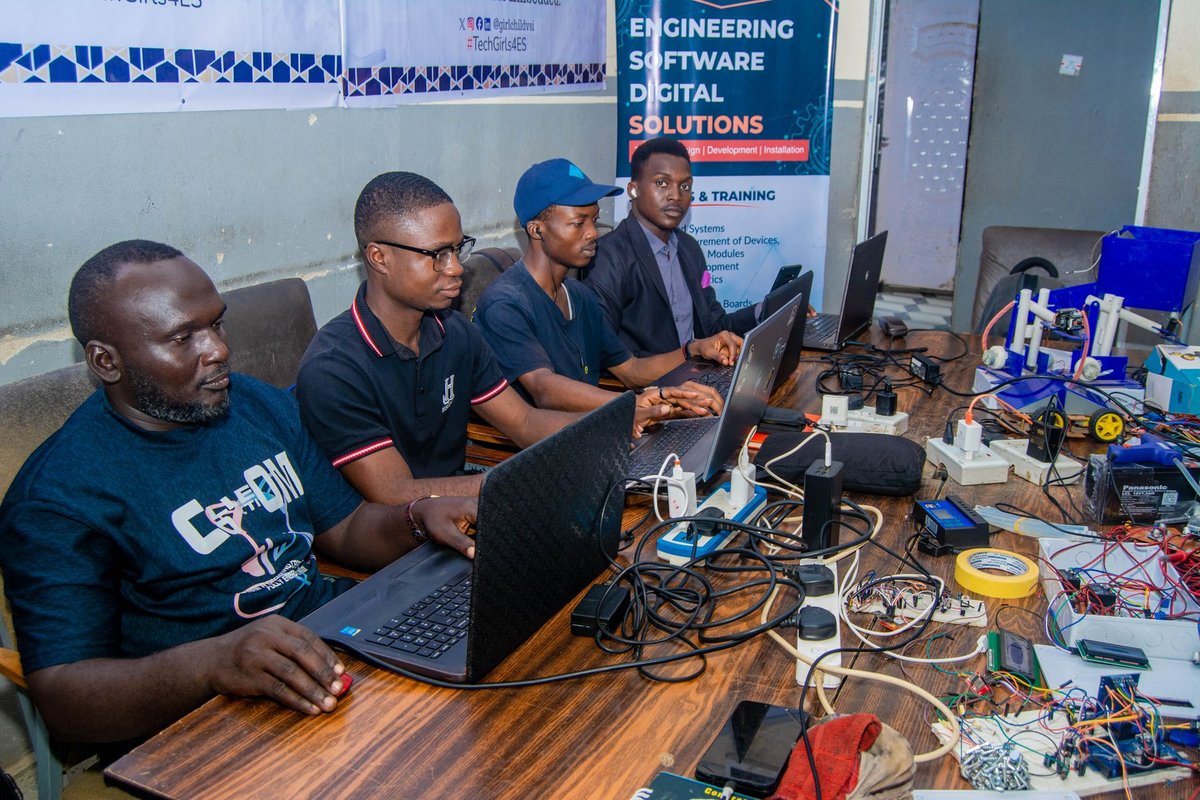
More than 140,000 people have already signed up for Ghana's One Million Coders Programme — and that number is the backdrop to a bigger argument Ghana is making on the world stage: that the next wave of technology must work for everyone, not just the countries that build it first.
Samuel Nartey George, Ghana's Minister for Communication, Digital Technology and Innovations, made that case at the International Telecommunication Union (ITU) Plenipotentiary Conference 2026, currently underway in Doha, Qatar. Speaking on a panel dedicated to emerging technologies, he pressed global leaders to design AI, satellite connectivity and other digital tools around people's actual needs — not just what is technically or commercially convenient.
Storytelling as Policy Argument
Rather than lead with statistics, Minister George opened with four hypothetical Ghanaians to illustrate how decisions made in rooms like the ITU conference hall ripple into real lives — affecting whether a farmer in a rural district can afford data, whether a pregnant woman in a peri-urban clinic can get emergency medical guidance, or whether a young developer in Accra can compete fairly in a global digital economy.
One example stood out: an AI-powered maternal health service that allows pregnant women to call for emergency assistance using basic mobile phones, with no internet connection required. According to the Minister, that service alone has registered more than 7,000 mothers and expectant mothers at a single hospital in Ghana. It is the kind of real-world application that reframes the AI conversation from abstract potential to measurable impact — the sort of health technology deployment that rarely makes global headlines but quietly saves lives.
Connectivity Is not Enough on Its Own
George pushed back on the idea that simply extending network coverage constitutes meaningful digital inclusion. Connectivity, he argued, must also be affordable, reliable and genuinely useful to the communities it reaches. Without locally relevant content, local language support and real skills development, infrastructure alone solves only part of the problem.
He also raised a pointed concern about satellite spectrum and orbital resources — the physical and regulatory infrastructure that underpins satellite internet services now expanding rapidly across Africa. His argument: these are finite, shared global resources, and the current trajectory risks allowing early-launching nations and corporations to effectively claim them by default.
"The question is not whether AI will shape Africa, but whether Africa will help shape AI." — Samuel Nartey George, Ghana's Minister for Communication, Digital Technology and Innovations
That line cuts to the heart of what Ghana is arguing at the ITU. It is not a rejection of AI or satellite tech — it is a demand for a seat at the table where the rules are written.
AI That Understands Local Realities
On artificial intelligence specifically, George called for systems that are accountable and responsible — ones that recognise local languages, reflect the lived realities of diverse communities, and include clear avenues for explanation and redress when automated decisions go wrong. That last point matters more than it might seem: across Africa, AI systems trained predominantly on Western data are already making decisions about credit, healthcare and employment that many users cannot understand or challenge.
The broader ask is for stronger cooperation between governments, technology companies, universities and civil society to develop cross-border policies and standards — a push that ties directly into Ghana's advocacy for technology transfer, South-South cooperation and international partnerships that build local capacity rather than long-term dependency.
One Million Coders: The Domestic Proof Point
The One Million Coders Programme is Ghana's most visible domestic bet on that future. With registrations now exceeding 140,000, it is not just a headline figure — it is the Minister's evidence that demand for digital skills in Ghana is real and urgent. George was clear that the goal is not to train a generation of passive tech consumers. Young Ghanaians, he said, must be equipped to build solutions, drive innovation and participate as full contributors to the digital economy.
The momentum behind the programme, combined with Ghana's posture at the ITU, signals a deliberate strategy: build the talent pipeline at home while simultaneously fighting for fairer rules globally. For African nations watching how AI governance shapes up over the next decade, Ghana's dual approach — domestic investment paired with international advocacy — may well be the template.