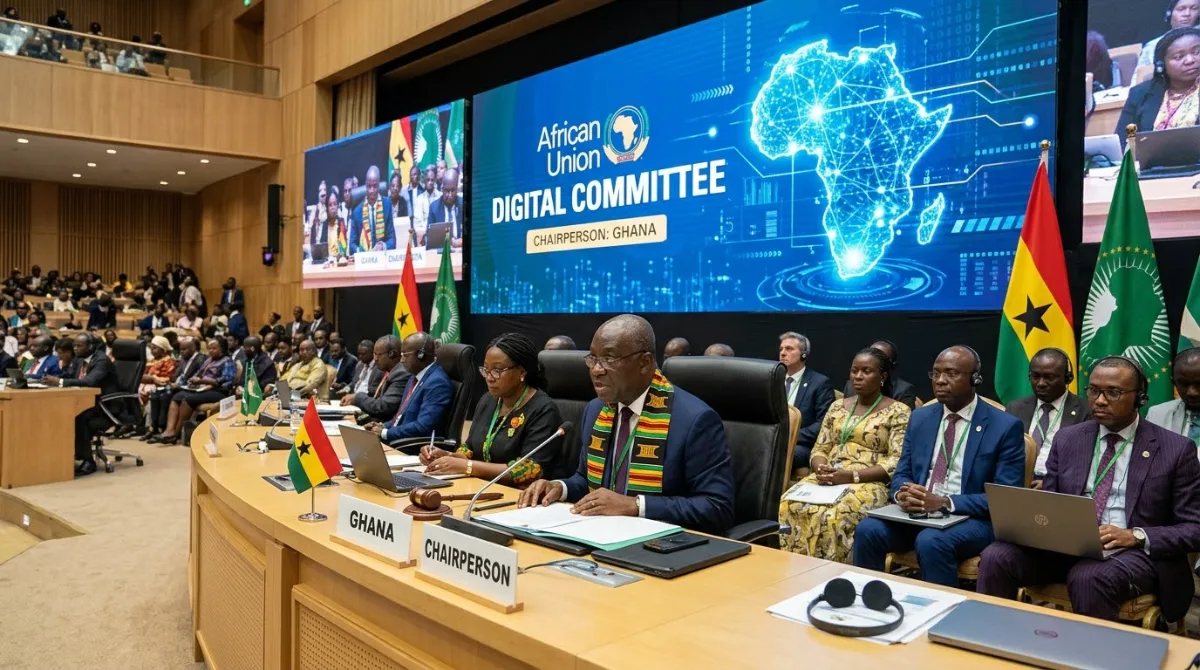
Africa's digital integration push just got a new driver. Ghana has assumed the two-year chairmanship of the African Union's Specialised Technical Committee on Communication and Information and Communication Technology (STC-CICT), with Communications Minister Samuel Nartey George taking the seat from Lesotho's outgoing chair Nthati Moorosi.
The handover happened at the Sixth Ordinary Session of the STC-CICT, held in Libreville, Gabon, where ministers from across the continent gathered to press for sharper, faster action on digital policy — not more strategy documents, but real implementation.
From Frameworks to Action
Sam George did not mince words about where Africa currently stands. The continent already has the Digital Transformation Strategy, the Continental Artificial Intelligence Strategy, the Data Policy Framework, and the Malabo Convention — but those frameworks have not translated into on-the-ground progress fast enough.
His central argument: Africa needs to stop thinking of itself as 55 separate economies and start acting as a single market of nearly 1.5 billion people. Connectivity, data governance, cybersecurity, and artificial intelligence should be treated as urgent national and continental priorities — not aspirational targets.
George also pointed to Ghana's One Million Coders Programme as a concrete example of how to build digital skills among young people, signalling the kind of practical initiatives he wants the committee to champion.
Infrastructure as the New Roads
Lerato D. Mataboge, the African Union Commission Commissioner for Infrastructure and Energy, made the case that digital infrastructure now sits in the same category as roads, ports, railways, and electricity — it is not optional, it is foundational to economic development.
She called for serious investment in cross-border fibre networks, regional data centres, internet exchange points, cloud infrastructure, and last-mile connectivity. That last part is critical — without reaching underserved communities, any continental digital market risks deepening existing inequalities.
"Africa does not suffer from a shortage of digital strategies… What we require now is sustained financing, stronger institutions and the courage and focus to implement our commitments," — Lerato D. Mataboge, AU Commission Commissioner for Infrastructure and Energy
Mataboge urged governments to synchronise their infrastructure, energy, and digital investment plans, and to advance the African Continental Free Trade Area's Protocol on Digital Trade. She specifically flagged digital identity systems, cross-border payments, electronic transactions, and data governance as the building blocks of a truly integrated market.
To fund all of this, she pushed for dedicated continental financing facilities alongside blended finance instruments, guarantees, and public-private partnerships — particularly to unlock capital in markets that private investors tend to skip over.
Gabon's Role as Host
Mark-Alexandre Doumba, Gabon's Minister of Economy, Digitalisation and Innovation, also addressed the session as the host nation representative. His presence underlined how central Libreville has become to continental policy conversations this year — the city's role as a neutral meeting ground for African Union technical sessions continues to grow.
What Ghana's Leadership Signals
Ghana's assumption of this chairmanship is not just symbolic. The country's track record on AI and digital policy discussions in recent years has positioned it as one of West Africa's most vocal advocates for continental tech integration. Leading the STC-CICT gives Accra a formal platform to shape how those policies are prioritised and monitored across all 55 AU member states.
The Single African Digital Market — the committee's headline ambition — would, if realised, make it significantly easier for businesses and consumers to access digital services and move money across national borders. For African cybersecurity and data governance frameworks, the two-year window under Ghana's leadership will be a critical test of whether the continent can move from drafting agreements to enforcing them.
The next two years will show whether this transition marks a genuine turning point — or just another well-attended summit.