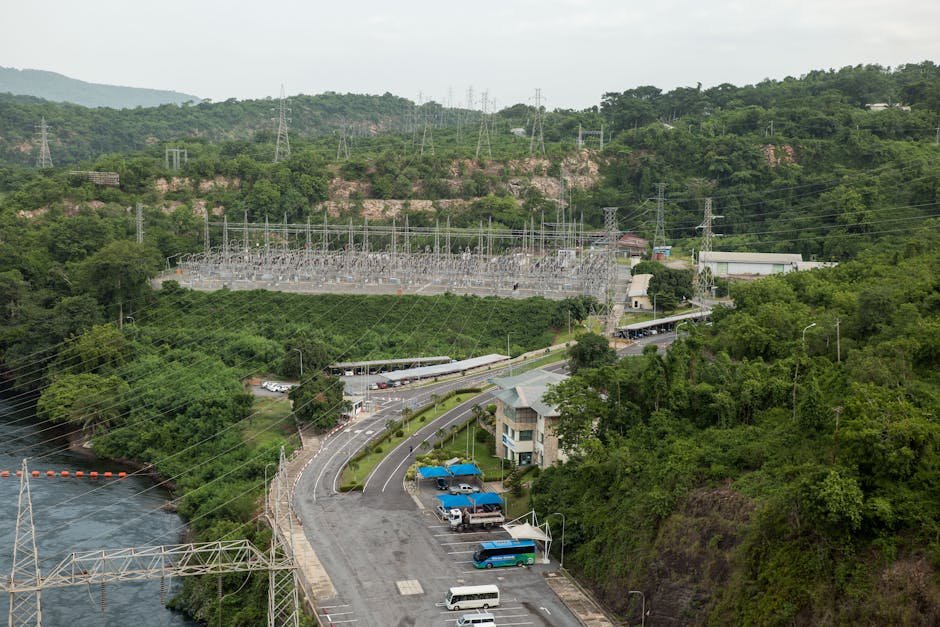
A fire outbreak at an Akosombo Dam substation has knocked out approximately 1,000 megawatts from Ghana's national electricity supply, forcing the shutdown of the country's largest hydroelectric facility and exposing critical weaknesses in the power system.
Richmond Rockson, Head of Communications at the Ministry of Energy and Green Transition, revealed the full scale of the crisis during an appearance on Joy FM's Super Morning Show on Friday, April 24. Notably, how this single incident has removed nearly a quarter of Ghana's total power generation capacity.
"Our peak demand is about 4,400 megawatts. Akosombo gives us approximately 1,000 megawatts, and as we speak, we have lost close to that," Rockson explained.
Dangerous Lack of Reserve Capacity
The impact has been particularly severe because Ghana operates without adequate backup power. This is frankly a recipe for disaster in any modern power grid.
Rockson admitted the country lacks the standard safety margins recommended for stable electricity systems. "Unfortunately, we do not have enough reserve margin. In any power system, to be efficient, you should have about 20 per cent of your generation as reserve so that in case of emergencies like this, you can fall on it," he stated.
The Ministry official traced this vulnerability to challenges in expanding power generation over recent years. "As a result, when Akosombo went off, a significant part of the system was affected," Rockson noted.
Government Response Plans
Despite the crisis, Rockson outlined ambitious plans to strengthen Ghana's power infrastructure. The government has announced intentions to add 1,200 megawatts of new generation capacity.
Cabinet has already approved a 200-megawatt solar project with battery storage, marking a shift toward renewable energy solutions. Additional projects targeting 200 to 400 megawatts are also in development to build proper reserve margins.
Gas Supply Remains Stable
In contrast to the Akosombo situation, Rockson confirmed that gas supply infrastructure continues operating normally. Ghana Gas has maintained steady deliveries to the Tema power plant, providing 120 million standard cubic feet of gas as of the previous night.
"Let me clarify that Ghana Gas has no issue as we speak. They have been supplying gas to the Tema plant," Rockson emphasized.
A minor technical fault at the gas processing facility was quickly resolved by switching from automation to manual operations, then back to automated systems once repairs were completed.
Recovery Efforts Underway
While acknowledging the severity of losing 1,000 megawatts, Rockson expressed confidence in engineering teams working to restore normal operations. The timeline for full restoration remains unclear, but the Ministry appears focused on both immediate fixes and long-term system improvements.
This incident serves as a wake-up call for Ghana's energy sector, which clearly needs more resilient infrastructure and diversified generation sources. The country cannot afford to operate so close to capacity limits without proper backup systems in place.