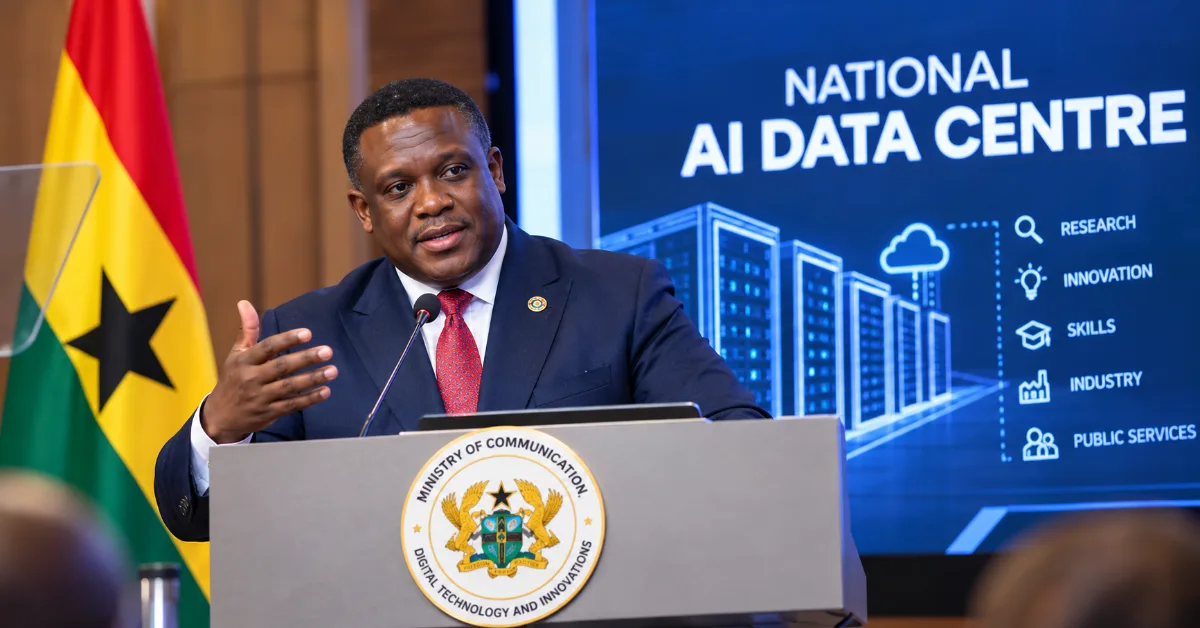
Ghana has set a 24-month deadline to complete the first phase of a national AI computing facility — a move that could significantly reduce the country's dependence on foreign cloud computing services for artificial intelligence research and development.
The announcement came from Samuel Nartey George, Minister for Communication, Digital Technology and Innovations, speaking at the JoyNews Digital Economy Forum on AI and the Ghana Economy on Wednesday, October 21. George confirmed that procurement processes are already underway through the Public Procurement Authority (PPA) to acquire the data centre infrastructure and related equipment.
"We are currently going through procurement with PPA on getting a data centre, the computer infrastructure and all the various parts of it put together. 24 months from now, we should have phase one completed with serious computing infrastructure that we can then give to our researchers, our industry and our universities who are currently buying tokens outside the country and buying capacity outside the country." — Samuel Nartey George, Minister for Communication, Digital Technology and Innovations
That line about buying tokens abroad says everything. Right now, Ghanaian universities, startups, and research institutions routinely pay foreign cloud providers — think AWS, Google Cloud, Azure — just to access the processing power needed to run AI models. The proposed facility is intended to bring that capacity onshore.
What the Facility Will Do
Training AI models and running large-scale data analysis demands serious computing horsepower. The planned national facility would provide exactly that kind of infrastructure to local researchers and businesses, removing the current bottleneck of sourcing it externally. George positioned the project as foundational work for Ghana's broader participation in the global AI economy.
The facility's real-world impact, however, will depend on more than just getting it built. Factors like capacity, affordability, reliability, and how accessible it is to smaller institutions and startups will determine whether it genuinely moves the needle for Ghana's AI development ecosystem.
A First Step, Not a Fix-All
George was careful to manage expectations. He acknowledged that completing phase one within the remaining period of the Mahama administration would be an initial milestone — not a comprehensive solution to Ghana's AI ambitions. The minister described this as "a long journey," signalling that sustained investment and policy follow-through will be needed well beyond this first phase.
That candour is notable. Too often, infrastructure announcements in Africa arrive wrapped in sweeping promises. George's framing — that this is one step in a much longer process — suggests the government is thinking in terms of a multi-phase build-out rather than a one-time project.
Why Computing Infrastructure Matters for AI
Access to local compute is increasingly seen as a strategic priority for nations looking to participate meaningfully in the AI economy. Countries that rely entirely on foreign infrastructure for AI training and deployment face cost disadvantages, data sovereignty concerns, and slower development cycles.
Ghana's push for sovereign computing capacity fits into a wider continental trend. Several African nations are investing in local data centre infrastructure to support digital economies, reduce forex outflows on cloud services, and build local technical expertise. Whether Ghana can execute within its 24-month window will be closely watched.
The PPA procurement process is currently ongoing. No contractor or vendor has been publicly named at this stage.