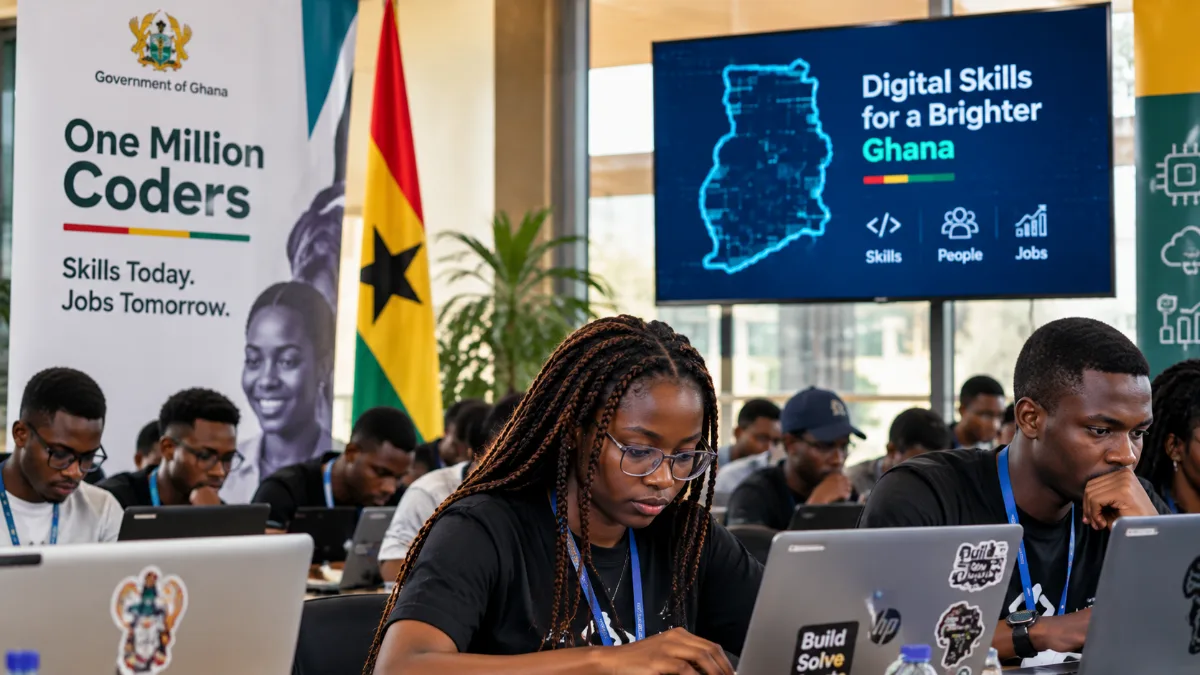
Ghana's government has set an ambitious target: 100,000 digitally enabled jobs within the next two years, as its flagship One Million Coders Programme moves beyond training and into direct employment creation.
Minister for Communication, Digital Technology and Innovations, Samuel Nartey George, announced the shift on Monday, October 13, during a monitoring visit to the Ashanti Region. He said the pivot came on the back of a direct directive from President John Dramani Mahama, who wants programme graduates to have clear job pathways after completing their training.
From Classrooms to Careers
The One Million Coders Programme was a National Democratic Congress manifesto commitment to train one million Ghanaians in digital skills over four years. That training target has not been abandoned — George said the Ministry had already presented the President with progress reports and remained confident the one-million mark would be crossed within the administration's term.
But the emphasis is clearly changing.
"We have shown His Excellency the trajectory the programme is on; we will cross a million in the four years. We are pivoting now away from the training into the job creation," Samuel Nartey George said during the Ashanti Region visit.
The Ministry is now actively working to connect trained participants with businesses that need digital expertise — both locally and internationally. George specifically highlighted growing demand from international companies looking to outsource digital work to Ghana, positioning the country as a destination for that kind of skilled labour.
10,000 Data Annotators Already in the Pipeline
One concrete outcome the Minister pointed to was a pool of 10,000 data annotators the programme has already developed. These are workers whose skills can be matched to businesses seeking people for specific digital assignments — a sector that is expanding rapidly as global demand for AI-related data work grows.
Data annotation — tagging and labelling datasets used to train AI systems — has become a growing source of digital employment across Africa, and Ghana's push to formalise a workforce around it signals the government sees real commercial potential there.
Ashanti Region Site Visits
George's monitoring visit took him to several facilities across the Ashanti Region. He toured training centres and artificial intelligence laboratories at Kwame Nkrumah University of Science and Technology (KNUST), before proceeding to sites at Kwadaso, Asawase, and Nkwantakese. The tour was framed as part of a broader effort to assess implementation progress at various training centres across the region.
The visits reflect the government's attempt to show that the programme is not just a headline figure — that real infrastructure and real people are being touched across the country, not just in Accra.
Building Ghana's Digital Workforce
The broader vision, as George described it, is to build a large enough pool of skilled digital workers to reliably serve international demand. Ghana's growing tech talent pipeline has drawn attention from global firms in recent years, and the government appears to be betting that scale — one million trained workers — will make the country a more attractive outsourcing destination.
Whether the 100,000 jobs target is met within two years will depend heavily on how quickly the Ministry can forge those business connections and translate training certificates into actual employment contracts. That work, George suggested, is now the programme's top priority.