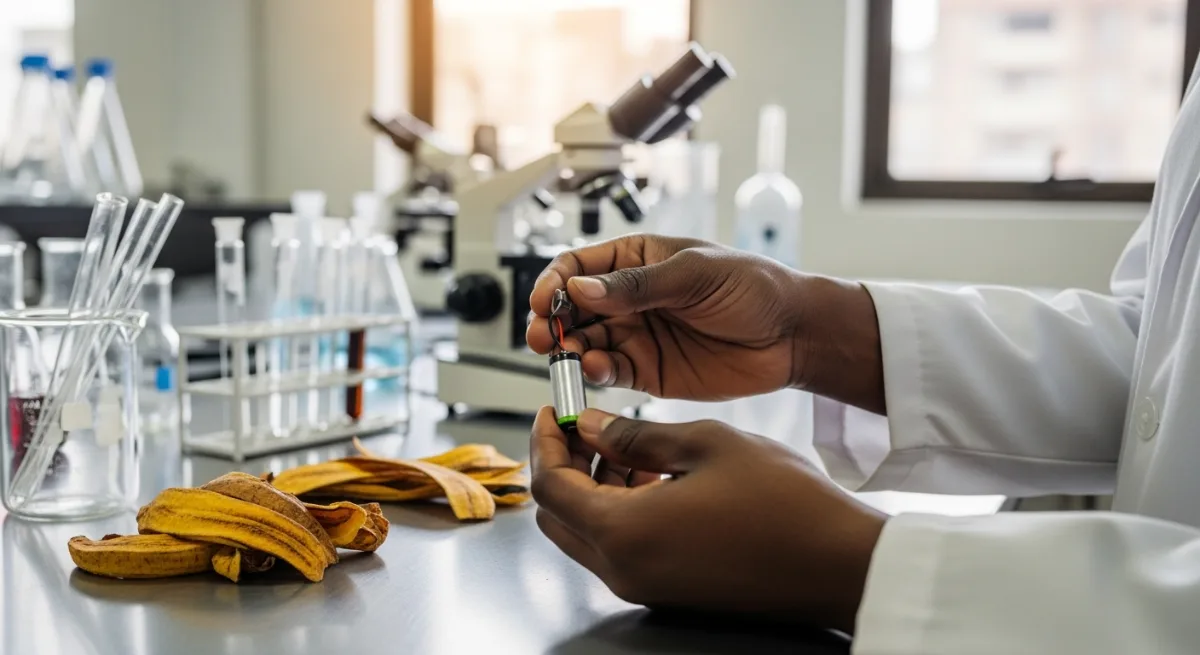
Scientists at Imperial College London are making remarkable progress converting everyday African food waste into battery materials that could power small electronic devices. Notably, how this research directly addresses two critical issues: Africa's massive food waste problem and the global battery industry's reliance on scarce materials like lithium and cobalt.
Dr. Kamogelo Modisane, a South African chemist in Imperial College's Department of Chemical Engineering, leads this innovative work. She transforms cassava peels, plantain skins, and other organic kitchen waste through a process of drying, grinding, and heating to create hard carbon materials for sodium-ion battery anodes.
"We use things you can find in your own home. Anything with starch, lignin, and cellulose can become a source for our battery materials," Dr. Modisane explains.
Breaking Free from Critical Materials
The research team deliberately avoids the supply chain vulnerabilities that plague traditional battery manufacturing. Instead of lithium and cobalt, they work with sodium and locally available African minerals including iron and vanadium.
Dr. Modisane emphasized the strategic importance of this approach: "We are trying to move away from critical materials like lithium, cobalt, and graphite. With biomass and locally available minerals, we can make batteries without worrying about shortages."
AI-Powered Battery Discovery
The research operates through the Automated High-Throughput Facility for Advanced Energy Research (DIGIBAT), which Imperial College describes as the UK's first self-driving laboratory for energy research. I found it fascinating how robots handle the entire process - synthesizing compositions, fabricating electrodes, and testing miniature batteries while artificial intelligence analyzes results and suggests improvements in real time.
This automated workflow compresses materials discovery timelines from years to months. Dr. Emma Antonio works alongside Dr. Modisane, focusing specifically on aluminum-based batteries using advanced surface-coating techniques to extend battery lifespan.
European Investment and African Impact
DIGIBAT participates in a European battery innovation project running from February 2025 to July 2028, backed by a 19.95 million euro budget. The project aims to accelerate development of high-performance, sustainable battery technologies.
Science journalists from West Africa, including Ghana and Nigeria, recently observed this automated workflow during visits as part of the UK-Ghana Science, Technology and Innovation (ST&I) Media Training Programme.
Sustainable Energy Future
The implications for Africa are significant. The continent's food waste crisis could become an opportunity for sustainable battery manufacturing. Converting organic waste that would otherwise decompose in landfills and release methane into useful battery components addresses environmental concerns while building local capacity.
The team's anodes are compatible with pouch cells commonly found in power banks and wristwatches, making this technology immediately applicable to consumer electronics. This research aligns perfectly with our AI coverage of how artificial intelligence accelerates scientific discovery.
I believe this work represents exactly the kind of innovation Africa needs - taking local challenges and turning them into technological advantages. The combination of addressing food waste, reducing dependence on imported materials, and creating new economic opportunities makes this research particularly compelling for the continent's future.