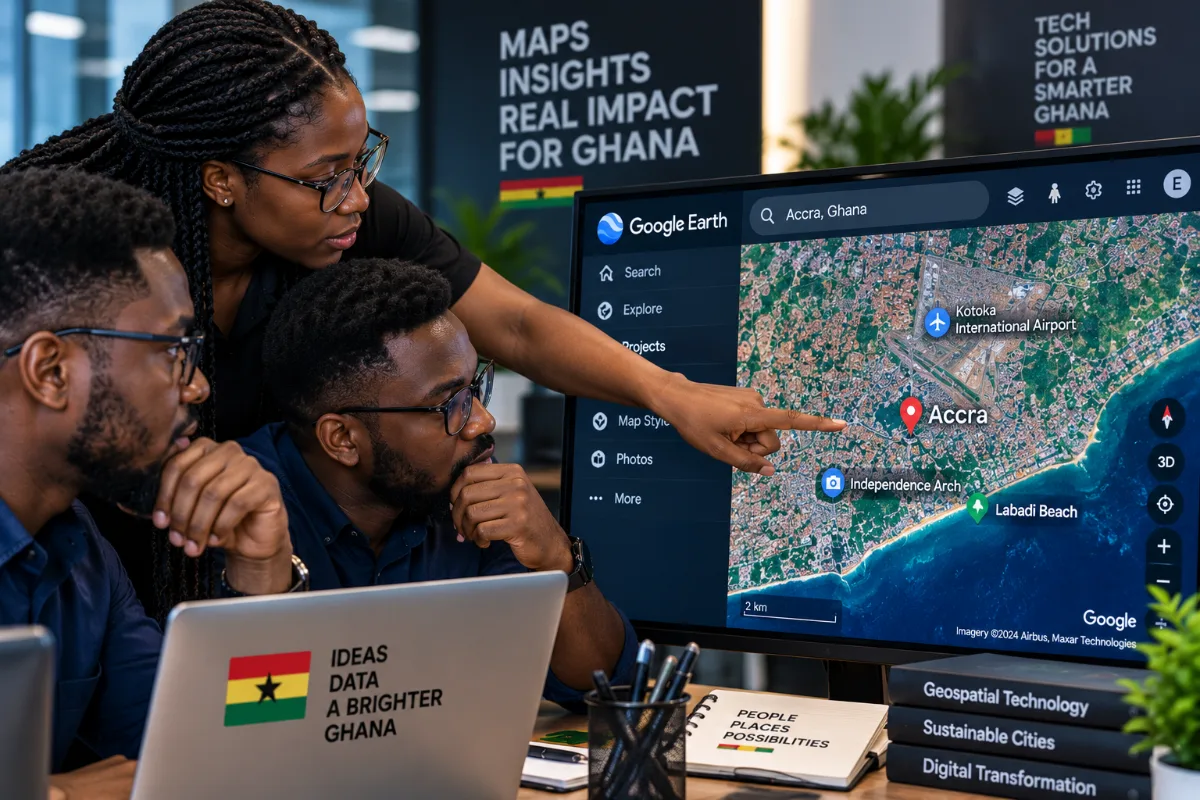
It took less than 24 hours. On July 30, Google quietly launched a generative AI feature inside Google Earth — the platform that open-source investigators have trusted for two decades as the closest thing to ground truth in conflict zones. Within hours, users had already conjured a fake nuclear plant in Iran, a fabricated bomb crater next to a Gaza hospital, and AI-generated floodwaters surrounding the U.S. Capitol.
By the next day, Google had pulled the feature following an outcry from investigative journalists and verification experts. The company said it would return "with stronger guardrails." The damage, however, had already been done.
Why This Particular Platform Mattered
Google Earth is not just any mapping tool. It is the platform on which open-source investigators are formally trained for conflict work — Syria, Yemen, Sudan. Since Israel and the U.S. launched strikes against Iran in February, plunging the Gulf region into a full information war alongside a military one, satellite imagery had become one of the few remaining anchors of verifiable reality.
The new feature changed that calculus entirely. Users could zoom in to real geographic coordinates, type a text prompt, and receive a photorealistic AI-generated scene blended directly into actual satellite and aerial imagery. It was not a separate creative tool — it was baked into the interface that analysts and journalists use specifically because it is not supposed to be editable.
A Pattern That is Becoming Familiar
Faking satellite imagery is not new. Google's own watermarks had previously exposed its Gemini AI model being used to fabricate satellite evidence — a tactic linked to Iran's state-affiliated propaganda operations. But those were external misuses of AI tools. The July 30 feature made the fabrication native to Google Earth itself, dramatically lowering the barrier.
The sequence of events fits a now-recognizable pattern in AI product development. A new generative tool launches. Harmful content follows almost immediately. Public pressure mounts. The company withdraws the product and promises the guardrails it could have built before launch.
"New ways to fabricate launch overnight, a storm of criticism ensues, and guardrails arrive only after the harm" — a description that applies equally to the Google Earth incident and to a string of similar AI product recalls in 2025 and 2026.
OpenAI shut down its Sora video app in March, months after a flood of abusive content involving women and problematic recreations of historical figures had already spread widely. The recalls are treated as proof that the system works. Critics argue they are proof it does not.
Veo 3 and the Watermark Problem
Product recalls are the exception, not the rule. Google's Veo 3 video generator, launched in May 2025 — just weeks before the Israel-Iran conflict began — illustrates what happens when a tool is not recalled. Within days of the first strikes, AI-generated videos of missile barrages over Tel Aviv were circulating on social media, many still carrying the Veo watermark.
That did not last. Users quickly became sophisticated enough to crop out the visible watermark before sharing. Watermarking, as a verification strategy in AI-generated content, only works on platforms that enforce it — and only for users who do not know how to remove it.
The situation was further complicated by a U.S. government directive ordering satellite companies to restrict journalist access to imagery from the conflict region, citing wartime security concerns. As the supply of real, verifiable imagery narrowed, fabricated alternatives filled the gap.
The Cost to Verification Infrastructure
For the online safety and digital verification community, the Google Earth incident represents something more corrosive than a single bad product decision. It introduces doubt into a tool that derived its entire value from being doubted. Once users know that Google Earth imagery can be AI-generated, every image from the platform carries a question mark — even the real ones.
That is the part that a 24-hour recall cannot fix. Google can remove the feature. It cannot remove the knowledge that the feature existed, or reassure analysts that the imagery they are examining predates it. In a conflict where satellite images are often the only independent window into what is happening on the ground, that uncertainty has real consequences.
Google's promise of a return "with stronger guardrails" may well materialize. But the verification community will be watching — and so will the propagandists who spent those 24 hours figuring out exactly what the tool could do.