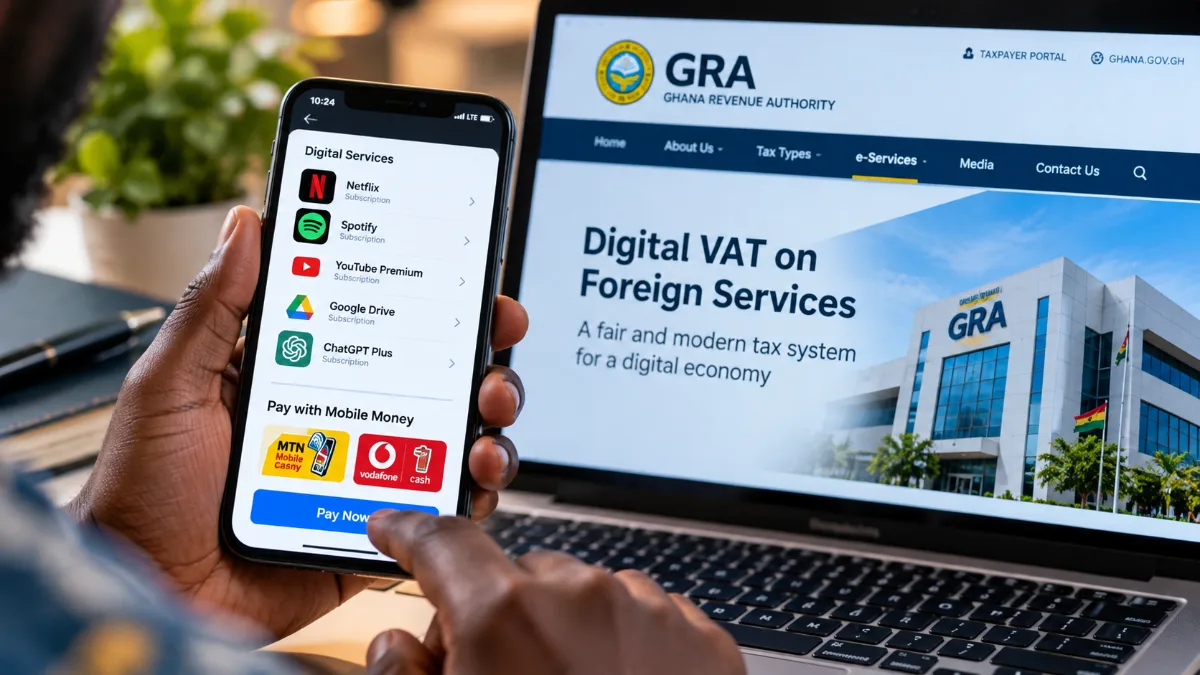
Ghana's tax authority has moved to clear up a significant misconception about its new digital VAT collection system — and the clarification has direct implications for millions of Ghanaians who pay for streaming services through mobile money.
Speaking on Joy FM's Super Morning Show on Wednesday, 14th October, Ghana Revenue Authority (GRA) Commissioner-General Anthony Kwasi Sarpong confirmed that the Real-Time VAT framework extends well beyond bank card transactions. Any qualifying payment made through a mobile money account or digital wallet will also be captured by the system.
"So it is not only for a card. Assuming you are also using your mobile to pay, that will also be captured," Sarpong said.
The clarification came after questions arose about whether consumers who pay through standing orders or direct debits — rather than traditional bank cards — would fall under the new collection mechanism. Sarpong's answer was unambiguous: the payment channel does not matter. If it is digital and it is qualifying, it is in scope.
How the Split-Payment Mechanism Works
At the technical level, the system is designed to intercept a payment the moment it is processed and divide it into two portions automatically. The tax component flows directly into a government account, while the remaining balance goes to the merchant or foreign service provider.
"So any other digital payment platform you are using, at the point of payment, the system will split the value into two," Sarpong explained.
The effective charge consumers already encounter is 20% — made up of a 15% VAT component, a 2.5% National Health Insurance Levy, and a 2.5% GETFund Levy. Services in scope include platforms like Netflix, Spotify, Zoom, and TikTok, among others. The GRA's earlier communications on digital services taxation had focused heavily on bank-issued cards, leaving mobile money users uncertain about their status.
No New Tax — Just Better Collection
Sarpong was emphatic on one point: the new framework is not adding a fresh layer of taxation. For services that already include VAT in their pricing, nothing changes for the consumer's pocket.
"So this system is not adding another 20 per cent to what you already pay. It is already embedded, and consumers are paying," he said.
What it does change is who collects and remits the tax. Currently, the GRA relies on foreign companies like Netflix to self-declare their transaction volumes and the VAT owed. That self-reporting model has obvious limitations — the authority cannot independently verify the figures.
The new system gives the GRA its own real-time record of transaction counts and values, independent of whatever the provider reports. Sarpong used Netflix specifically as an example, noting that the shift would significantly improve the authority's ability to verify compliance among non-resident digital service providers.
100 Non-Compliant Providers in the Crosshairs
The GRA says it intends to bring those non-compliant providers into the system gradually. The Real-Time VAT framework covers electronically supplied services from non-resident providers, paid for through Ghana-issued payment instruments — specifically including cards, mobile money accounts, and digital wallets.
Elsie Appau-Klu, Technical Advisor to the Commissioner-General, had previously explained that participating financial institutions would be responsible for collecting and remitting the tax at the point of payment, making the banks and payment processors the functional enforcement point rather than the foreign providers themselves. This matters for understanding consumer data and transaction oversight under the new regime.
The Real-Time VAT system represents a structural shift in how Ghana taxes the digital economy — moving from trust-based self-reporting by global tech giants to automated, transaction-level capture. With mobile money now explicitly included, the net has been cast considerably wider.