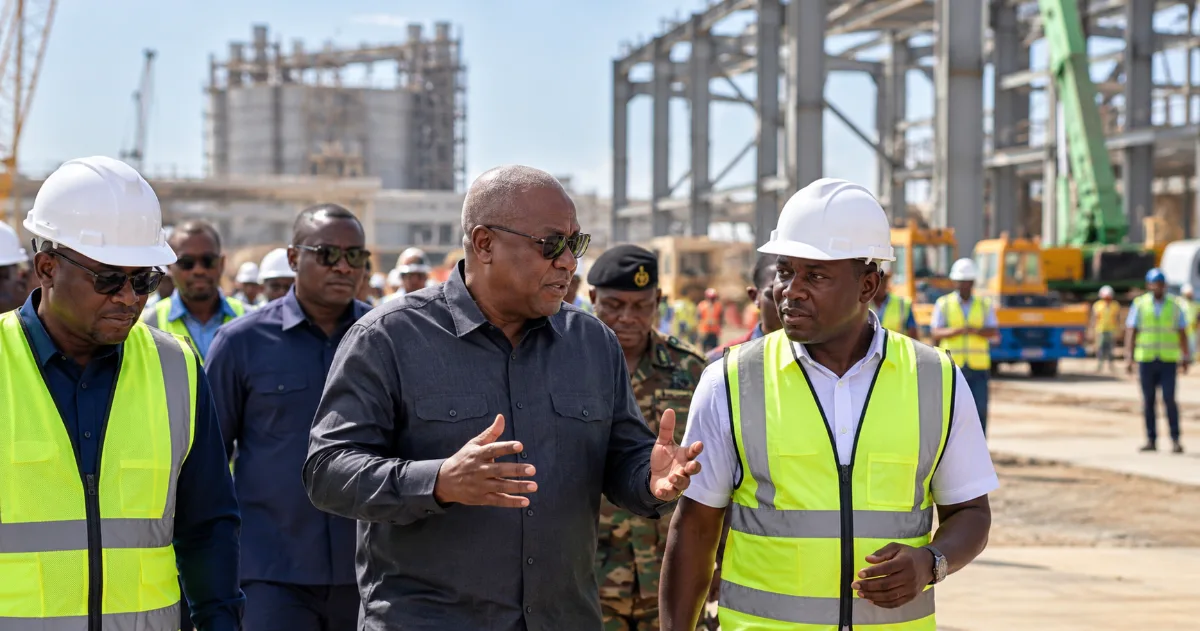
Ghana is making a serious industrial bet. President John Dramani Mahama on Thursday, October 15, 2026, announced plans to pump $2 billion annually over four years into the economy under the government's proposed $10 billion New Economy Programme — a sweeping initiative aimed at transforming Ghana into a manufacturing and logistics powerhouse for West Africa.
The announcement came as Mahama cut the sod for construction works at the Afienya Industrial Park, a project designed to expand Ghana's industrial capacity, attract fresh investment, and generate employment at scale.
Where the Money Goes
Half of the annual $2 billion allocation — a full 50% — is earmarked specifically for agriculture and agro-processing. The remaining funds will be directed toward industry and the infrastructure needed to connect producers to markets across the region.
Mahama framed the Afienya project as a direct response to investor demand that Ghana's existing facilities simply cannot meet. He noted that growing interest from investors, combined with limited space at the Tema Export Processing Zone, made the development of new industrial land a strategic necessity rather than just an ambition.
Land Security at the Heart of the Plan
Elizabeth Ofosu-Adjare, Minister for Trade, Agribusiness and Industry and Chair of the Board of the Ghana Free Zones Authority, used the occasion to spotlight a persistent bottleneck: land disputes. Drawing on her 22 years of experience at the Bar, she stressed that undisputed land is non-negotiable for industrial development.
Ofosu-Adjare underscored that access to land free from litigation was critical to helping businesses establish factories, expand operations, and avoid costly delays — and called for recognition of the cooperation shown by traditional authorities and local communities in making that possible.
It is a practical concern that has derailed previous industrial projects across the country. Factories stalled mid-construction, investors spooked by years-long court battles — these are not hypothetical risks in Ghana, and Ofosu-Adjare's emphasis on it signals the government is moving to get ahead of those problems this time.
The Regional Ambition
Ghana's goal is not just domestic growth. The New Economy Programme is explicitly designed to position the country as a regional industrial and logistics hub for West Africa — a market of over 400 million people with rapidly growing consumer and manufacturing demand. The technology and infrastructure dimensions of this kind of regional integration will be as important as the physical factories themselves.
Whether $2 billion a year — sustained over four consecutive years — actually lands in productive sectors will depend on implementation, investor confidence, and the kind of land and regulatory certainty Ofosu-Adjare is calling for. The Afienya sod-cutting is a visible starting gun. The real race begins now.