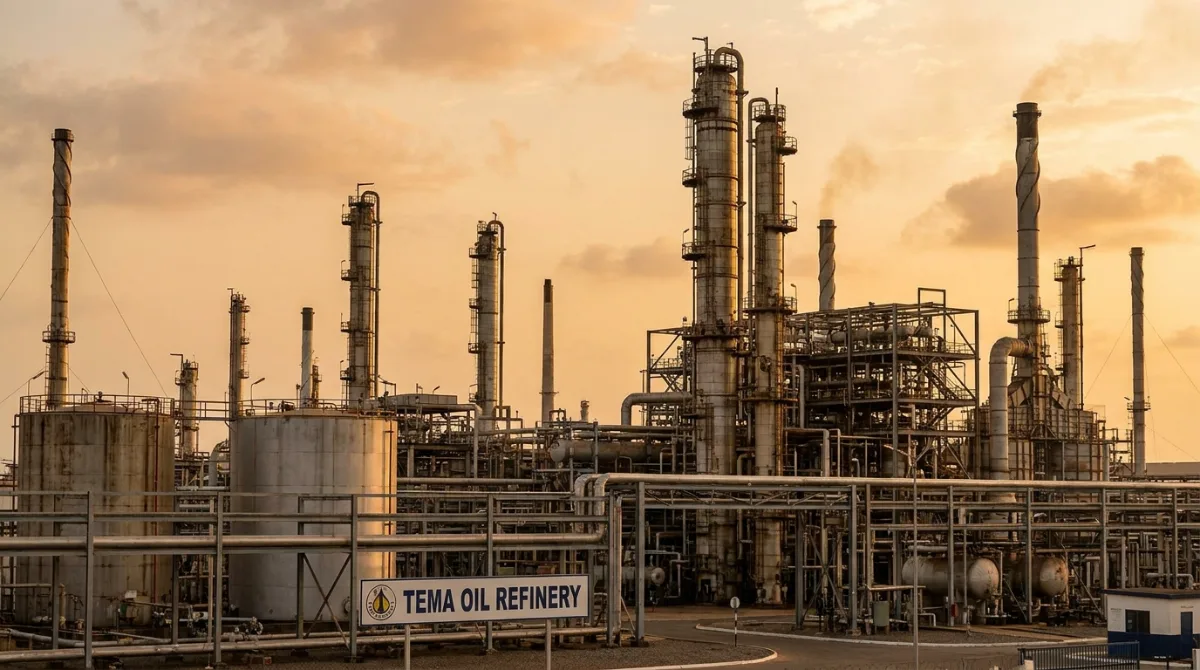
President John Dramani Mahama wants Ghana's Tema Oil Refinery processing 100,000 barrels of crude oil every single day — and he is put the country's energy minister on the clock to make it happen.
On Saturday, August 1, Mahama issued a formal directive to Minister for Energy and Green Transition John Abdulai Jinapor, alongside the Board and management of the Tema Oil Refinery (TOR), to develop a strategic roadmap toward that production target. The announcement came during the commissioning of the refurbished refinery at the Tema Industrial Enclave, a ceremony that doubled as a statement of national industrial ambition.
More Than a Refurbishment
The event was not just ceremonial. TOR marked a concrete operational milestone on the same day — one million barrels of locally produced Jubilee Field Medium Sweet Crude successfully processed into finished petroleum products. That is real output, not a projection.
But Mahama was quick to frame the refurbishment as a starting point, not the finish line. He made clear the government's ambitions stretch well beyond getting TOR back online.
"Our vision for Tema Oil Refinery extends far beyond the successful refurbishment of these facilities. We do not intend merely to keep TOR operating. We intend to make it more competitive. We intend to make it more efficient, and we intend to make it more commercially viable."
He described the rehabilitation work completed so far — including the Crude Distillation Unit, the restored Residual Fluid Catalytic Cracking Unit, the newly installed F-61 crude heater, and the return of Boiler No. 8 to service — as evidence of renewed confidence in Ghana's industrial capacity.
West Africa's Refining Hub: The Bigger Play
Mahama's vision goes regional. He announced plans to upgrade TOR's Single Buoy Mooring (SBM) infrastructure to improve crude offloading efficiency, and outlined a goal that is hard to miss in its scope.
"Our work does not end with restoring TOR. Our vision is to transform Ghana into West Africa's leading petroleum refinery, storage and logistics hub, adding value to our natural resources, creating jobs, strengthening energy security and driving industrial growth."
The refinery, he said, will be central to delivering the government's 24-Hour Economy policy and the Accelerated Export Development Programme — supporting manufacturing, industrial production, and exports under the African Continental Free Trade Area (AfCFTA).
24-Hour Operations Already Underway
TOR Managing Director Edmond Kombat confirmed during the event that the refinery is already running on a 24-hour basis — something Mahama publicly welcomed. It is a notable operational shift that aligns directly with the government's round-the-clock economy push.
Mahama also disclosed that tax relief and other incentives for businesses operating outside standard hours would be rolled out soon, though specific timelines were not provided at the commissioning event.
Shielding TOR From Political Interference
One of the more pointed announcements concerned governance. Mahama said institutional reforms are planned specifically to insulate TOR from political interference — a recurring problem that has historically disrupted continuity at state-owned enterprises in Ghana. The goal, he stressed, is long-term operational stability, not just short-term optics tied to any particular administration.
For context on how energy infrastructure intersects with Ghana's broader technology and industrial future, TOR's expansion sits at the centre of what could be a multi-decade economic pivot — if the roadmap Jinapor's ministry delivers is both ambitious and credible.
The refinery's next chapter is being written at Tema. Whether it reaches 100,000 barrels a day will depend on how fast that roadmap moves from directive to delivery.