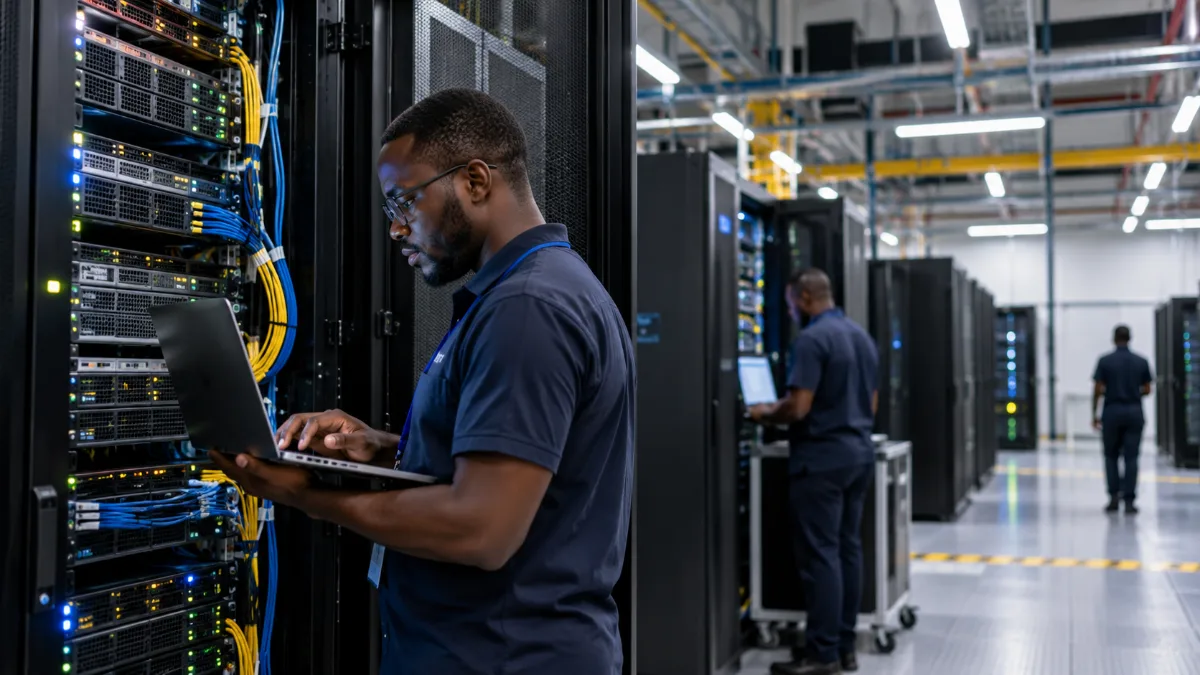
South African infrastructure investment firm INFRAGORA Global Capital has announced plans to build two AI-ready data centres in Nigeria, backed by a proposed investment of between $650 million and $1 billion — placing the project among the largest planned data centre commitments in the country's history.
Construction is targeted to begin by the second quarter of 2027, pending financial close. The facilities will form part of INFRAGORA's AFRIDATA data centre platform, and are currently in the final stages of detailed assessment and design, according to Kiel Odiogo, INFRAGORA's senior managing director.
"We cannot disclose specific funding secured due to confidentiality obligations," Odiogo told TechCabal, adding that capital mobilisation was on track.
The project is framed as the flagship of a continental data infrastructure platform INFRAGORA values at $3 billion to more than $5 billion. Beyond Nigeria, the firm plans to develop between 300MW and 550MW of additional data centre capacity across Ghana, Côte d'Ivoire, Kenya, Tanzania, Angola, South Africa, and Egypt.
What is Driving the Push
Nigeria's appetite for computing infrastructure has been growing fast, driven by demand for AI workloads, cloud services, and enterprise data processing. INFRAGORA's two proposed Nigerian facilities are not the only major projects in the pipeline — Kasi Cloud is also developing a 100-megawatt data centre backed by an estimated $250 million in initial capitalisation.
The AI infrastructure race across Africa is intensifying, with Nigeria emerging as a top destination given its population size, tech ecosystem, and digital economy trajectory. INFRAGORA's project would deliver an initial capacity of 80–100 megawatts, with the infrastructure designed to scale.
The US Trade and Development Agency (USTDA) is funding a feasibility study for the project, covering technical and financial assessments of both facilities, including their capacity to handle AI workloads. Odiogo confirmed the agency's involvement is also designed to open doors for American technology firms supplying AI software, cloud infrastructure, computing hardware, networking equipment, and cybersecurity solutions.
The Power Problem
Nigeria's chronic electricity challenges sit at the heart of the project's execution risk. Without reliable power, even the most well-funded data centre is dead in the water.
INFRAGORA says it is building its own solution. The firm plans to develop a 160–200 megawatt independent power plant using a combination of gas and renewable energy, supported by battery storage. Electricity supply will be managed through Ocha Energy, INFRAGORA's sister energy platform, with long-term power purchase agreements intended to keep costs stable.
"INFRAGORA's strategy is to have independent power deployment accompanying each AFRIDATA project roll-out across the continent under the Ocha green energy platform," Odiogo said. "This will be supported by a robust battery storage backbone."
Excess electricity generated beyond the data centres' own needs could be sold to other infrastructure providers, energy merchants, or fed into the national grid where feasible. That built-in power strategy sets this project apart from data centre developments that rely on Nigeria's strained public grid.
Financing Still an Open Question
Despite the scale of the announcement, key financial details remain undisclosed. INFRAGORA has not named its financial backers, citing confidentiality obligations, though Odiogo stated the project has attracted commitments from regional and global institutional investors.
Financial close — the point at which funding is formally locked in — must happen before construction begins. That remains the single biggest variable between a bold announcement and actual groundbreaking in 2027. The broader picture for data centre investment across Africa suggests appetite is real, but execution timelines in the region have historically been optimistic.
What INFRAGORA is attempting — bundling power generation, battery storage, and hyperscale data infrastructure into a single continental rollout — is ambitious by any standard. Whether it translates into concrete in the ground by Q2 2027 will be Nigeria's next big infrastructure story to watch.