Nearly seven in ten Ghanaians say data is too expensive — and a new report has identified exactly why that problem is not going away anytime soon.
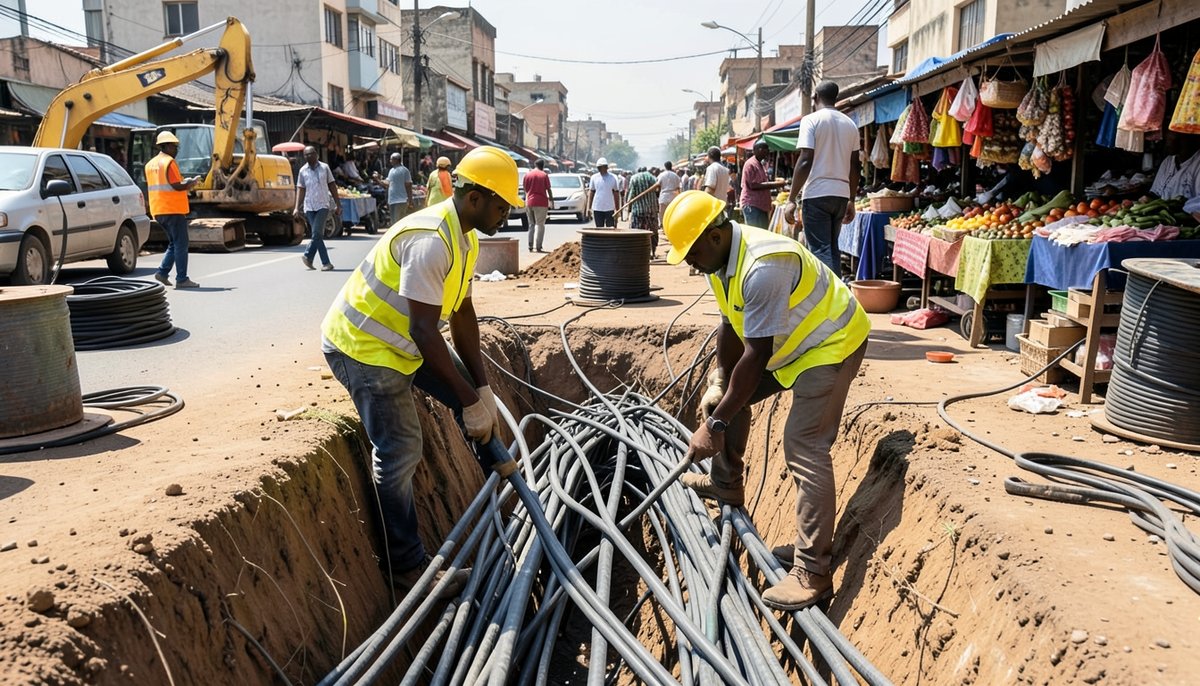
The Ghana Digital Economy Outlook 2026 has found that the absence of a legally binding fibre-sharing framework is a primary driver of high broadband costs across the country. Without a regulatory mandate forcing operators to share passive infrastructure like ducts and poles, every provider builds its own separate network — a duplication that inflates capital expenditure and ultimately gets passed on to consumers.
The report was commissioned by the Ministry of Communication, Digital Technology and Innovations and the German development agency GIZ, with technical support from MGA Consulting Ghana Ltd. It identifies a binding fibre-sharing framework under the National Communications Authority (NCA) as the single most urgent of six priority actions needed to close Ghana's digital infrastructure gaps.
"Infrastructure growth is currently hindered by the absence of a formal, legally binding fiber-sharing policy. Without a regulatory mandate to share passive assets like ducts and poles, operators face excessive capital expenditures and create redundant networks."
The consequences of that redundancy land hardest on low-income households. International benchmarks generally treat broadband as affordable when one gigabyte of data costs no more than two per cent of average monthly income. For many Ghanaians, that threshold is still far out of reach.
Telcos Are Feeling the Squeeze Too
It is not just consumers under pressure. The report found that 46.2 per cent of service providers identified financial constraints as a major obstacle to network expansion — a burden compounded by infrastructure deployment costs, taxes, and energy prices. When operators cannot share the physical cost of laying fibre, everyone's margins shrink and expansion slows.
The report makes a pointed argument about where Ghana's digital divide actually sits today. Device ownership is no longer the central problem — connectivity quality and affordability are.
"The digital divide is therefore less about owning a digital device and more about the connectivity quality, affordability, and ecosystem investment gaps."
That reading tracks with what Ghanaians themselves are saying. In the same survey, 53.7 per cent of respondents said government should prioritise infrastructure investment — a clear signal that the public understands the bottleneck, even if policy has not caught up.
Proof That Sharing Works
The report does not just diagnose the problem — it points to working examples already operating in Ghana. The Eastern Corridor fibre network uses an open-access model that lets multiple telecom operators extend connectivity into areas that private providers had previously written off as commercially unviable. That is exactly the kind of shared infrastructure the report argues should become standard.
The Ghana Investment Fund for Electronic Communications (GIFEC) is applying a similar logic in rural communities, deploying solar-powered base stations that competing operators can share, stretching connectivity further at lower cost per provider.
Both models demonstrate that infrastructure sharing is not a theoretical fix — it is already delivering results inside Ghana's own borders. The question is whether the NCA will establish the regulatory teeth to make it the rule rather than the exception.
Ghana's broader digital economy ambitions — from e-government to fintech growth — rest on a foundation of affordable, wide-reaching connectivity. Until a binding fibre-sharing policy is in place, that foundation stays shaky, and the cost of being connected in Ghana stays unnecessarily high.