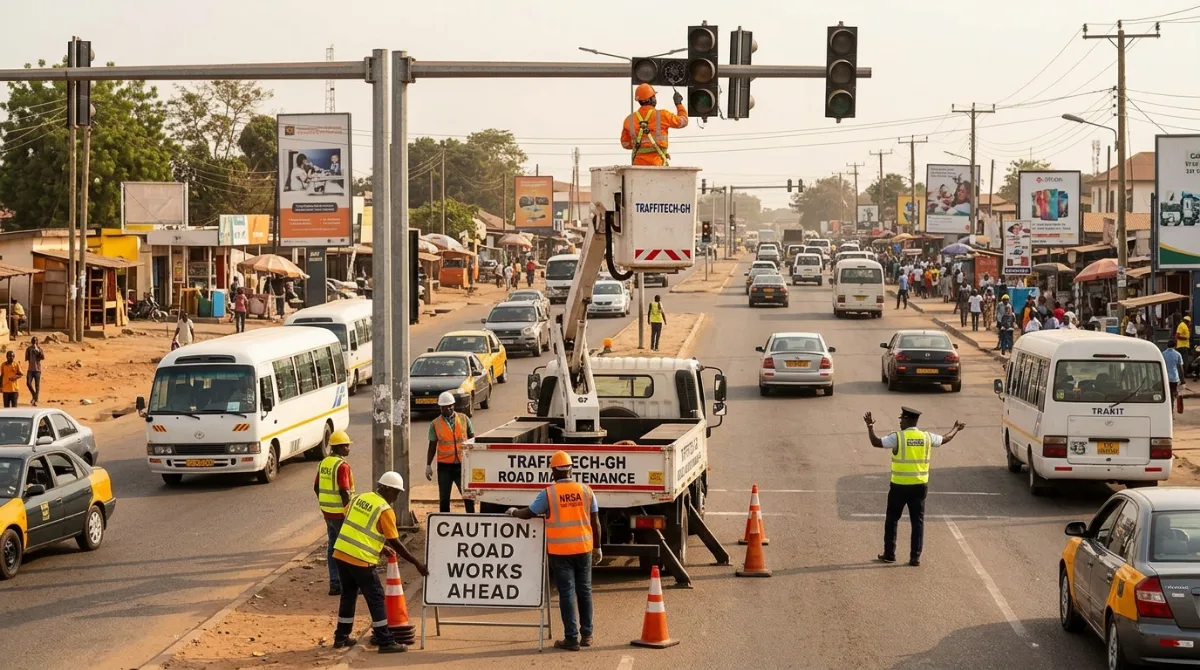
Ghana's National Road Safety Authority has put road agencies on notice: fix broken traffic lights, replace missing road signs, and re-mark faded road lines — or face formal compliance action. The directive, issued in a letter dated November 3, 2026, comes just days after the NRSA launched its technology-driven enforcement platform, TraffiTech-GH, on November 1, 2026.
The timing is deliberate. TraffiTech-GH is designed to monitor and enforce traffic regulations using digital systems, but the NRSA has flagged a critical problem: the road infrastructure it depends on is in poor shape across multiple jurisdictions. Without functional traffic lights, legible signage, and visible road markings, the system simply cannot do what it was built to do.
What the Directive Says
The NRSA's November 3 letter identifies three main deficiencies that agencies must address immediately: malfunctioning traffic lights, missing or damaged road signs, and faded or completely absent road markings. The Authority described these gaps as posing significant risks to motorists, pedestrians, and other road users, while also eroding public confidence in the agencies responsible for road maintenance.
Agencies have been told to prioritise remedial works at high-risk locations, provide clear timelines for completing repairs, and ensure all road furniture is functional and fully compliant — with no further delay.
The NRSA has warned that institutions which do not comply could receive formal compliance notices under the Authority's mandate. Monitoring will be handled by the Authority's Regulations, Inspections and Compliance Directorate.
A System Built on Infrastructure That Is not Ready
The concern is not just bureaucratic. TraffiTech-GH, as the NRSA describes it, is a technology-driven enforcement and monitoring system — which means its effectiveness is directly tied to what is on the ground. Faulty traffic lights create ambiguity about right-of-way; missing signs leave drivers without guidance; faded road markings make lane enforcement nearly impossible. Any one of these could compromise enforcement. All three together risk rendering the entire system ineffective.
This kind of challenge — where digital enforcement tools outpace physical infrastructure readiness — is a recurring tension in African road safety efforts, and it connects to broader questions about how technology is deployed in public infrastructure contexts across the continent.
Background: Concerns Raised Before Launch
The directive did not emerge from nowhere. The NRSA noted it had received persistent reports and observations about the state of road furniture well before issuing the letter. Concerns were also raised formally at a recent Breakfast Meeting on Road Safety, held under the auspices of the Minister for Transport. That meeting appears to have accelerated the Authority's decision to put the directive in writing.
The NRSA was direct in its reasoning: all government agencies are required to support government programmes and ensure their successful implementation. TraffiTech-GH, the Authority stressed, depends largely on the readiness of road infrastructure under the responsibility of the relevant institutions.
Whether the agencies meet their deadlines — and how quickly the NRSA's Compliance Directorate follows up — will likely determine whether TraffiTech-GH delivers on its promise or stalls before it gains traction. For now, Ghana's roads need to catch up to the technology meant to police them.