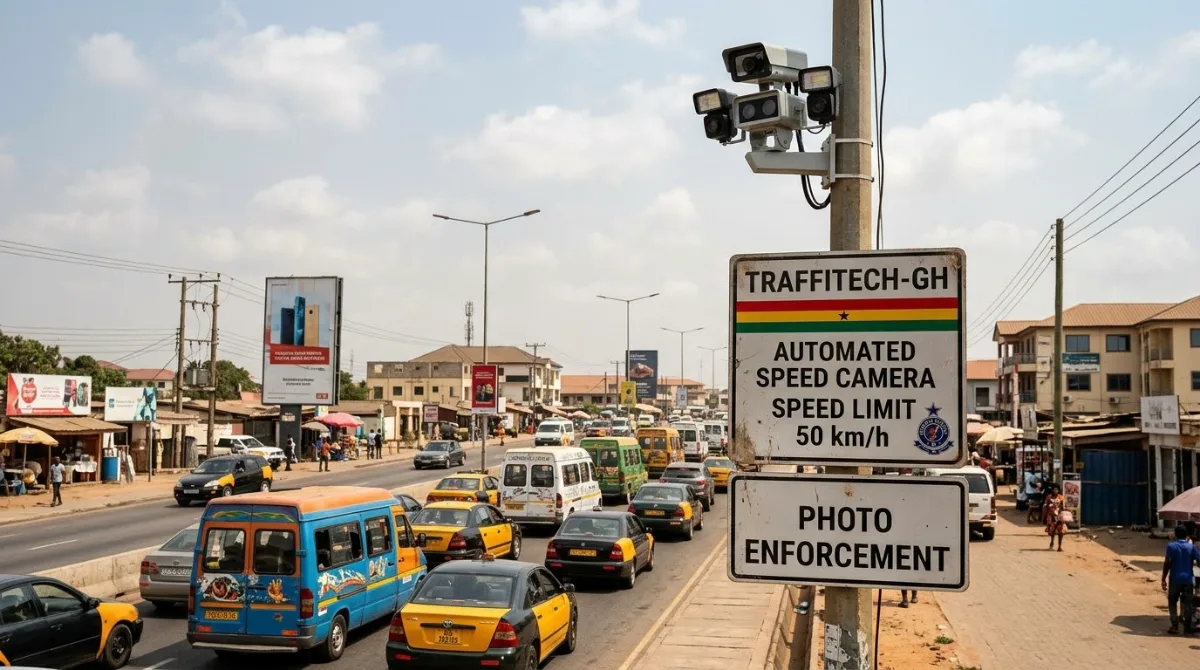
Ghana's new automated traffic enforcement system, TraffiTech-GH, is drawing sharp questions — not about whether it works, but about who it is really working for.
Former COCOBOD Director of Public Affairs, Fiifi Boafo, has publicly challenged the government's decision to claim 60 per cent of all fines collected under the system, while private investors who funded the infrastructure receive just 40 per cent. Speaking on JoyNews' Newsfile programme, Boafo argued that this arrangement raises serious questions about whether TraffiTech-GH is genuinely about road safety — or simply a new revenue stream for the state.
"I think it is important for us to answer these questions because if you look at the conversation that has taken place, it gives you a reason to wonder whether or not it is genuinely a way of raising money for government and not to prevent people from doing the wrong thing or accident," Boafo said.
A Revenue Split That Does not Add Up
At the heart of Boafo's concern is what he sees as a fundamental contradiction. The government did not fund TraffiTech-GH's setup — private sector investors did. Yet the state walks away with the larger share of whatever fines the system generates from traffic offenders.
"We are told that the people who are making an investment into this project will take 40% off the penalties that will accrue from people who will fall foul of the law. What is the 60% going to government for? Is it to raise money for government?" — Fiifi Boafo
It is a pointed question. In comparable jurisdictions, Boafo noted, governments sometimes directly finance such traffic enforcement systems so they do not pass the investment burden onto motorists through penalties. Ghana's arrangement, by contrast, leans on private capital but lets the state collect the bigger cut.
"Are We Not Already Overburdened?"
Boafo was careful to say he has no objection to private sector involvement in traffic enforcement. His concern is specifically about the government's entitlement to the majority share without a clear public explanation of what that money is for.
He raised the burden question directly — Ghanaians are already navigating a difficult economic environment, and an enforcement system that functions more like a tax than a deterrent could add yet another layer of financial pressure.
"I have no problem with private participation, but the question is, why is government taking 60% of the money? What is it for? Are we not already overburdened? Must government now come to us and demand more?" — Fiifi Boafo
That framing matters. If TraffiTech-GH is primarily a road safety tool, fines should ideally function as a last resort — a deterrent that generates little revenue because most drivers are complying. If the system is instead designed to maximise fine collection, the incentive structure points in a very different direction.
Transparency, Not Opposition
Boafo's position is not that TraffiTech-GH is a bad idea. He acknowledged that reducing road accidents and preventing avoidable deaths are commendable goals — Ghana's road fatality numbers make that case on their own. His demand is for honesty about the objectives.
He said if the 60 per cent government share is meant to cover the system's ongoing operation and maintenance, that rationale should be communicated clearly to the public. Transparency around digital enforcement tools is essential for public trust, especially when those tools carry financial penalties.
What Boafo is really asking is a straightforward governance question: when a system is billed as a public safety initiative, the public deserves to know exactly how the money flows — and why.
The government has not yet publicly responded to the specific revenue-sharing concerns he raised on Newsfile.