Ghana's new automated speed enforcement system, TraffiTech-GH, launched on Sunday, November 1 — and within hours, police were recording speeding violations in the thousands. Some drivers were clocked at above 130km/h on roads with a 50km/h limit.
ACP Alexander Kwaku Obeng, Director of Education, Research and Training at the Motor Traffic and Transport Department (MTTD), disclosed the figures on Joy FM's Super Morning Show the following Monday. He declined to give an exact number but was candid about the scale.
"But yesterday, we were worried because it was in the thousands," ACP Obeng said of Sunday's figures.
Hotspots identified on day one included Mahama Road from Boundary Road, Boteyman from School Junction towards the motorway, and the Mallam–SCC–Kokrobite Junction road. Cameras also caught offenders on the stretch from the toll booth police station towards Kasoa, through Amanfrom and over the Kasoa flyover.
A Deliberate Weekend Start
The choice to go live on a Sunday was not accidental. ACP Obeng said police deliberately launched on a weekend to observe how drivers behave when fewer officers are on the road. Many, he noted, stayed within limits — but thousands clearly did not.
Boteyman drew particular concern. ACP Obeng flagged it as a stretch where police have recorded many fatal crashes, warning drivers not to treat flat city roads as highways.
Speeding, he told the Daily Graphic ahead of the launch, accounts for 60 to 62 per cent of serious injuries and deaths in road crashes. During TraffiTech-GH's warm-up phase, over 200,000 electronic caution notices were issued. Combined with public education, he credited those measures with a 9.4 per cent drop in crashes and a 7.82 per cent fall in deaths in September 2026 compared to September 2025.
The system is now active in Accra, Tema, Kumasi, Takoradi, Sunyani, Tamale, Koforidua and Ho, using cameras mounted both on patrol vehicles and on tripods. Vehicle owners who receive a notice have 14 days to pay or contest it — a process that ties into Ghana's broader push toward tech-driven public safety infrastructure.
Transport Unions Allege Extortion, Call Strike
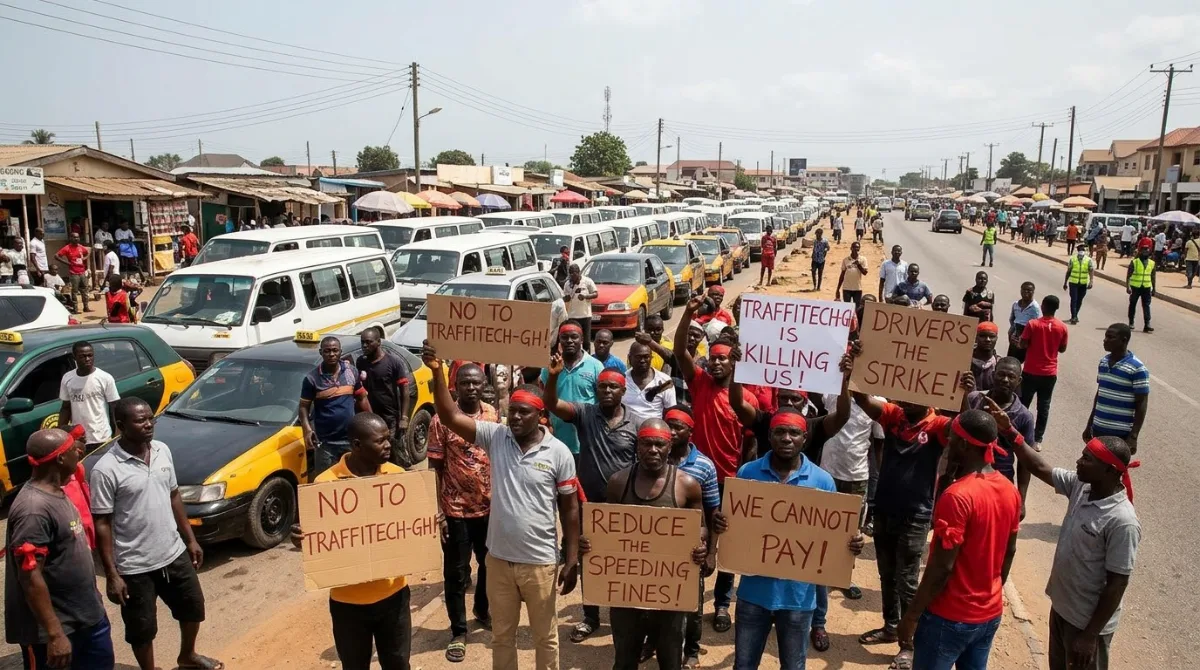
Even before the cameras switched on, commercial transport groups had gone on the offensive. A statement dated October 31, signed by the GPRTU of TUC, the Commercial Transport Operators of Ghana, and the Concerned Drivers Association of Ghana, accused the government of planning to profit from drivers' fines.
"This shows clearly that the government wants to use TRAFFITECH-GH to extort money from innocent drivers while leaving traders to take over our legally designated spaces," the statement read.
David Agboado, National PRO of the Concerned Drivers Association, was among the signatories. The groups summed up their position in a pointed declaration: "You cannot digitalise illegality."
Their central grievance is that traders have taken over bus stops at Kaneshie, Circle, Madina, Kasoa and Kejetia, leaving commercial drivers with no legal stopping options — and therefore vulnerable to fines for pulling over in the wrong place. The unions are demanding the government first enforce Regulation 142 of L.I. 2519, which explicitly bans trading at bus stops and on walkways.
Five transport unions escalated the dispute by directing commercial drivers to park their vehicles from Wednesday, November 4, until further notice — a strike that threatens to disrupt commutes across the country's major cities.
MTTD: Do not Mix the Issues
ACP Obeng has pushed back firmly on the unions' framing. Speaking on Adom FM's Dwaso Nsem, he insisted TraffiTech-GH's cameras are focused solely on speed — nothing else.
"We should not mix the issues up," he said. "As for the other offences, we will continue to enforce them manually."
The MTTD's position is clear: the grievances around street trading and bus stop enforcement are real but separate, and they will not slow down the speed camera rollout. Whether that argument satisfies Ghana's commercial transport sector — and the commuters now facing disruption — is another question entirely.
Questions around the system's fairness, its money trail, and the unresolved issue of illegal street trading at bus stops are unlikely to fade. For now, thousands of Ghanaian commuters may wake up Wednesday morning to empty bus stops for a very different reason than speeding cameras.