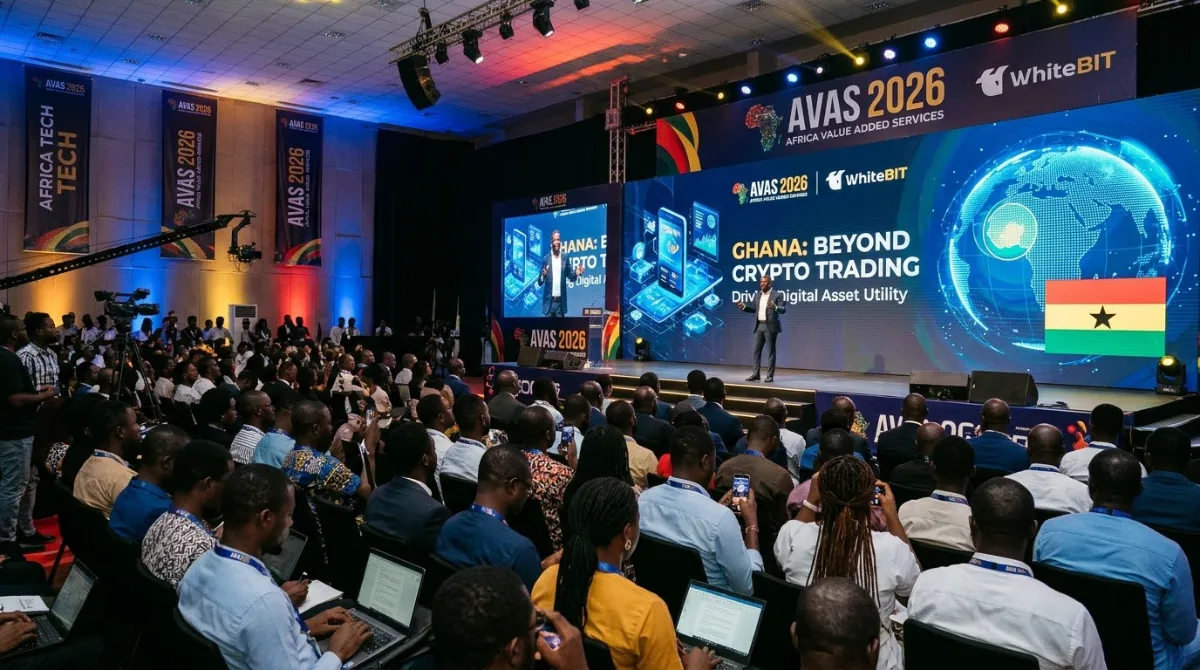
Ghana's crypto economy grew 80% year-on-year to $5.1 billion between July 2025 and June 2026 — but one global exchange is arguing that the country is still only scratching the surface of what digital assets can actually do.
WhiteBIT, a global cryptocurrency exchange and part of the W Group fintech ecosystem, used its headline sponsorship of the AVAS 2026 Summit to push a pointed message: Ghana needs to move from crypto adoption into real-world utility.
Fred Frimpong, WhiteBIT Ghana's Country Manager, addressed the summit and outlined a range of blockchain applications that go well beyond trading — including international payments, real-world asset tokenisation, property ownership verification, and capital markets access.
"Crypto adoption is only the beginning. The real opportunity for Ghana lies in exploring how digital assets can support businesses, expand access to investment, and make financial services more efficient. Achieving this requires not only technology, but also collaboration between industry participants, financial institutions, and regulators." — Fred Frimpong, WhiteBIT Ghana Country Manager
The timing of WhiteBIT's advocacy is not accidental. In March 2026, WhiteBIT Ghana was admitted into the Securities and Exchange Commission's (SEC) virtual asset regulatory sandbox, giving the company a formal seat at the table as Ghana shapes its digital asset framework.
A Market That is Moving Fast
The numbers backing WhiteBIT's interest in Ghana are hard to ignore. According to Chainalysis' 2026 Geography of Cryptocurrency Report, that $5.1 billion figure — itself an 80% jump — was driven by activity across both centralised and decentralised exchanges. The IMF's September 2026 report ranked Ghana as the fifth-largest cryptocurrency market in sub-Saharan Africa, with an estimated 8% to 17% of the population having bought or sold digital assets, and annual transactions sitting at roughly $21 billion.
Zooming out, sub-Saharan Africa's total crypto activity hit $101 billion during the same period — a 13.4% annual increase that makes it the world's fastest-growing region for cryptocurrency. Ghana is a significant piece of that story.
The Gap Between Hype and Utility
Despite the volume, Ghana's digital asset activity is still concentrated in trading and stablecoin usage. Applications like asset tokenisation and institutional blockchain infrastructure remain early-stage — which is precisely the gap Frimpong and WhiteBIT are pointing at.
WhiteBIT itself serves approximately 10 million users globally, while the broader W Group ecosystem — spanning digital asset trading, blockchain infrastructure, payments, and financial services — reaches more than 40 million users across its various businesses.
That scale matters in a market like Ghana, where emerging technology sectors are increasingly competing for institutional and regulatory attention. The question is not whether Ghanaians are interested in crypto — the data answers that clearly. The question is whether the ecosystem can deliver something more lasting than speculative trading gains.
What is Next for Ghana's Regulatory Push
WhiteBIT's admission into the SEC sandbox places it among a small group of exchanges operating under supervised conditions as Ghana builds out its virtual asset rules. That regulatory engagement, combined with AVAS 2026 positioning, signals the company is playing a long game in the market — not just chasing trading volumes.
Frimpong's remarks at the summit land at a moment when Ghana's digital financial infrastructure is under active construction. With the IMF watching, the SEC sandbox live, and $21 billion in annual crypto transactions already flowing, the pressure to build practical, regulated use cases is very real — and exchanges like WhiteBIT are clearly keen to shape what that looks like.