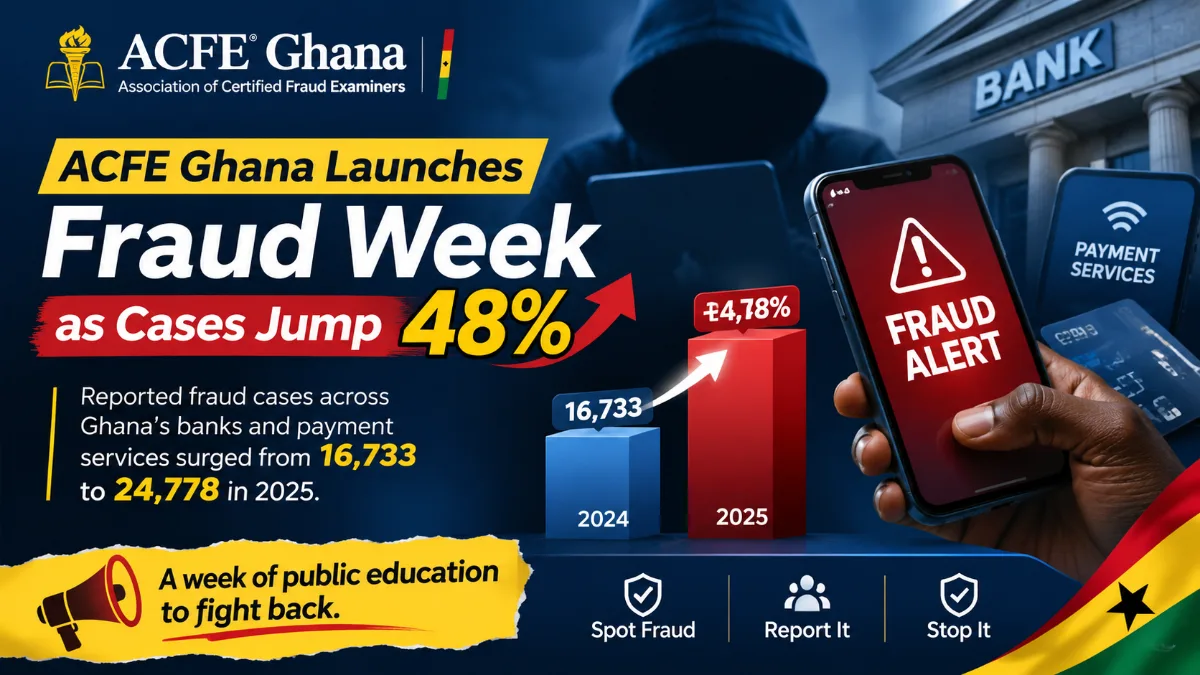
Banks and payment services recorded 24,778 reported fraud cases in 2025 — up from 16,733 the year before — a 48 per cent jump that the Association of Certified Fraud Examiners (ACFE) Ghana Chapter says demands a national response, not just action from investigators and law enforcement.
The ACFE Ghana Chapter launched a week-long public education campaign on Monday, November 16, running under the theme "Building a Fraud-Aware Ghana: Recognise. Verify. Protect. Report." It forms part of the global International Fraud Awareness Week, which runs from November 15 to 21, 2026, though Ghana's activities extend to November 22.
What the Numbers Say
The figures come directly from the Bank of Ghana's 2025 Fraud Report, which covers banks, Specialised Deposit-Taking Institutions and Payment Service Providers. The total value at risk across those sectors rose from GH¢99 million to GH¢101 million, with the Payment Service Provider sector driving much of that growth.
Cyber incidents are compounding the picture. The Cyber Security Authority (CSA) recorded 3,876 cybersecurity incidents between January and July 2026, with online fraud accounting for approximately 47 per cent of those reported cases.
Fraudulent business impersonation online is also adding up fast. Between January 1 and April 26, 2026, the CSA received 54 cases of fraudulent online business impersonation, resulting in reported losses of GH¢266,195.
AI Is Making Scams Harder to Spot
The ACFE Ghana Chapter has flagged that fraudsters are no longer relying only on old tricks. They are increasingly using artificial intelligence to generate convincing voices, images and videos that impersonate trusted individuals — making phishing, romance scams, deepfakes and Business Email Compromise harder for ordinary people to detect.
Other schemes on the rise include account takeover, mobile money fraud, fake investment offers, identity theft, and fraudulent job and scholarship advertisements. The Chapter's message to the public is blunt: "STOP. VERIFY. THINK BEFORE YOU PAY."
The Chapter warns that fraud prevention should not be left solely to investigators, auditors, financial institutions and law enforcement — it requires government, businesses, regulators and individuals all working together.
Specific advice includes never sharing PINs, passwords, One-Time Passwords or card security details, and always independently verifying payment requests or any changes to supplier bank details through trusted channels.
A Full Week of Sessions and Events
The campaign kicked off with media engagements and a webinar on phishing, deepfakes and social engineering. Six more webinars follow throughout the week, running from 5:30pm to 7:30pm.
Topics include "Account Takeover and Digital Payment Fraud in Ghana", "The New Face of Fraud: AI, Deepfakes and Digital Impersonation" and "Follow the Money: How Financial Fraud Happens in Ghana". Other sessions will cover workplace vulnerabilities and practical fraud scenario exercises, relevant to anyone concerned about online safety.
On Saturday, November 21 at 6:30am, the Chapter will hold a fraud awareness health walk at McCarthy Hill in Accra, open to professionals, businesses and families. The week closes on Sunday, November 22 with a fraud awareness church service at Accra Ridge Church at 10:00am, followed by a webinar on 20 fraud techniques Ghanaians should know in 2026.
Who Needs to Act
The ACFE Ghana Chapter is calling on businesses to strengthen internal controls and employee awareness, on financial institutions to improve fraud detection and customer protection, and on public institutions to reinforce accountability. Parents are also urged to educate young people about online fraud.
The global ACFE, which has more than 100,000 members worldwide, estimates through its Occupational Fraud 2026: A Report to the Nations that organisations lose approximately five per cent of their annual revenue to fraud. For Ghana, that benchmark makes the 48 per cent spike in reported cases all the more urgent.