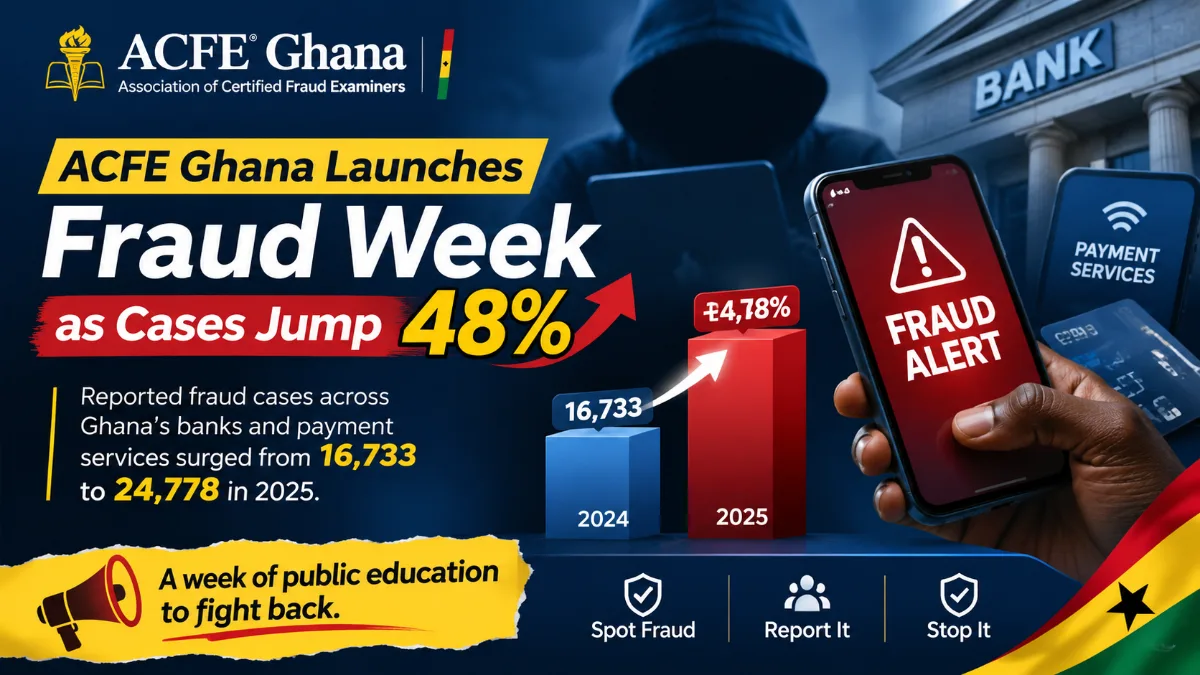
Ghana's digital financial sector is growing fast — and so are the threats targeting it. Academic City University, the Bank of Ghana (BoG), and the Institute of ICT Professionals Ghana (IIPGH) have jointly called for deeper collaboration among financial institutions, technology companies, and academia to lock down the country's expanding digital finance ecosystem.
The call came out of a Cybersecurity in FinTech Roundtable held as part of Ghana's 2026 National Cyber Security Awareness Month. The event brought together regulators, fintech professionals, academics, and cybersecurity experts to examine emerging threats and map out practical steps for securing digital finance without stalling innovation.
Trust Is the Real Stakes
Mr. Eric Afanu, Head of the Offensive and Defensive Unit at the Bank of Ghana, put the human cost of fraud in plain terms. He warned that when ordinary Ghanaians lose money to digital fraud and cannot get it back, they do not just lose savings — they lose faith in digital finance entirely.
"If a market trader loses her savings through a wallet takeover and cannot recover the money, she may lose confidence in digital finance as a whole," Afanu stated, adding that security, trust and institutional resilience are the foundations on which sustainable innovation is built.
Afanu acknowledged that mobile money and digital banking had expanded financial inclusion across Ghana, but said these same platforms had opened new doors for fraudsters — particularly through impersonation and manipulation tactics. He urged financial institutions to overhaul their complaint-handling systems so fraud victims get timely, fair support.
He also pushed for stricter oversight of third-party technology and cloud service providers, stressing that outsourcing a service does not outsource accountability. On artificial intelligence, Afanu called for clear governance frameworks, regular testing, and meaningful human oversight to prevent AI from being weaponised for sophisticated fraud and impersonation schemes.
Sustained public education — especially in local languages, targeting market traders, farmers, and older Ghanaians — is what he described as critical right now.
Innovation and Security Must Move Together
Dr. Muhammad Suraj, Director of Graduate and Continuous Education at Academic City University, explained that the decision to merge the university's annual fintech conference with the cybersecurity roundtable was deliberate. The goal was to reflect just how inseparable financial innovation and digital security have become.
He noted that while digital transactions look seamless on the surface, complex backend systems run continuously to keep them working — and those systems expose users and providers alike to risks including account takeovers, cyberattacks, system disruptions, and third-party vulnerabilities.
Dr. Suraj described AI as a "double-edged sword": a tool that bad actors can exploit to launch sophisticated attacks, but also one that can strengthen intrusion detection, anti-malware systems, and Security Operations Centre (SOC) operations when used responsibly.
Social Engineering Remains a Critical Gap
Dr. Mark Tampuri, Head of the Department of Business and Entrepreneurship at Academic City University, pointed to social engineering as a continuing threat. He said fraudsters continue to exploit gaps in financial literacy, manipulating victims through deceptive conversations to extract sensitive information.
Tampuri urged regulators to enforce clear policies that hold financial institutions accountable, while pushing service providers to invest in stronger security systems and customer education. He also called on consumers themselves to stay vigilant about protecting their personal and financial data — a point that connects directly to online safety practices.
A Shared Responsibility
Richard Kafui Amanfu, Executive Director of IIPGH, made the message simple: convenience should never replace caution. He urged the public to pause and verify before clicking, sharing information, approving transactions, or transferring money.
Amanfu said every fraud case, SIM-swap attack, and compromised account chips away at public trust in Ghana's digital financial ecosystem. He called on banks, telecoms, technology firms, regulators, and industry bodies to close ranks — stressing that protecting Ghanaians online is a shared, not individual, responsibility.