This week in African tech, Ghana dominated the conversation — and not by accident. Between a blockbuster network investment pledge, a national AI centre announcement buried in a budget speech, a space agency in the works, and a central bank swinging at unlicensed loan apps, Accra is clearly trying to signal that it is serious about its digital future. The harder question, as one local outlet put it bluntly, is whether any of this actually gets built.
MTN Ghana Drops a $1.1 Billion Network Pledge on Its 30th Birthday
MTN Ghana used its 30th anniversary dinner to announce it will spend US$1.1 billion over three years on network sites, fibre infrastructure, and 5G rollout. The commitment includes a target of connecting one million homes to fibre broadband — an ambition that would represent a meaningful shift in how Ghanaians access the internet at home.
Thirty years in, MTN Ghana is not a scrappy startup making hopeful promises. This is a company with the balance sheet and the operational history to actually execute. The 5G timeline and the fibre target are still aggressive, but if even half of this lands on schedule, Ghana's connectivity story changes significantly.
Why it matters: A $1.1bn private sector commitment to digital infrastructure is exactly the kind of investment that makes government digital agendas credible. Without the pipes, none of the AI centres or coding programmes mean much.
Ghana's 2027 Budget Promises a $300m AI Centre and Rural 4G
Finance Minister Cassiel Ato Forson's 2027 Budget Statement included a commitment to spend US$300 million on a national AI centre alongside an expansion of rural 4G coverage. The government also allocated GH¢45 million specifically for rural telephony expansion.
A national AI centre is a bold line item. Done right — with genuine research capacity, industry partnerships, and a mandate to solve local problems — it could anchor Ghana as a serious player in African AI development. Done wrong, it becomes an expensive building with a few imported servers and a ribbon-cutting ceremony.
"Ghana will spend US$300m on a national AI centre and rural 4G, Budget says" — 3News
Why it matters: Budget line items are not the same as delivered infrastructure. But the direction of travel matters — a government that is at least writing these numbers into its fiscal plan is one that can be held accountable for them. If you are tracking how African governments are approaching AI investment, Ghana is now firmly on that map.
Mahama's Tech Promises Are Still Mostly on Paper
TechLabari published a sharp accountability piece this week, noting that nearly two years into President Mahama's administration, the bulk of his flagship tech commitments remain undelivered. The E-Levy is gone and data bundle sizes have improved, but the national coding programme is well behind schedule, school Wi-Fi, a fintech fund and regional digital centres have little to show.
It is a useful corrective. Ghana has a real pattern of ambitious announcements that do not survive contact with implementation.
Why it matters: Voters and investors both need to know the difference between a government that builds things and one that announces things. Right now, the evidence leans toward the latter. The MTN investment above is private money — and that distinction is worth keeping in mind as you read every budget line this week.
Bank of Ghana Names 19 Unlicensed Loan Apps — SikaPadi Among Them
The Bank of Ghana issued a formal public warning this week against 19 digital loan applications it says are operating without a licence or regulatory authorisation. The list includes apps named SikaPadi and Cedi Trust, and the central bank's notice was signed directly by its Secretary, Aimee Vyda Quashie — signalling this was not a casual advisory.
The fact that the BoG is naming names rather than issuing vague warnings is the right call.
If you have used or know someone using an unfamiliar loan app in Ghana, cross-reference against the BoG list. Understanding how to spot predatory fintech is becoming a basic financial literacy requirement — our guide on digital security and financial scams covers the warning signs worth knowing.
Mobile Money Moved Nearly GH¢5 Trillion in Ten Months
Bank of Ghana data released this week showed that mobile money transactions across Ghana's networks came close to GH¢5 trillion in just the first ten months. That is not a typo. The sheer volume of economic activity now flowing through mobile wallets rather than bank branches tells you everything about where financial infrastructure actually lives for most Ghanaians.
This number reframes every conversation about fintech in West Africa. Mobile money is not an alternative to banking anymore — in Ghana, it effectively is the banking system for a large portion of the population. That carries enormous responsibility for the telecoms and fintechs running these networks, and enormous regulatory responsibility for the BoG.
Why it matters: When you see numbers at this scale, the conversation has to shift from "how do we grow mobile money" to "how do we make sure this critical infrastructure is resilient, secure, and fair." Banks are now touting GhanaPay as a fee-free alternative to mobile money, and that competition is healthy.
Ghana Eyes a Space Agency to Build Local Geospatial Capacity
Ghana is moving to establish a dedicated national space agency, with the stated goal of strengthening local geospatial intelligence capabilities.
Geospatial intelligence is not science fiction ambition — it is practical infrastructure for agriculture, disaster response, urban planning, and border management. The question is whether Ghana builds an institution with real technical depth or creates another ministry-level body that outsources all the actual work.
Why it matters: Africa's reliance on external satellite data for critical decisions is a genuine sovereignty issue. Every country that builds local capacity in this area reduces a dependency that has real consequences for food security, climate response, and national planning. Ghana getting serious about this is worth watching closely.
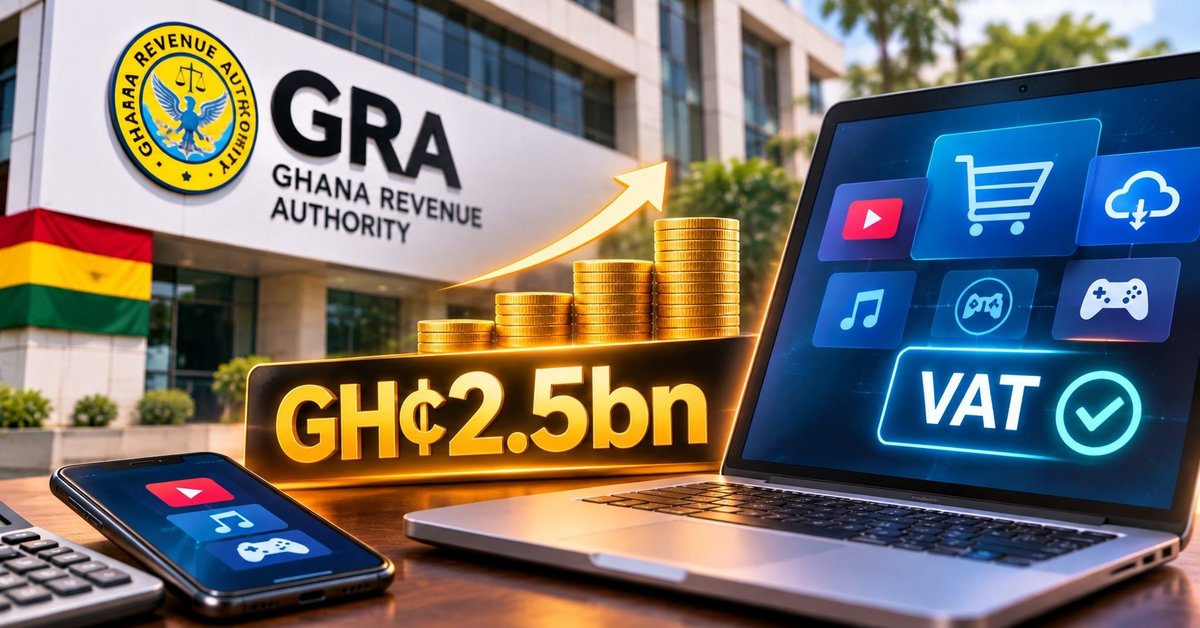
GRA Projects GH¢2.5bn from Real-Time VAT on Foreign Digital Services
Ghana's Ghana Revenue Authority is projecting that applying real-time VAT collection on cross-border digital services could raise GH¢2.5 billion in year one alone.
Ghana joining this push is both overdue and potentially lucrative — if the technical infrastructure for real-time collection actually gets built.
Why it matters: Digital taxation of foreign platforms is one of the most consequential policy debates in African tech right now. Done well, it funds the very infrastructure investments Ghana keeps announcing. Done poorly, it becomes a compliance nightmare that pushes smaller platforms out of the market and raises costs for consumers.
What to Watch Next Week
Keep an eye on whether MTN Ghana's $1.1bn pledge comes with any binding rollout milestones or whether it stays at the level of a headline number. Watch for more African governments responding to Ghana's AI centre announcement with their own budget commitments — this kind of signalling tends to be contagious across the continent. And if the Bank of Ghana follows up its unlicensed loan app warning with actual enforcement action against app stores or payment processors, that will be the real story. Announcements are cheap. Enforcement is not.