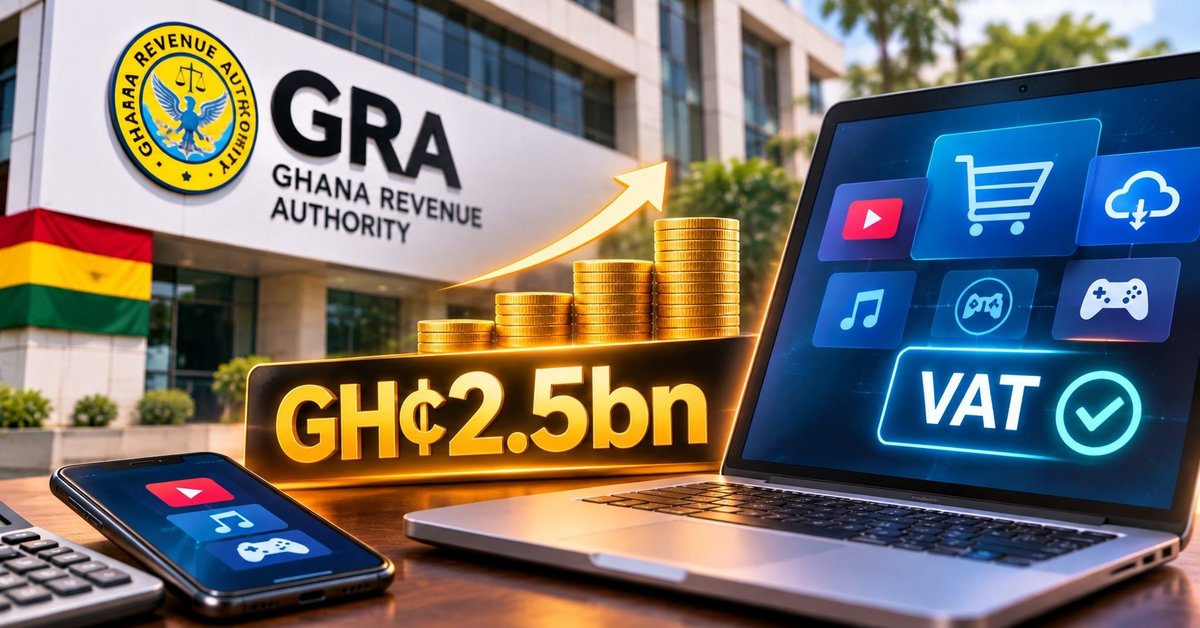
Ghana's tax authority is projecting at least a GH¢2.5 billion windfall in the very first year of its real-time VAT system for cross-border digital services — a figure that underscores just how much revenue has been slipping through the cracks.
Ghana Revenue Authority Commissioner-General Anthony Kwasi Sarpong made the projection at a post-budget forum organised by KPMG and UNDP in Accra on Thursday, confirming that full implementation of the system begins in January 2027.
"Based on our preliminary assessment, we are expecting not less than 2.5 billion cedis from the first year of implementation," Sarpong said.
How the System Works
The GRA introduced the framework on October 15. Under it, banks, mobile money operators, and payment firms deduct VAT at the moment a customer pays — then forward it directly to the Authority. Previously, nonresident suppliers charged and remitted the tax themselves, according to KPMG's briefing on the framework.
It kicks in when the payment instrument is issued in Ghana, the merchant is nonresident, and the service is delivered electronically. In-scope services include streaming and subscriptions, cloud services, online gaming, and online marketplaces. Imported physical goods remain under Customs procedures.
The maths are straightforward: on a GH¢100 service, the customer pays GH¢120 in total. The merchant receives GH¢100, while the payment provider sends the GH¢20 VAT straight to the GRA. Customers receive a text message or email confirming every deduction.
Closing a Leaky Revenue Line
Sarpong described VAT as the tax type with the highest potential, growing at more than 20 per cent, yet simultaneously the weakest line in collections. He noted that nearly 60 per cent of potential VAT revenue is currently going missing.
Taking the tax at the point of payment, he argued, gives the Authority far greater visibility over VAT flows and helps close that gap. Crucially, he stressed there are no new taxes or rates involved — only improved collection through systems and compliance, alongside the fiscal electronic devices programme Parliament approved in July.
Enforcement Already Under Way
The projection did not arrive in a vacuum. Officers found VAT breaches in nearly every shop checked at the Achimota Retail Centre, while staff at China Mall were arrested over E-VAT invoice violations at Ashaiman, Weija, and Nsawam.
Sarpong also defended lifestyle audits — matching tax returns against cars and imports — in a separate interview on Thursday, signalling the Authority is tightening compliance across multiple fronts at once.
His message to ordinary Ghanaians was simple: always ask for a VAT receipt.