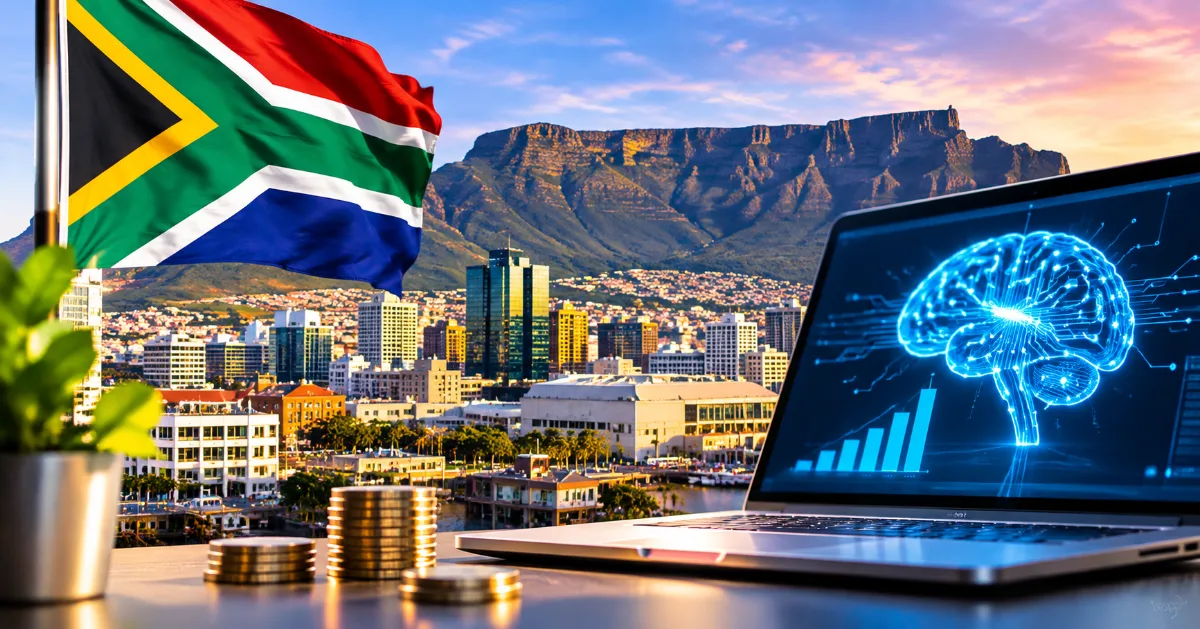
South Africa is putting R100 million — roughly $5.9 million — behind a new AI startup fund, following President Ramaphosa's visit to California earlier this month. The announcement came at the close of a trip designed, in the Presidency's own words, to "learn from countries and institutions at the forefront of AI development."
The fund will draw from both public and private sources. South African tech investor Andile Ngcaba has already committed R25 million ($1.47 million) of the total. In his weekly address to the nation on Monday, Ramaphosa said: "stake our claim in the next technological frontier so that we can more effectively confront our developmental challenges."
A 90-Day Plan With Four Pillars
The fund has triggered a 90-day AI Action Plan built around four priorities: deploying AI to improve public services, attracting investment in AI infrastructure, expanding access to technology and building local AI capabilities, and preparing for the disruptions the technology will bring.
Ramaphosa's concluding speech in the U.S. suggested the R100 million is just a starting point — he framed it as a figure the initiative would "start with", leaving open the possibility of continuous top-ups if results follow.
How Silicon Valley Shaped the Thinking
Abejide Ade-Ibijola, Professor of AI and Applications at South Africa's Wits University, told Forbes Africa that the most important lesson from California was how quickly an idea can become a business.
"My reading of the President's remarks is that the most important lesson from Silicon Valley was how quickly an idea can become a business when researchers, investors and first customers are within reach of one another." — Professor Abejide Ade-Ibijola, Wits University
That proximity model — researcher, investor and first customer within reach of one another — is the professor's central point.
The Reality Check
$5.9 million is a meaningful signal, but the AI industry operates on a very different scale. The sector already deals routinely in billions, and Anthropic's recent IPO pushed its market cap north of $1 trillion.
South African venture capitalist Michael Jordaan put the gap bluntly on X: "Ramaphosa came back from Silicon Valley with a $5.9 million national AI fund. The same day, Andreessen Horowitz put $110m into one robot startup's seed round. A whole country's AI fund is 5% of one Californian first raise."
It is a pointed comparison, and one that underlines why the fund may need future top-ups. The country's broader AI ambitions will need significantly more capital if South Africa wants to move beyond the pilot phase.
Who Gets the Money?
Professor Ade-Ibijola outlined what he believes will be the three practical requirements for startups seeking allocation from the fund: whether the product solves a real problem, whether the team can prove it works, and whether there is a credible first customer ready to test it.
"A township founder with a working prototype and a customer ready to pilot it should be competitive on those merits. That would give practical effect to the President's commitment to reach entrepreneurs in townships, small towns, and rural communities." — Professor Abejide Ade-Ibijola
That framing matters. The professor cites the President's commitment to reach entrepreneurs in townships, small towns, and rural communities, which makes the selection criteria — and how rigorously they are applied — a defining question for the fund's credibility.
Silicon Valley, home to Anthropic and OpenAI among many others, remains the global benchmark. Whether R100 million is enough to spark something comparable in townships, small towns, and rural communities is the bet South Africa is now making.